
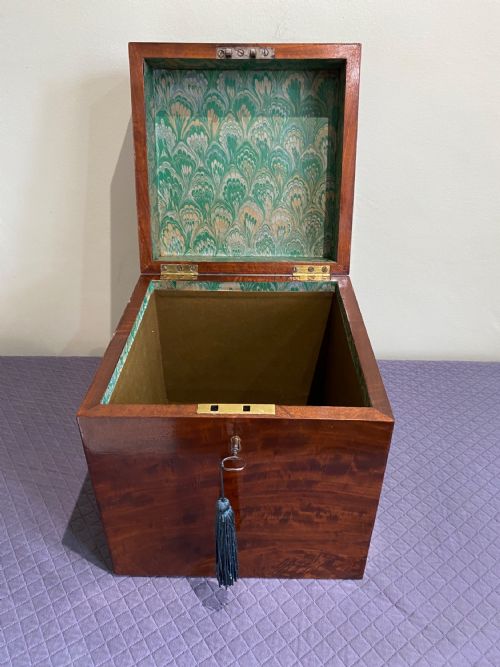
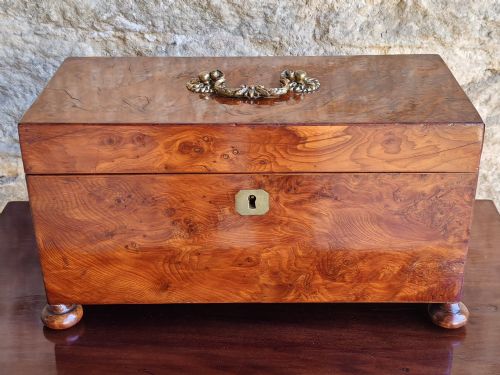

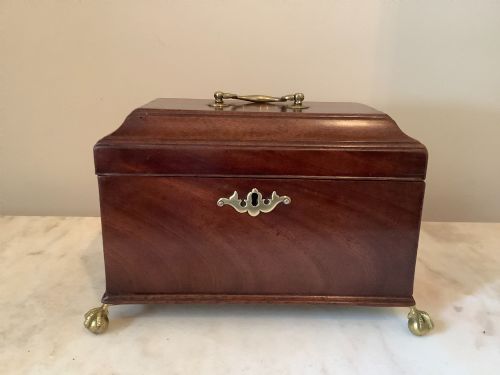
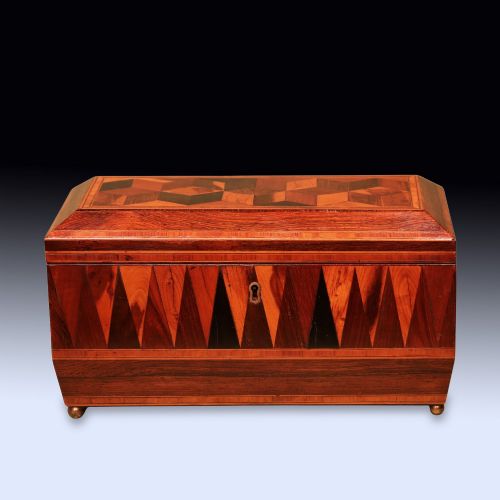


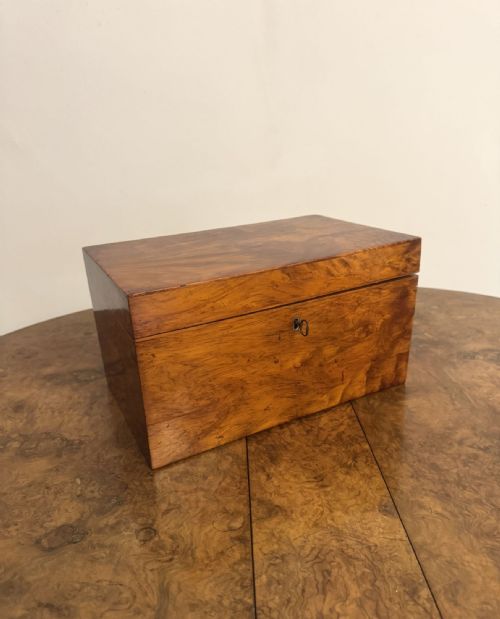


Lockable Wooden Tea Caddy
A lockable wooden tea caddy is a secure storage box for precious leaves, offering tactile history and period craftsmanship for the home.
Lockable Wooden Tea Caddy
A lockable wooden tea caddy is a decorative storage container designed to keep expensive tea leaves secure under lock and key. These pieces span the eighteenth, nineteenth, and twentieth centuries, appearing in Georgian, Regency, and Victorian styles.
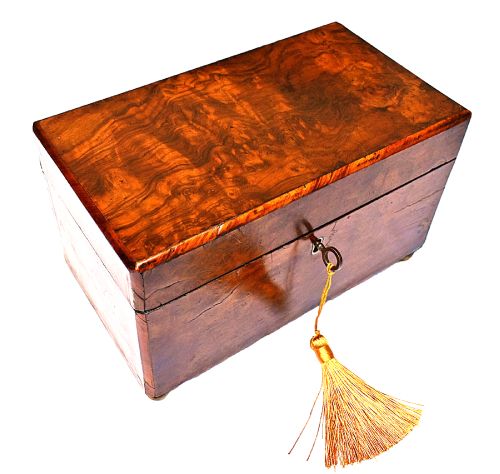
The version most commonly met on this page is a mahogany or rosewood box, often shaped as a sarcophagus or dome, complete with internal compartments and a functional key.
How they were made
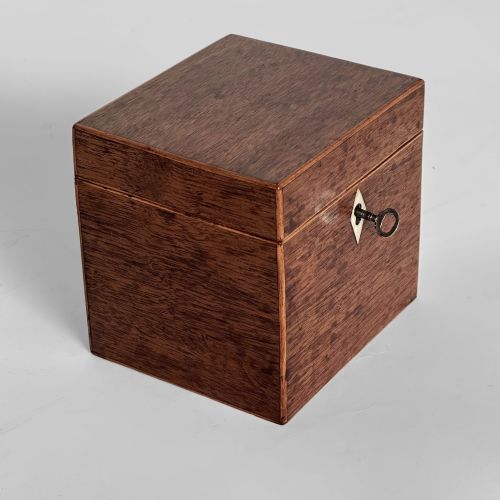
Cabinetmakers constructed these boxes using dense timbers such as mahogany, rosewood, and walnut, frequently applying fine veneers like satinwood, amboyna, and harewood. Surfaces were decorated with boxwood stringing, shell inlays, parquetry, and marquetry.
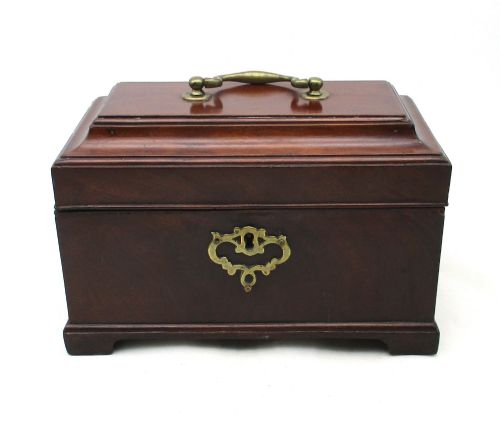
Hardware played an essential role in construction, with brass hinges, escutcheons, and lion mask handles fitted alongside internal mechanisms such as secret drawers and loose leaf canisters.
Listings feature woods such as mahogany, rosewood, satinwood, ebony, and boxwood across Georgian, Regency, and Victorian periods.
What varies in quality
The standard of a lockable wooden tea caddy depends on the precision of its veneer work and the complexity of its timber selection, such as burr walnut or partridge wood. Superior examples display meticulous parquetry and harmonious grain matching across every surface.
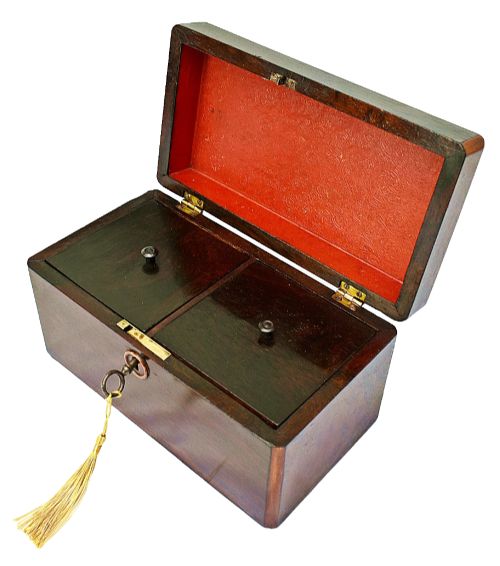
Internal arrangement also dictates distinction, separating simple single compartments from elaborate layouts featuring multiple canisters, mixing glasses, and secret drawers operated by concealed catches.
The Lockable Wooden Tea Caddy Glossary
- Sarcophagus
- A box form featuring a sloping lid and a stepped or domed profile, commonly seen on Regency and Victorian tea caddies. This architectural shape references ancient stone tombs.
- Escutcheon
- A protective brass plate surrounding the keyhole on the front of a caddy. It prevents the wood from splitting around the lock mechanism.
- Marquetry
- The art of forming decorative patterns using thin pieces of wood veneer and other materials. It creates pictorial or geometric designs on the exterior of the box.
- Stringing
- A narrow strip of contrasting wood inlaid into the surface to create a linear border. Boxwood and ebony are frequently utilised for this detailing.
- Canister
- An internal compartment or separate vessel designed to hold distinct tea leaves. Many caddies contain two canisters flanking a central mixing glass.
Lockable Wooden Tea Caddy: Frequently Asked Questions
How were tea caddies used?
Tea was an expensive luxury commodity in the eighteenth and nineteenth centuries, requiring secure storage away from household servants. The mistress of the house kept the key on her person, measuring out the leaves for each pot.
Inside the box, dual compartments held different varieties of tea, such as black and green, while the central glass bowl served as a mixing vessel or spoon bath.
How do I date a tea caddy?
Dating relies on combining timber choices, decorative styles, and construction methods. Pieces from the eighteenth century often feature simple geometric or oval forms with delicate shell inlay.
Nineteenth-century examples frequently adopt the heavier sarcophagus shape with brass ball feet, lion mask handles, and elaborate rosewood or walnut veneers.
Do the locks still work?
Many caddies retain their original locks, and surviving keys are often noted in the descriptions. However, historical locks can be delicate and should be operated with care.
Even when the mechanism is functional, these boxes are collected for their decorative and historical value rather than high-security storage.
How do I care for wooden tea caddies?
These boxes require stable room conditions away from direct sunlight and dramatic temperature fluctuations, which can cause old veneers to lift. Regular dusting with a soft, dry cloth preserves the polished surface.
Applying microcrystalline wax occasionally helps nourish historic wood without harming the original finish.