
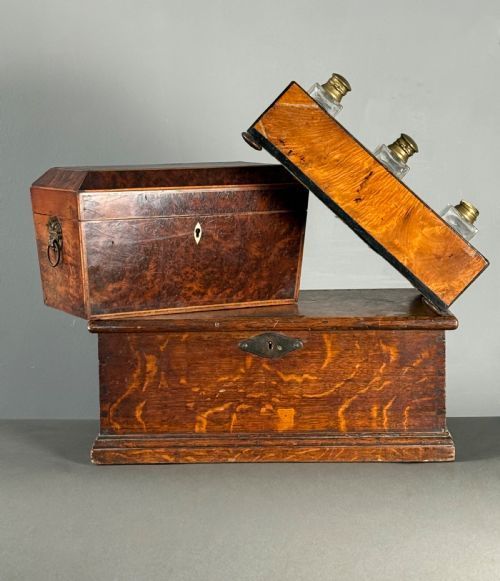


Brass Mounted Tea Chest
A brass mounted tea chest is a fine storage box for dry leaves, built from rich woods and fitted with metal hardware.
What They Are
A brass mounted tea chest is a container designed to keep precious tea leaves dry and secure. Buyers searching this phrase examine storage boxes made across the Georgian and Victorian eras.
The pieces on this page appear as tea caddies and tea chests shaped from mahogany, padouk, and coromandel wood. They originate from the eighteenth and nineteenth centuries.
Georgian examples sit alongside Victorian specimens, showing the shift in taste over a century of woodworking. Most items take the form of tea caddies rather than large floor chests.
How They Were Made
Cabinetmakers constructed these vessels using dense hardwoods like mahogany, padouk, and coromandel wood, often finished with paint or polished surfaces. They fitted each box with brass mounts to reinforce the corners and edges.
Internal arrangements frequently included wooden compartments and lids to separate different varieties of tea leaves. The joinery relied on traditional methods suited to exotic timbers.
Retail Price Guide 2026
Typical UK retail prices for brass mounted tea chest, calculated from the Sellingantiques database of over a million retail prices indexed since 2003. This retail price guide relies exclusively on Sellingantiques data; no external sources or auction records are used, so the figures do not describe the wider market.
Listings feature items spanning the Georgian, 18th Century, and Victorian periods.
What Varies in Quality
Quality rests in the choice of timber and the precision of the brass work fitted to the exterior. Dense grains like coromandel and padouk elevate a piece above standard mahogany.
The survival of internal fittings distinguishes a complete box from one that has lost its original compartments. Finely cast brass mounts show superior craftsmanship compared to plain sheet metal.
The Brass Mounted Tea Chest Glossary
- Tea caddy
- A small box or chest designed for storing loose tea leaves. These containers often featured internal lids and compartments.
- Padouk
- A heavy, durable tropical hardwood with a reddish hue used in fine cabinetmaking. It provides a sturdy structure for eighteenth-century boxes.
- Coromandel wood
- A dense, dark timber featuring contrasting streaks, popular in nineteenth-century decorative boxes. This material adds a striking visual texture to Victorian pieces.
- Georgian
- The architectural and decorative style spanning the reigns of the first four Georges. Pieces from this era display classical proportions.
Frequently Asked Questions
What is a brass mounted tea chest?
It is a lidded box designed to store loose tea leaves securely. These containers date from the Georgian and Victorian periods.
They utilise woods like mahogany, padouk, and coromandel, reinforced with brass mounts on the corners and edges.
How were tea chests used?
Tea was an expensive commodity in the eighteenth and nineteenth centuries, requiring secure storage. Owners kept their leaf supplies locked inside these boxes to protect them from moisture and theft.
Servants or the master of the house would dispense the tea from the caddy when preparing the brew.
How do I date a tea caddy?
Dating relies on the wood species, construction methods, and hardware styles. Georgian pieces often show simpler mahogany frames, while Victorian examples utilise exotic veneers like coromandel.
Examining the interior fittings also reveals the period preferences for dividing the leaf compartments.
Are these chests made of solid wood?
Cabinetmakers built these boxes using dense timbers such as padouk, mahogany, and teak. Some fine specimens feature decorative veneers applied over a secondary wood base.
The inclusion of brass mounts helped protect the wooden edges from knocks during daily use.