
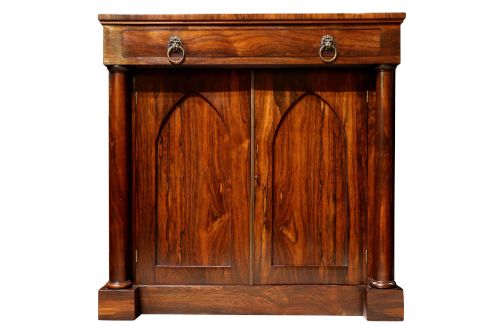
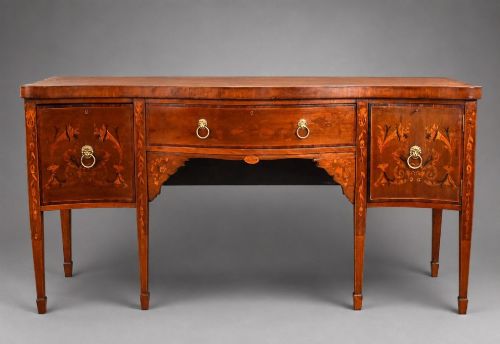
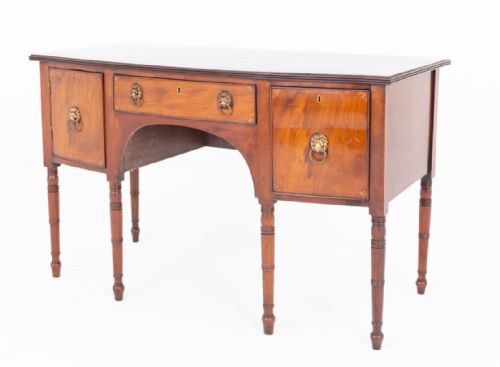
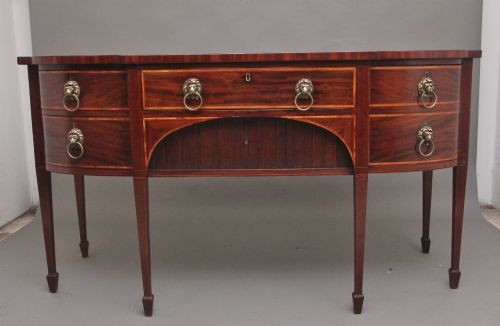
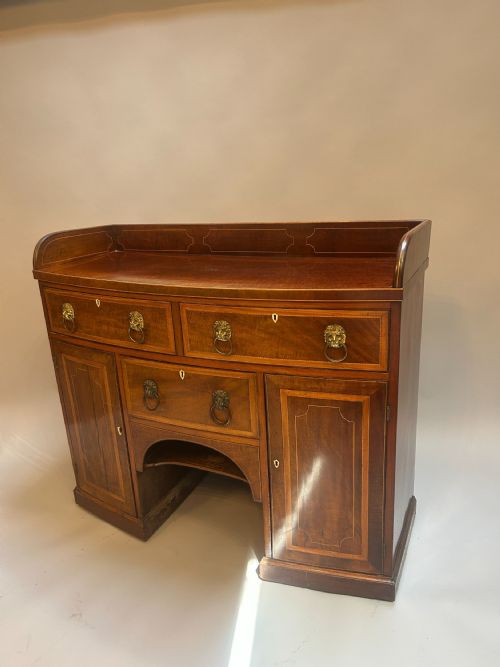
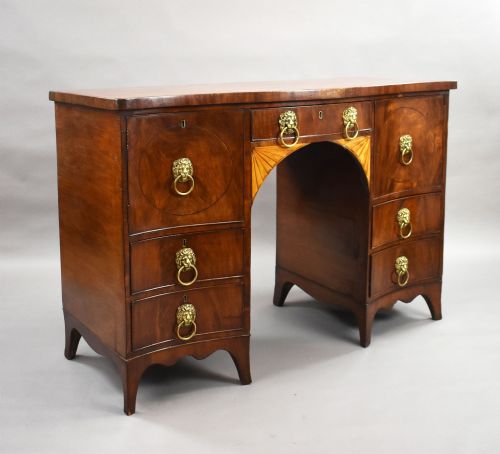


Lion Mask Handle Credenza
A lion mask handle credenza is a substantial storage piece defined by classical hardware, offering formal presence and period character to a dining room or hall.
Lion Mask Handle Credenza
A lion mask handle credenza brings together formal British storage forms and neoclassical hardware motifs. When exploring a lion mask handle credenza, buyers encounter pieces drawn from Georgian, Regency, and Victorian periods.
The selection on this page centres on sideboards, chiffoniers, and credenzas executed in mahogany and rosewood. These forms provide deep storage capacities while displaying the characteristic brass furniture that defines the grouping.
Construction materials and techniques
Cabinet makers utilised dense primary timbers such as mahogany and rosewood for the main carcase and drawer fronts. Boxwood and satinwood provide contrasting stringing and marquetry inlay across drawer fronts and panel borders.
Cast brass hardware, including the characteristic drop rings and masks, is secured directly to the drawer and door faces. Timber panels are fitted into solid frames to accommodate seasonal movement in domestic environments.
Listings feature mahogany, rosewood, and satinwood across Regency, Georgian, and Victorian periods.
Assessing quality and execution
The distinction between standard and superior pieces rests on the choice of timber and the crispness of internal joinery. Flame mahogany veneers and precise boxwood inlay indicate a higher tier of workshop production.
Hardware weight and original casting detail separate fine examples from later replacements. The integration of secondary woods and the precision of dovetailed drawer construction reflect the maker's hand.
The Lion Mask Handle Credenza Glossary
- Chiffonier
- A compact sideboard or low cabinet developed during the Regency period, often fitted with shelf tiers above and panelled doors below. They suit smaller reception rooms.
- Bowfront
- A curved cabinet front that swells outward in a convex arc. This shape softens the corners of dining room furniture and requires precise joinery.
- Marquetry Inlay
- The art of forming decorative patterns using fitted veneers of contrasting woods like satinwood and boxwood. It creates detailed surface ornament without adding structural thickness.
- Breakfront
- A cabinet front where the central section projects forward from the flanking wings. This configuration breaks up long elevations in large dining spaces.
Lion Mask Handle Credenza: Frequently Asked Questions
Where should I place a credenza?
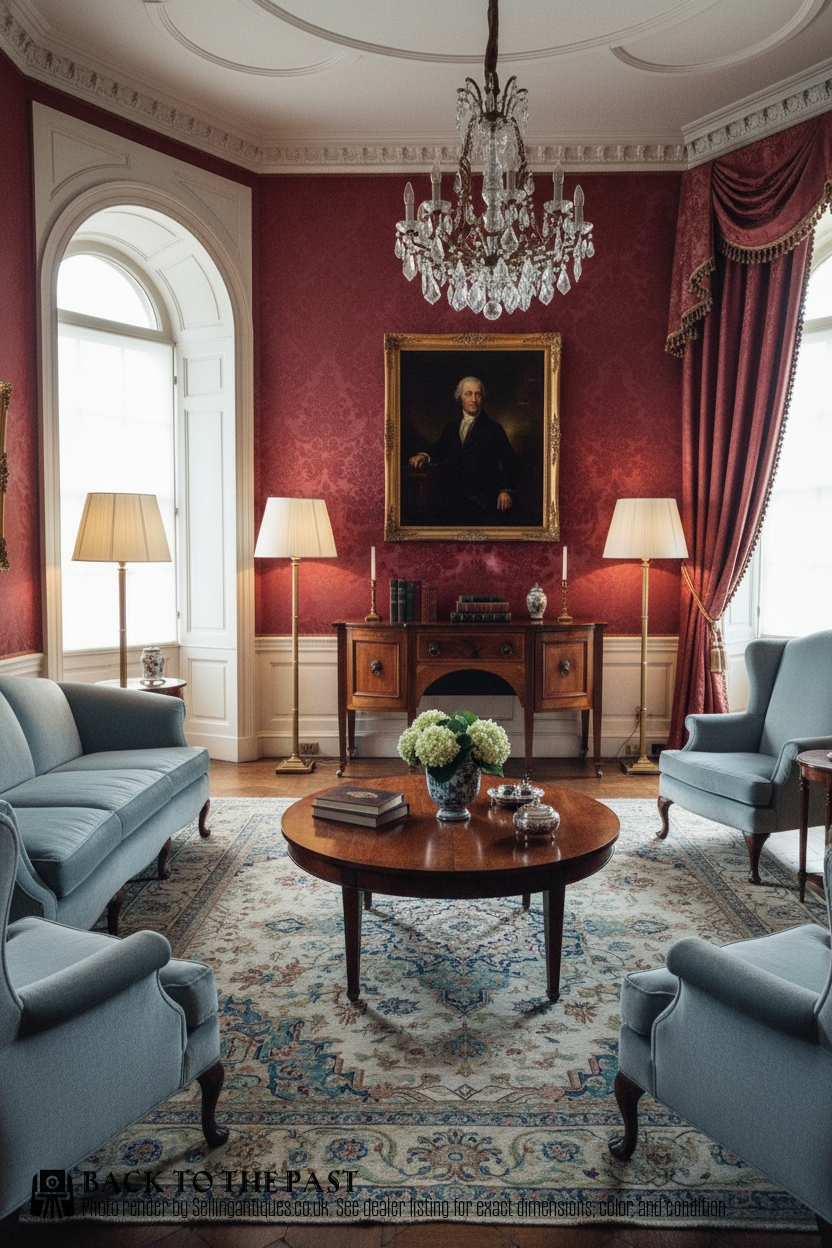
These low storage units fit naturally against dining room or hallway walls where surface space and interior capacity are both required. Their modest height also allows paintings or mirrors to be hung comfortably above them.
Ensure the room has sufficient clearance for doors or drawers to open fully without striking surrounding furniture. Placing the piece away from direct heat sources protects the timber and polish from drying out.
How do I care for mahogany surfaces?
Dust the timber regularly with a dry, soft lint-free cloth to prevent particulate accumulation in the grain and carved details. Avoid silicone-based polishes, which build up a heavy film over time and attract fresh dust.
Apply a traditional beeswax sparingly once or twice a year to nourish the polish and maintain a soft, natural sheen. Keep the room at a stable humidity level to prevent timber shrinkage or veneer lifting.
What is the difference between a sideboard and a chiffonier?
Sideboards were traditionally built longer and deeper for dining room service, featuring extensive drawer arrangements for linen and cutlery alongside lower cupboards. They formed the backbone of formal nineteenth-century dining furniture.
Chiffoniers are generally smaller and often include a raised shelf superstructure supported by pillars on the top surface. They evolved for parlour use to hold books, small ceramics, and daily items.
How can I identify Regency period pieces?
Regency furniture often displays architectural restraint, classical motifs, and dark exotic timbers like rosewood contrasted with light brass inlay. Look for clean lines, brass gallery rails, and distinct classical mounts.
Construction details such as hand-cut dovetails and solid mahogany drawer linings provide further confirmation of the period. Secondary woods like pine or oak are typically found internally on British pieces from this era.