
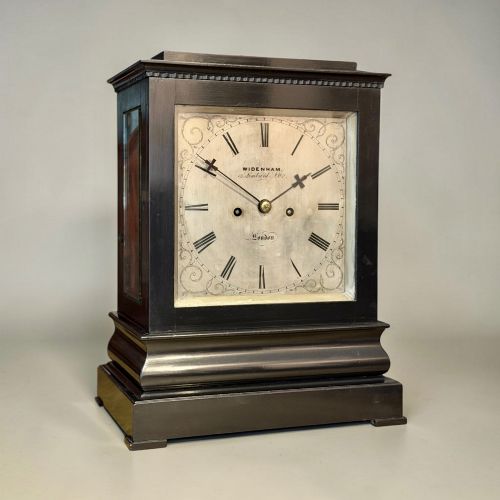
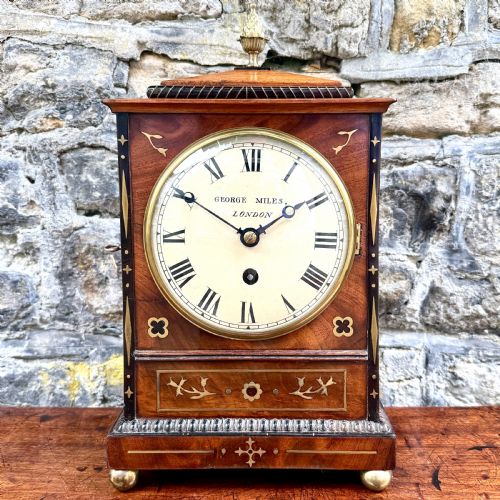
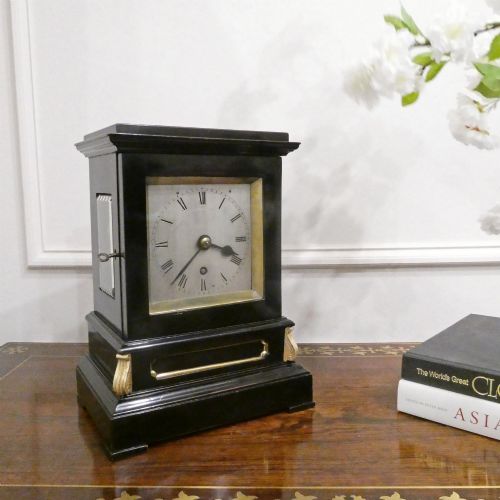
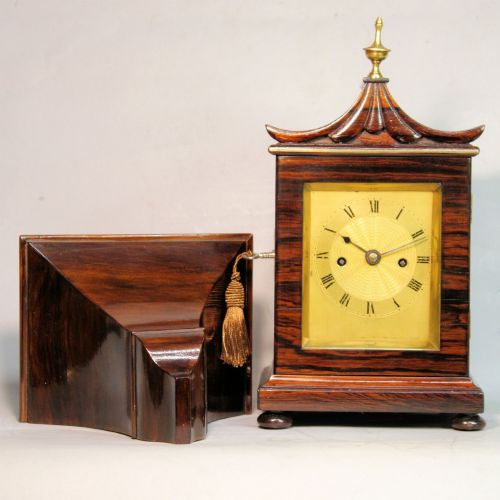


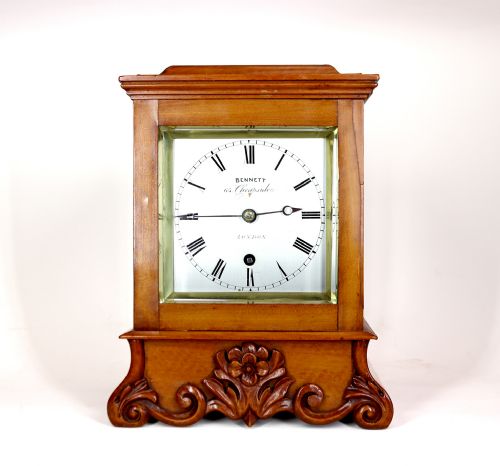


Library Mantel Clock
A library mantel clock brings precise mechanical movement and refined cabinetry together, serving as a functional centrepiece for a desk or reading room.
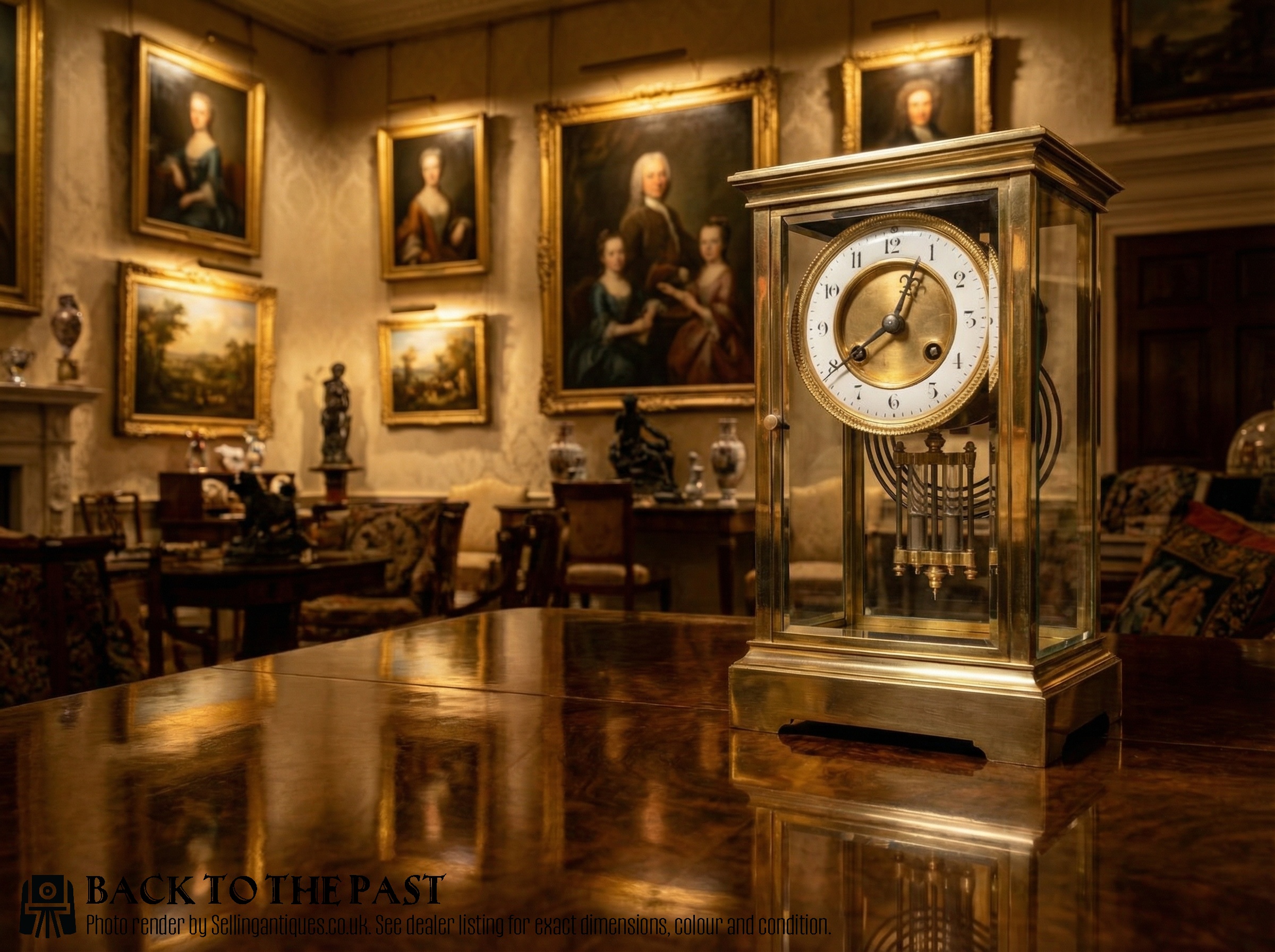
Library Mantel Clock
A library mantel clock is a portable timepiece designed for domestic and study spaces during the Georgian, Regency, and Victorian periods.
The version most commonly met on this page is the English single fusee timepiece, housed in mahogany, rosewood, or satinwood cases.
Many examples feature glass panels or multi-glass constructions that expose the mechanical movement within the timber or brass frame.
Distinctions in quality
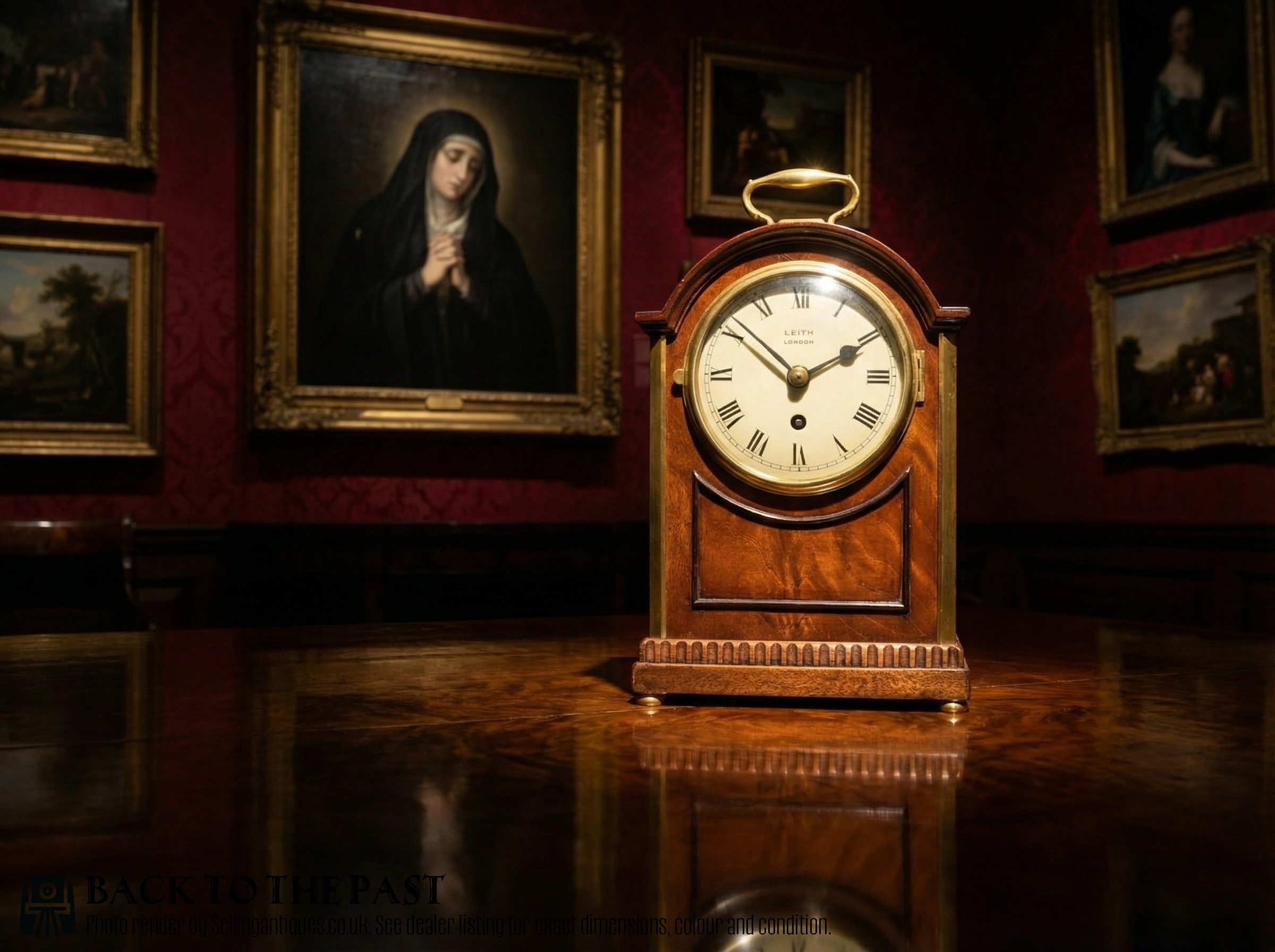
Quality rests upon the crispness of the cabinet joinery, the execution of engine-turned gilding on the dial, and the reputation of the recording maker.
Complications such as striking mechanisms, year-going movements, platform escapements, or delicate mercurial pendulums elevate an example above standard timepieces.
The clarity of the bevelled glass panels and the fineness of the hand-engraved signatures demonstrate the original maker's skill.
Some miniature library clocks are small enough to travel with an optional matching wall bracket.
Widenham of London·Bush of London·Webster Cornhill London·Sir John Bennett·Walker·Dent·Phillips Brothers·Arnold and Frodsham·Samuel Marti·McCabe London·Plumbly and Tupman·Barraud and Lunds·John Massey London·Leith of London·Cleret of Paris·W and H·Japy Freres·Price of London·John Murray London·T Boxell Brighton
The Library Mantel Clock Glossary
- Fusee
- A conical pulley used in mechanical clocks to equalise the torque of the mainspring as it unwinds. This mechanism helps maintain consistent amplitude in the balance wheel or pendulum.
- Single fusee
- A movement powered by one fusee drive that controls timekeeping without striking functions. Such movements are typical in library clocks designed purely for hours and minutes.
- Five glass clock
- A style featuring glass panels on the top and all four sides to showcase the interior mechanism. These cases often utilise brass framing around bevelled glass.
- Platform escapement
- An independent escapement assembly mounted on a small platform within the clock. This layout allows portable clocks to keep accurate time without requiring a fixed vertical position.
- Timepiece
- A clock that indicates the time of day but does not strike the hours. Many library clock examples perform solely as timepieces.
Library Mantel Clock: Frequently Asked Questions
What is a library mantel clock?
A library mantel clock is a compact mechanical timekeeper built during the eighteenth and nineteenth centuries to sit on desks, tables, or bookshelves.
These pieces combine portable precision movements with decorative timber or brass housings tailored for interior study spaces.
How do fusee movements work?
A fusee movement uses a conical pulley connected to the mainspring via a chain or cord to regulate power delivery.
As the mainspring unwinds and loses tension, the chain rides higher on the wider part of the cone, ensuring steady force reaches the escapement.
How do I date a Victorian library clock?
Dating relies on stylistic markers such as case timber, dial design, and signature formats recorded on the movement backplate or face.
Victorian pieces frequently utilise ebonised finishes, rosewood cases, or multi-glass panel constructions associated with the mid to late nineteenth century.
What is a four glass clock?
A four glass clock is a mantel timepiece enclosed by glass panes on the front, back, and sides within a brass or wooden framework.
This design allows light to pass through the case, displaying the gear trains and pendulum or platform escapement from multiple angles.