
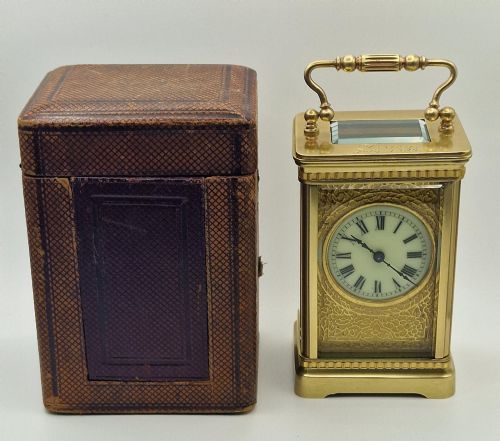
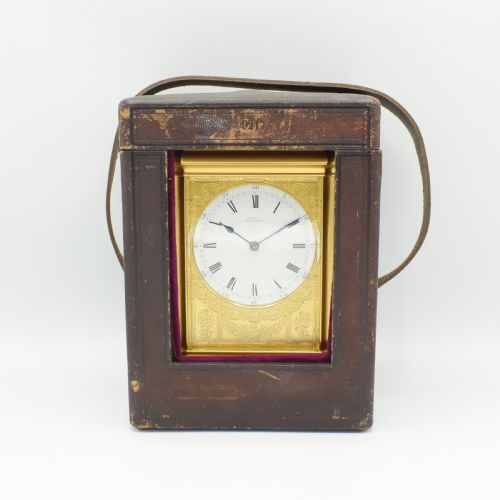
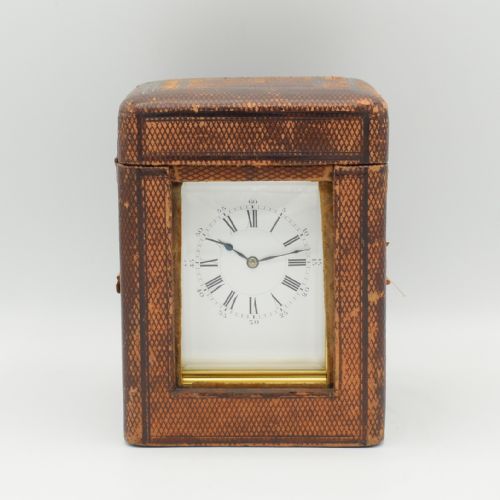
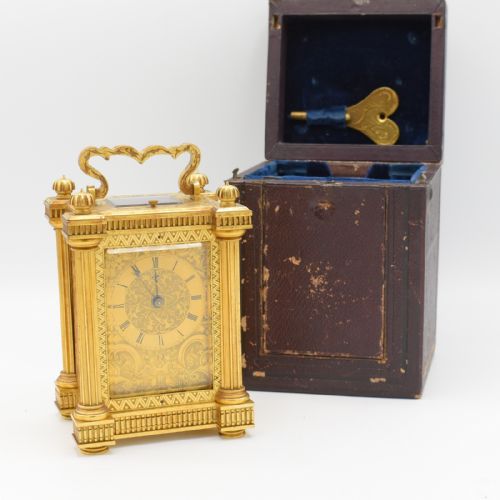


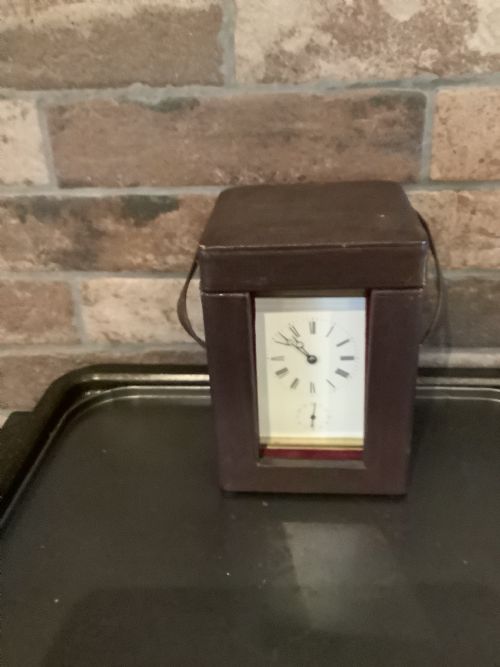


Leather Travelling Clock
These leather travelling clock pieces are portable timepieces housed in protective cases, offering the reliability of mechanical movements on the move.
Leather Travelling Clock
A leather travelling clock comprises a portable timepiece, often a carriage clock or boudoir clock, paired with a fitted protective case. Buyers seeking this phrase will find pieces spanning the nineteenth century, the Victorian era, the Edwardian period, and the Art Deco style.
The examples on this page predominantly take the form of carriage clocks or desk clocks housed in leather or original cases. They range from miniature designs to large repeater models produced in France and England.
Materials and construction
These clocks are built with brass, gilt brass, gilt bronze, chrome-plated metal, and sterling silver frameworks holding glass panels. Many incorporate enamel dials and brass movements designed for eight-day operation.
Protective outer cases are fashioned from leather, often tailored specifically to enclose the clock body and handle. Engraved brass cases and gorge frames provide structural housing for the internal mechanisms.
Listings feature brass, silver, and chrome-plated metal alongside glass panels, housed in leather travel cases spanning the Victorian period to Art Deco.
Distinctions in quality
Quality rests upon the intricacy of the movement, such as repeating mechanisms, alarm functions, and grand sonnerie striking capabilities. Fully engraved brass cases and fine enamel masks separate standard timepieces from superior examples.
The presence of the original leather travel case or box influences the completeness of the piece. Fine finishing on the gilt brass and the inclusion of maker signatures distinguish the upper tier of these clocks.
Henri Jacot·Howell And James London·Harrods Of London·Hunt And Roskell·Alfred Hollinge
The Leather Travelling Clock Glossary
- Carriage clock
- A portable spring-driven clock designed for travellers, featuring a handle on top and glass panels to view the movement. These clocks originated in France during the nineteenth century.
- Gorge case
- A stepped rectangular brass case style commonly found on nineteenth-century carriage clocks. This design provides robust housing for the internal gear train.
- Repeater
- A mechanism that chimes the hours and quarters on demand when a button or lever is pressed. This complication was valued for telling time in the dark during travel.
- Grand Sonnerie
- A striking train that sounds the hours and quarters automatically as each quarter passes, alongside chiming the full hour. It represents a complex level of clockmaking skill.
- Boudoir timepiece
- A small clock intended for domestic bedroom use rather than heavy travel, often featuring delicate enamel or silver decoration.
Leather Travelling Clock: Frequently Asked Questions
How do I wind a carriage clock?
Most of these clocks utilise a key inserted into winding squares on the backplate to tension the mainspring. Care must be taken not to overwind the movement.
Repeating mechanisms and alarms often require separate winding arbours or distinct handling procedures depending on the specific movement type.
Were all these clocks made for travel?
Many carriage clocks were built with sturdy brass frames and protective leather cases specifically for journeys by carriage or train. Others served as desk clocks or boudoir timepieces that remained stationary.
The inclusion of an original leather travelling case indicates intended portability for nineteenth-century journeys.
What is a gorge case?
A gorge case is a distinct rectangular brass housing style characterised by moulded, stepped top and bottom sections. This architectural form provides a stable frame for glass panels.
Found frequently on French carriage clocks from the nineteenth century, it protects the delicate escapement visible through the top glass.
How do I identify the period of a clock?
Stylistic indicators such as Art Deco chrome plating point toward the twentieth century, while ornate floral enamel work often suggests Edwardian production. Victorian pieces frequently display heavy brass casting and fully engraved gilt masks.
Maker signatures and case designs help narrow down the decade of manufacture within the nineteenth and twentieth centuries.