



Leather Saddled Rocking Horse
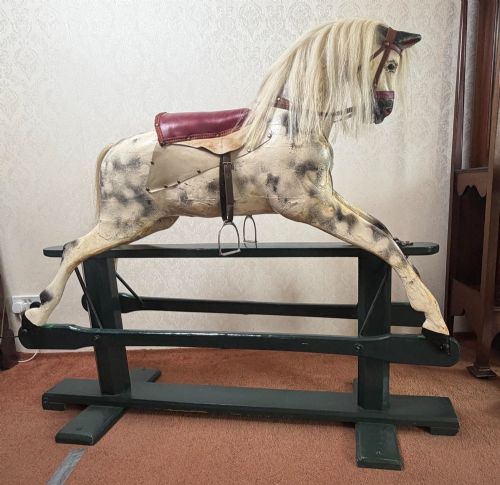
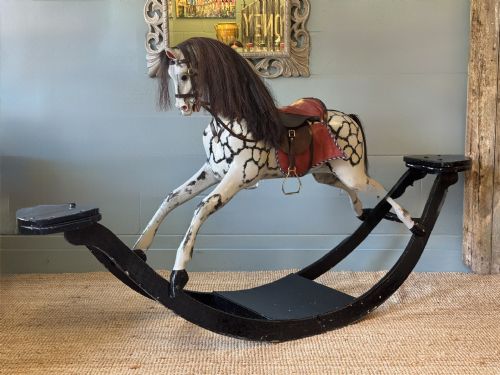
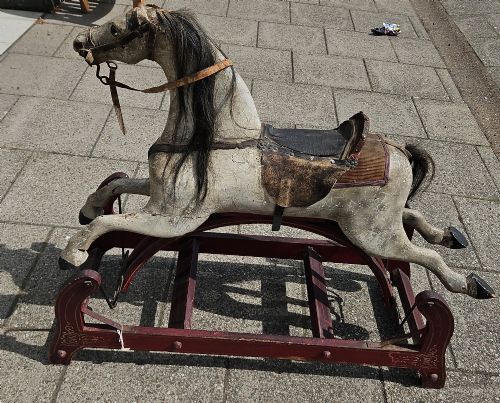
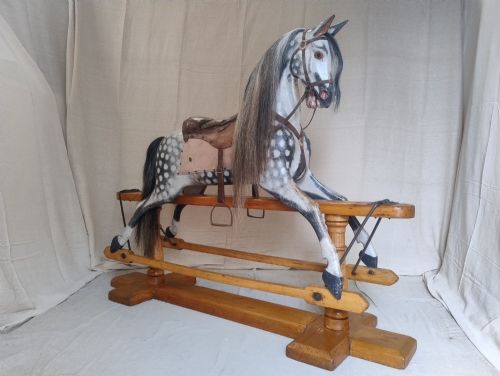
A leather saddled rocking horse brings traditional nursery charm into a room, fashioned from carved timber and real horsehair.
Leather Saddled Rocking Horse
A leather saddled rocking horse is a traditional nursery toy designed for childhood play and now collected for display. These pieces appear in various sizes, spanning forms from the late nineteenth century through the interwar period.
Most examples found here rest on curved wooden rockers or original swing stands. Makers shaped these figures from carved pine and other timbers, finishing them with painted dapple coats and genuine leather tack.
How they were made
Carvers shaped the bodies from solid timber such as pine, often constructing the core in sections before joining them. Artisans applied gesso and paint to create the characteristic dappled coats seen on Victorian and Edwardian examples.
Tack makers fitted genuine leather saddles and bridles alongside real horsehair manes and tails. Metal and iron components reinforced the rocking mechanisms and structural joints to withstand vigorous use.
Leather Saddled Rocking Horse Retail Price Guide 2026
Typical asking prices for leather saddled rocking horse among the pieces listed under this phrase on Sellingantiques today, from the lower quarter to the upper quarter. They describe what is for sale here now, not the wider market.
The listings here span the Victorian era through the 1940s, utilising materials such as leather, horsehair, pine, and iron.
What varies in quality
The finesse of the carver's hand dictates the sculptural quality of the head and expression. Finer examples display detailed musculature and naturalistic proportions rather than rigid, blocky forms.
Survival of original surfaces influences the character of each piece. Retaining the authentic leather saddle, horsehair, and painted dapple finish distinguishes a well-preserved survivor from a heavily restored specimen.
G & J Lines of London·F.H.Ayres·Collinson
The Leather Saddled Rocking Horse Glossary
- Dapple
- A painted spotting pattern mimicking grey horses. Artisans applied this finish to nineteenth and twentieth century nursery toys.
- Rocker
- The curved wooden arc supporting the horse. These allow the toy to sway back and forth during play.
- Tack
- The harness equipment fitted to the animal. This includes the leather saddle, reins, and bridle.
- Gesso
- A plaster mixture applied to the carved wooden base. Craftsmen used this surface preparation before painting the dappled coat.
Leather Saddled Rocking Horse: Frequently Asked Questions
How do I date a rocking horse?
Examine the construction methods, paint style, and materials used in the body and stand. Earlier nineteenth century examples often feature heavier carved pine frames and distinct ironwork.
Maker marks, where present, help pinpoint the workshop of origin. Comparing the stance and tack to dated pieces provides a reliable guide to the era.
What maintenance do leather saddles need?
Leather tack benefits from gentle cleaning and occasional conditioning to prevent drying and cracking over time. Keeping the material away from direct heat sources preserves its suppleness.
Avoid harsh chemical cleaners that might strip the historic finish. Light dusting keeps the horsehair mane and tail in good order.
How do I identify a Victorian rocking horse?
Victorian specimens typically display deep carving, substantial wooden frames, and traditional curved rockers. Their painted dapple coats often show a mellowed patina developed over many decades.
Proportions tend to be robust, reflecting the heavy timber construction favoured by makers of that era. Original leather saddles and glass eyes further point toward a nineteenth century origin.