
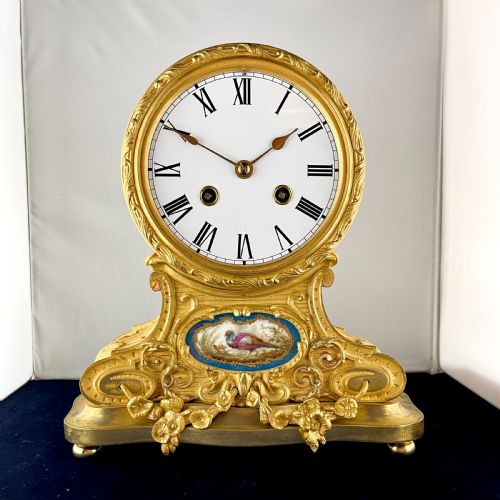
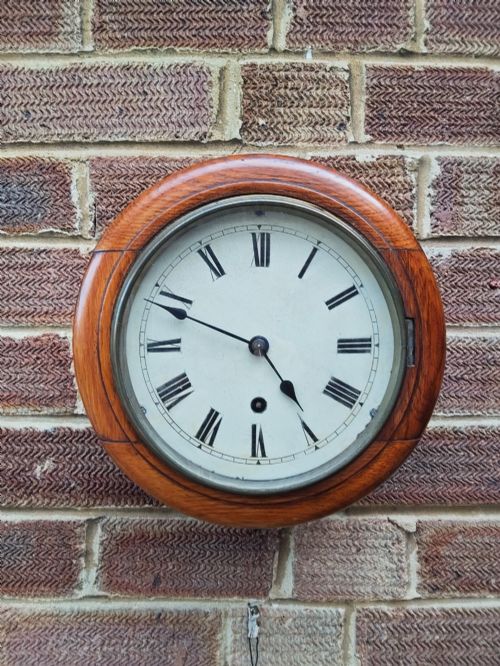


Late Victorian Dial Clock
A late victorian dial clock brings functional timekeeping and robust mahogany or oak joinery straight to the wall.
Late Victorian Dial Clock
When you search for a late victorian dial clock, you are looking at practical timepieces made for offices, stations and homes during the late nineteenth century. These wall clocks feature clear faces designed for easy reading from a distance.
You will most commonly meet mahogany or oak cased examples on this page, often housing reliable fusee movements. Their straightforward circular faces reflect the utilitarian requirements of the period.
How they were made
Cabinetmakers utilised solid timbers such as mahogany and oak to construct sturdy circular surrounds and trunk cases. Glass protects the dial face, while brass components form the internal mechanical gear trains.
Enamel serves as the traditional material for the chapter rings and painted faces, providing high contrast against the timber. Metal casting and hand-finishing completed the durable brass bezels.
Listings feature mahogany, oak, and walnut timber cases housing glass-fronted enamel dial faces.
What varies in quality
The precision of the fusee movement and the crispness of the timber joinery separate standard examples from finer pieces. Superior clocks show careful attention to movement finishing and timber selection.
The clarity of the enamel dial and the integrity of the original case timbers dictate the overall standard. Maker attribution and movement complexity further elevate certain wall clocks above ordinary utility pieces.
Winterhalder And Hofmeier·Henri Jacot Paris·Mappin And Webb·Geo Tarratt Of Leicester·James Bell Bath·Godfrey Watson Fugill
The Late Victorian Dial Clock Glossary
- Fusee
- A conical pulley used in clock movements to maintain even force on the gear train as the mainspring unwinds. This mechanism helps the clock maintain accurate timekeeping throughout its running cycle.
- Dial
- The visible face of the clock where numerals indicate the hours and minutes. On these pieces, enamel or painted metal provides the legible surface.
- Bezel
- The metal ring that holds the glass door protecting the clock face. It usually hinges open to allow hand-setting.
- Chapter ring
- The circular band on the dial bearing the hour numerals. It frames the central hands.
- School clock
- A common term for a simple, wall-mounted dial clock used in public buildings and offices. These utility timepieces prioritized legibility and robust construction.
Late Victorian Dial Clock: Frequently Asked Questions
Where were these clocks originally hung?
These dial clocks hung in railway stations, offices, schools, and large domestic hallways where quick time-checking was essential.
Their robust timber frames and clear faces suited busy public environments as well as private homes.
How do fusee movements work?
A fusee movement uses a conical drum and a cord to equalize the power delivered by the mainspring as it runs down.
This clever mechanical design ensures consistent force reaches the escapement, improving overall timekeeping accuracy.
What timber types appear most often?
Mahogany and oak dominate the timber selection for these wall clocks, chosen for their durability and attractive grain.
Walnut also appears periodically among the recorded pieces, offering a slightly richer tone for domestic interiors.
How do you wind a dial clock?
Winding involves inserting a specialised key into the winding hole on the dial face and turning it carefully.
Most eight-day fusee movements require a weekly turn to maintain continuous operation.