
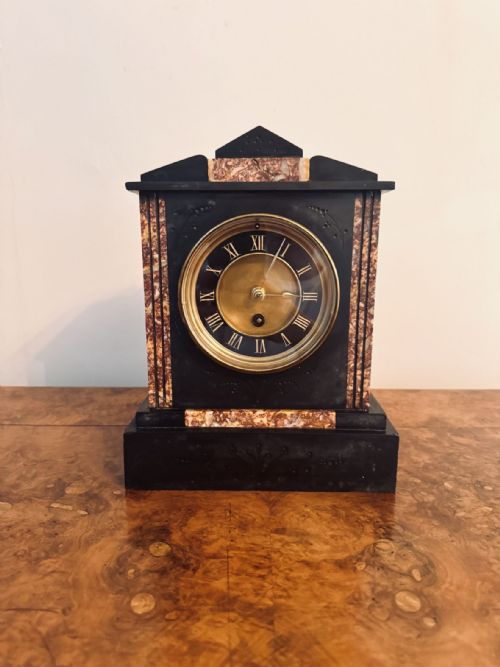
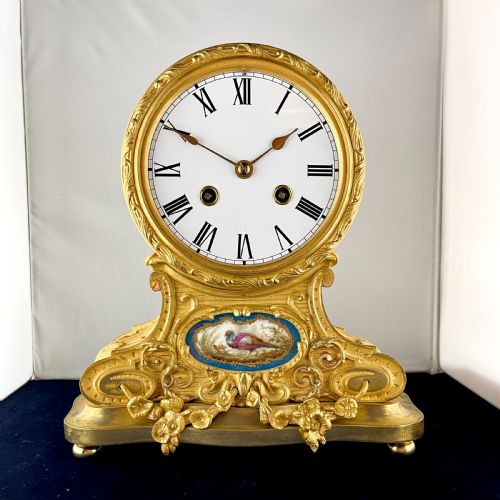


Late Victorian Desk Clock
A late victorian desk clock sits on a study table or bureau, measuring the hours in brass, bronze, and glass with steady precision.

Late Victorian Desk Clock
When you search for a late victorian desk clock, you encounter timepieces produced during the closing decades of the nineteenth century and the early years of the twentieth. These objects bridge the gap between practical timekeeping and domestic display, often taking the form of carriage clocks, drumhead mantel clocks, and miniature boudoir pieces.
The selections on this page lean heavily towards French workshops alongside British examples, reflecting the widespread popularity of continental movement makers during the Victorian era. Brass cases with bevelled glass panels and enamel dials dominate the selection, offering clear visibility of the escapement within.
Forms range from simple corniche-case timepieces with alarm functions to elaborate crystal regulators and compendiums featuring integrated thermometers and compasses. Whether housed in mahogany, gilt bronze, or heavy ormolu, each piece serves as a functional centrepiece for a desk or mantel.
Materials and Construction
Makers utilised cast brass and gilt bronze to form the robust structural frameworks of these timepieces, frequently fire-gilding the metal surfaces to create a lasting lustre. Heavy bevelled glass panels were then fitted into the frames to protect the delicate internal gear trains while allowing light to reach the escapement.
Enamel dials, often painted with Roman numerals and minute markers, provide the classic face for these clocks, sometimes accompanied by finely pierced hands of blued steel. Selected pieces incorporate champlevé enamel or painted Limoges panels directly into the brass housing for added visual depth.
Cabinetmakers deployed solid mahogany for traditional British mantel clocks, incorporating inlaid wood details to frame the dial. Meanwhile, carriage clocks relied on brass springing and precision gear-cutting to maintain accurate time within a portable housing.
Listings feature brass, gilt bronze, ormolu, and mahogany housings paired with bevelled glass and white enamel dials.
Distinctions in Quality
The calibre of a late victorian desk clock is determined by the complexity of its movement and the crispness of its metal casting. Pieces featuring striking mechanisms, repeaters, or additional complications such as alarms and compasses demonstrate a higher standard of horological ambition.
Case finishing separates standard production items from finer works, visible in the hand-chased detail of side panels and the weight of the gilt bronze or ormolu mounts. Heavy brass frames with tightly fitted bevelled glass show superior structural integrity compared to lighter, stamped alternatives.
Lemerle Charpentier·Andre Guilmet
The Late Victorian Desk Clock Glossary
- Carriage clock
- A small, portable spring-driven timepiece designed for travel, typically fitted with a carrying handle and a glass-panelled brass case. These clocks frequently feature platform escapements visible through the top glass.
- Crystal regulator
- A mantel clock housed in a brass frame with four glass panels that reveal the mechanical movement and pendulum from all sides. This style became popular in late nineteenth-century France.
- Corniche case
- A standard rectangular carriage clock case design featuring simple moulded pillars at the four corners and a flat top supporting the handle. It represents one of the most common housings found on this page.
- Champlevé
- An enamelling technique where troughs or cells are hollowed out of the metal surface and filled with vitreous enamel before firing. This method adds colourful geometric or floral patterns to the clock bezel and pillars.
- Escapement
- The internal mechanism that controls the unwinding of the mainspring by delivering impulses to the balance wheel or pendulum. The platform escapement is standard in portable nineteenth-century clocks.
Late Victorian Desk Clock: Frequently Asked Questions
How do I wind a carriage clock?
Most portable clocks on this page use a key inserted into the winding squares on the backplate. Turn the key gently until you feel resistance, taking care not to overwind the mainspring.
Keep the original key with the clock if possible, as replacement sizes vary and incorrect tools can damage the winding square over time.
Were these clocks made for travel?
Carriage clocks were originally built for officers and travellers on the move, protected by sturdy brass cases and fitted leather travelling boxes. They kept accurate time in transit thanks to their robust platform escapements.
Today, these pieces serve primarily as stationary desk ornaments, though their portable heritage remains visible in the folding handles and heavy protective glass panels.
What is a repeater mechanism?
A repeating carriage clock sounds the last hour and quarter-hour when you press a plunger on the case top. This allowed owners to check the time in the dark without striking a match.
This complication requires intricate gear trains and indicates a higher grade of manufacture, often found in pieces signed by premier French workshops.
How should I clean the brass case?
Dust the exterior regularly with a soft, dry microfibre cloth to prevent the accumulation of grime in the chased details and corners. Avoid using liquid brass polish, as harsh chemicals can strip the original gilding or lacquer from the metal.
Glass panels can be wiped clean with a standard glass cleaner applied to a cloth first, ensuring no liquid seeps into the movement through gaps in the case.
Why does my clock have an alarm?
Many nineteenth-century desk and carriage clocks include a secondary gear train dedicated to an alarm function, set via a small auxiliary dial on the backplate. Owners used these to wake up while travelling or to manage daily schedules in a study.
Setting the alarm involves winding the separate spring and pulling or turning a small pin depending on the specific French movement design.