
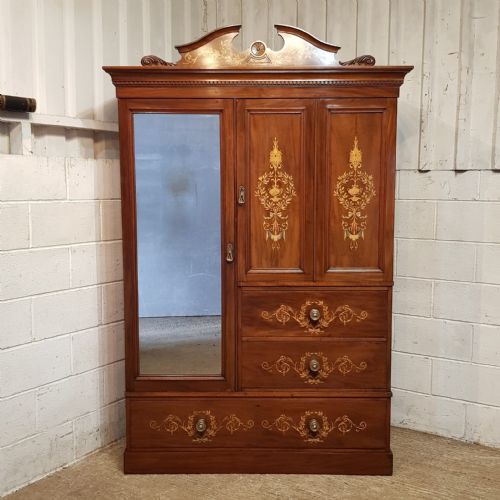
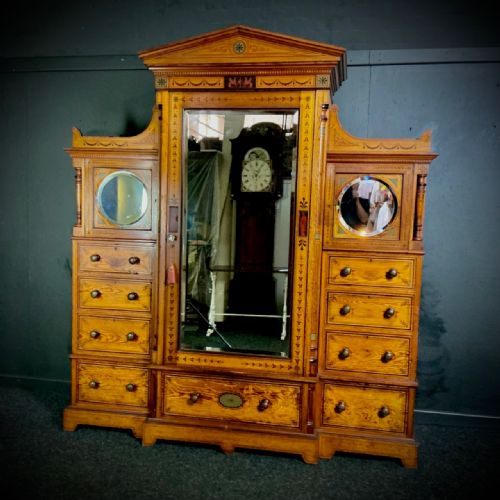
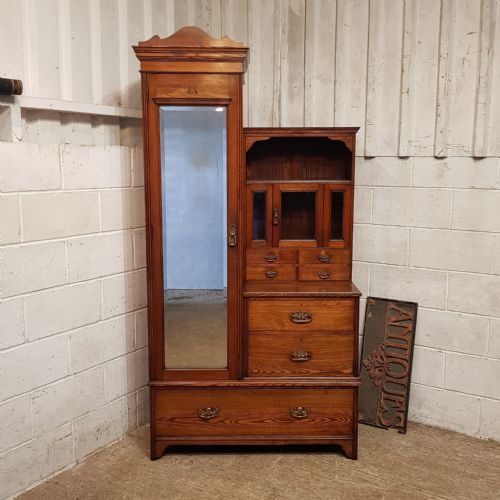
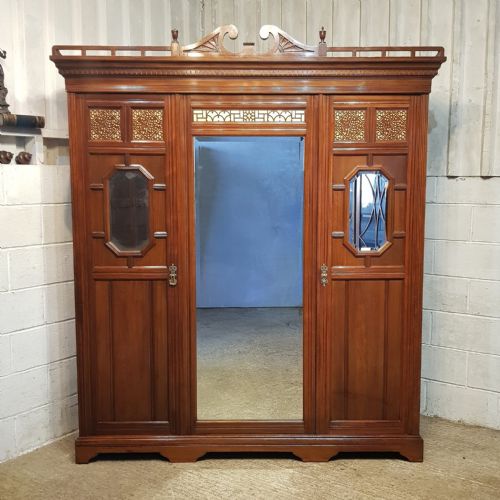


Late Victorian Compactum
A late victorian compactum offers serious bedroom storage, combining hanging space, drawers and shelving within one substantial piece of furniture.
Late Victorian Compactum
A late victorian compactum is a multi-functional wardrobe designed to house various garments and linen in a single carcass. The pieces appearing in this selection span the nineteenth century and the turn of the twentieth century, predominantly taking the form of triple wardrobes or combination pieces.
Buyers seeking this furniture encounter items spanning the Victorian era, with dates clustering around eighteen ninety. Alongside standard wardrobes, the inventory includes combination pieces and bedroom suites displaying styles from the Aesthetic Movement and Arts and Crafts.
The format usually integrates hanging compartments flanked by linen drawers, small cupboards, or sliding trays. This configuration delivers an all-in-one storage solution developed to meet the demands of late nineteenth-century domestic interiors.
Materials and construction
Cabinet makers utilised a range of dense timbers, relying heavily on mahogany, walnut, burr walnut, and ash. Pitch pine, satinwood, and Oregon pine also appear across the selection, providing diverse grain patterns and structural foundations.
Surface decoration often incorporates detailed inlay work on mahogany carcasses. Metalwork utilises brass for handles and hanging hooks, while glass frequently appears in mirrored door panels.
Makers occasionally designated narrow single wardrobe versions as sentry box compactums, perhaps nodding to military efficiency in domestic dressing.
Factors determining quality
The choice of timber dictates much of the visual character, with burr walnut and figured mahogany representing the more decorative end of the spectrum compared to standard pine or ash. Grain selection and matching across large triple wardrobe doors demonstrate the skill of the cabinet maker.
The complexity of the interior arrangement influences the execution, distinguishing basic hanging space from sophisticated compactums fitted with multiple internal drawers, sliding linen trays, and brass hardware.
The Late Victorian Compactum Glossary
- Compactum
- A multi-functional wardrobe combining hanging space with internal drawers, shelves, and small compartments. This design maximises bedroom storage efficiency.
- Combination wardrobe
- A piece of furniture uniting wardrobe hanging sections with drawer units or cupboards in a single structure. They supersede simpler single-door wardrobes.
- Burr walnut
- Timber taken from the warted excrescences of walnut trees, showing intricate swirling grain patterns. Cabinet makers prized it for veneering prominent door panels.
- Triple wardrobe
- A large three-section wardrobe, typically featuring flanking hanging compartments and a central tower of drawers or mirrored doors. These dominate the nineteenth-century bedroom suite.
- Aesthetic Movement
- A late nineteenth-century design style emphasising visual beauty over narrative subject matter. Pieces from this movement display clean lines and simplified forms.
Late Victorian Compactum: Frequently Asked Questions
What is a compactum wardrobe?
A compactum wardrobe is a large piece of nineteenth-century bedroom furniture that integrates hanging space, shelving, and internal drawers into a single carcass. It was designed to provide complete garment storage for a household.
These pieces typically present as triple wardrobes where the central section contains linen slides or drawers flanked by full-length hanging compartments.
How do I date a late victorian piece?
Dating relies on recorded construction dates, timber choices, and stylistic markers such as Aesthetic Movement or Arts and Crafts influences. Most examples cluster around eighteen ninety.
Examining internal drawer construction, timber selection like burr walnut or mahogany, and brass hardware helps confirm the late nineteenth-century period.
Will a compactum fit in a modern bedroom?
These pieces are substantial structures, usually built as triple wardrobes or large combination units requiring significant wall space and ceiling height. Measuring clearance is essential before purchase.
Many examples separate into modular sections or individual robes for transport, though assembly still demands a generous room layout.
What woods were used for these wardrobes?
Cabinet makers utilised a variety of dense hardwoods and softwoods depending on the desired finish. Mahogany, walnut, and burr walnut provided dark, figured surfaces.
Ash, pitch pine, satinwood, and Oregon pine also feature across the inventory, offering lighter tones and distinct grain patterns.