


Large Wool Flatweave
A large wool flatweave brings floor coverings of considerable scale woven without a pile from various regional traditions into a room.
Large Wool Flatweave
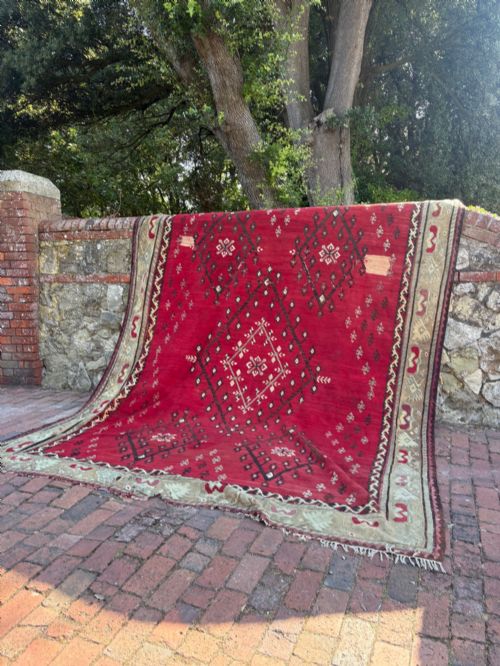
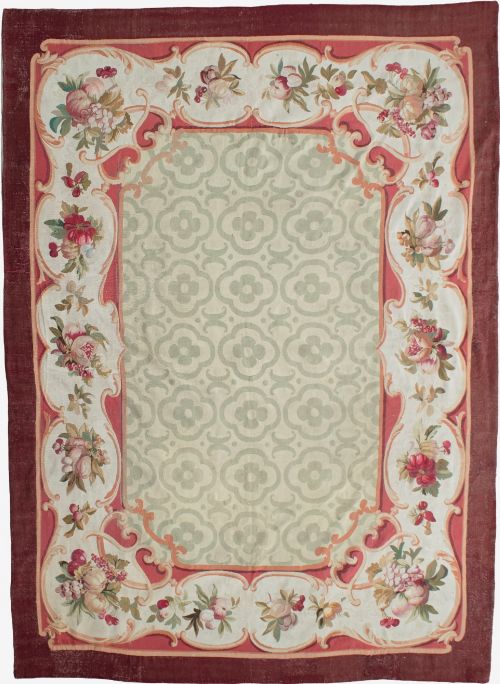
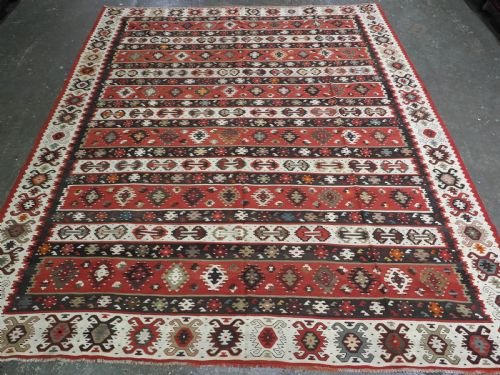
A large wool flatweave comprises room-sized floor coverings and carpets produced across regions such as Anatolia, the Caucasus, and the Balkans during the nineteenth and early twentieth centuries. These textiles are encountered in forms including kilims, Aubusson carpets, and needlepoint pieces spanning dates from the 1850s to the 1920s.
The buyer exploring large wool flatweave examples will find woven flat surfaces dominated by tribal motifs, floral compositions, and banded geometric designs. These objects serve as functional floor coverings and wall hangings that define large interior spaces.
How they were made
These textiles rely primarily on wool and cotton for their structural foundation and surface pattern. Weavers interlocked weft threads tightly over warps to create durable, pileless structures.
Needlepoint and crewelwork techniques appear in specific European variants, utilising wool yarn stitched across canvas grounds to form detailed pictorial designs.
Listings feature wool and cotton materials across periods spanning the nineteenth and early twentieth centuries.
What varies in quality
The degree of precision in the weave and the complexity of the regional design separate examples. Tighter interlockings and well-preserved structural integrity elevate an individual piece.
Colour retention and the clarity of regional motifs dictate the visual impact of the textile. Pieces retaining harmonious natural dyes stand apart from those with compromised coloration.
The Large Wool Flatweave Glossary
- Flatweave
- A textile produced by interweaving warp and weft threads without forming a raised pile. This technique creates a thin, durable floor covering.
- Kilim
- A pileless woven rug or carpet originating from regions including Turkey, the Caucasus, and Central Asia. These items often display sharp geometric or medallion designs.
- Warp
- The stationary vertical threads stretched onto a loom before weaving begins. They form the underlying structural skeleton of the textile.
- Weft
- The horizontal threads passed through the warp to build the pattern and colour of the piece. Interlocking these threads forms the distinct flat surface.
- Medallion
- A central decorative motif placed in the middle of a carpet or rug. It typically commands the visual focus of the composition.
Large Wool Flatweave: Frequently Asked Questions
How are these large flatweave carpets cleaned?
Maintenance relies on gentle surface vacuuming without rotating brushes to protect the flat structure. Professional textile cleaning is necessary for deep maintenance to safeguard wool fibres.
Avoiding excessive moisture and direct sunlight preserves the dyes and structural strength of the weave over time.
Can these rugs be placed on heated floors?
Natural wool and cotton materials tolerate standard underfloor heating environments quite well. Placing a breathable underlay beneath the textile prevents sliding and promotes air circulation.
Checking the temperature limits ensures the historical fibres do not dry out or become brittle.
What distinguishes an Anatolian flatweave from a Balkan one?
Anatolian examples frequently incorporate tribal motifs and geometric symbolism rooted in village traditions. Balkan and Sharkoy pieces often display refined floral or banded compositions influenced by European design.
Examining the specific colour palette and border arrangements helps identify the geographical weaving origin.