



Large Round Mahogany Table
A large round mahogany table anchors a room with dignity, offering generous proportions and rich timber grain suited to daily dining or grand centre placement.
Large Round Mahogany Table
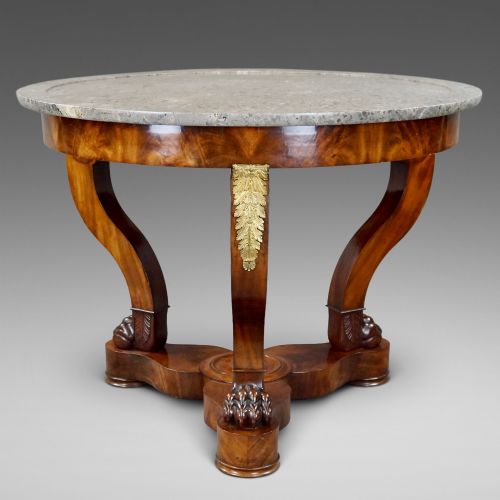
A large round mahogany table serves as a substantial centrepiece, most commonly appearing in nineteenth-century dining, centre, breakfast, and tilt-top formats across Regency, Victorian, and William IV styles. These pieces range from extending dining designs with multiple leaves to solid pedestal tables and marble-topped gueridons.
The variety spans centuries and revivals, including George III craftsmanship, early twentieth-century Regency revivals, and solid timber breakfast tables. Buyers encounter forms designed specifically for large gatherings alongside grand architectural centre tables meant for central hall placement.
How they were made
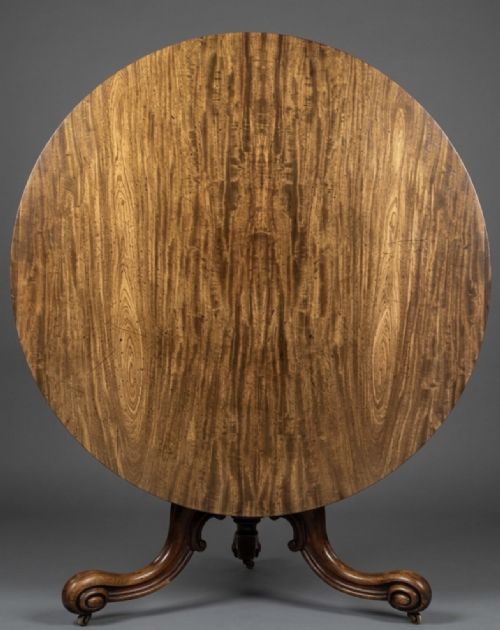
Cabinet makers utilised dense timber varieties such as flame mahogany and figured mahogany, often enhancing the circular tops with satinwood inlay or cross-banding. Structural strength relied on solid mahogany framing, sometimes paired with brass fittings and pedestal supports.
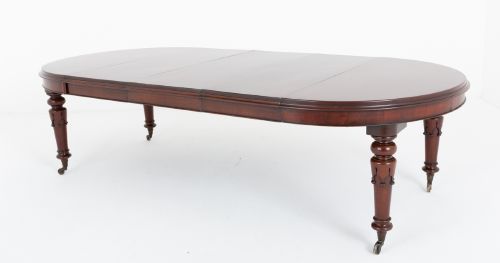
Surface treatments incorporated leather inserts on specific drum tables, whilst grander French Empire and gueridon examples integrated marble tops and gilt bronze accents. Extending mechanisms employed wind-out systems and removable leaves to support large seating capacities.
Listings feature mahogany, marble, gilt bronze, and satinwood inlay across periods spanning the early nineteenth century to the early twentieth century.
What varies in quality
Excellence in these tables rests upon the selection and matching of timber veneers, where vibrant flame figure and precise cross-banding elevate the visual impact of the circular top. The integrity of the pedestal base, whether carved timber or fitted with brass castors, dictates the stability of large formats.
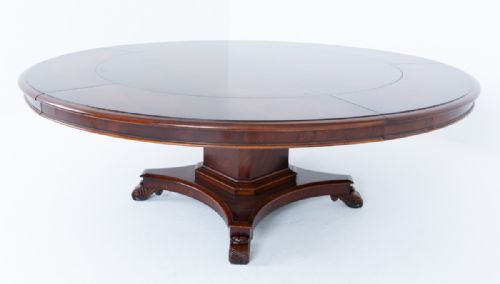
The sophistication of the mechanism in extending and wind-out dining tables separates standard utility from superior craftsmanship. Finer pieces demonstrate precision engineering in their leaf integration and balanced weight distribution across pedestal or pillar supports.
Gillows
The Large Round Mahogany Table Glossary
- Flame mahogany
- A veneer cut from the fork of the mahogany tree to create a distinctive, flickering flame pattern across the tabletop. This decorative grain choice signals a high-status piece of furniture.
- Tilt-top
- A table mechanism allowing the circular top to pivot vertically against the pedestal for storage when not in use. This practical design was common in breakfast and supper tables.
- Gueridon
- A small circular table on a pillar and base, often influenced by French classical design. These frequently feature marble tops and gilt bronze mounts.
- Cross-banding
- A border of veneer laid around the perimeter of the tabletop with the grain running perpendicular to the centre. It creates a neat framing effect on mahogany surfaces.
- Wind-out table
- An extending dining table operated by a detachable handle that turns an internal screw mechanism to separate the halves for extra leaves. This allowed large tables to expand smoothly.
Large Round Mahogany Table: Frequently Asked Questions
How do I seat guests comfortably around a round table?
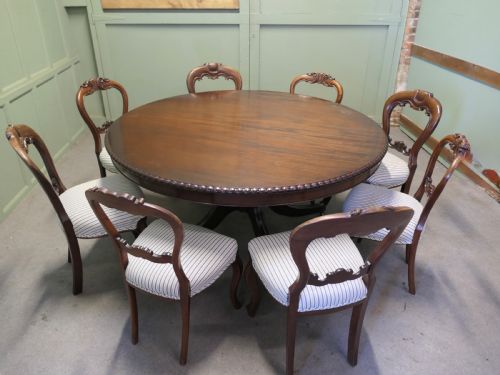
A large circular table encourages conversation because every guest faces the centre without the physical barriers of rectangular corners. Ensure adequate clearance around the perimeter for chairs to pull out easily.
For larger gatherings, extending versions with wind-out mechanisms allow the top to expand while maintaining stability on central pedestals or pillar supports.
What is the difference between a breakfast table and a dining table?
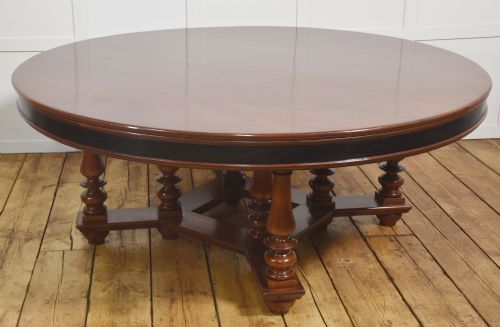
Breakfast tables from the Regency and Victorian periods often feature tilt-top mechanisms designed to save space by tipping upright against a wall when the room served other daytime purposes. They typically rest on a single central pedestal with tripod or platform feet.
Standard dining tables remain fixed in a horizontal position, utilising solid frames, multiple legs, or substantial pedestal bases to support heavy daily use and large meals.
How do I maintain a mahogany and leather surface?
Polishing the timber regularly with traditional wax preserves the rich colour and grain depth of the mahogany without building up synthetic residues. Avoid placing the table in direct sunlight to prevent the timber from fading.
Leather top drum tables require specialised leather balms to keep the surface supple and free from cracking, while avoiding excess moisture during cleaning.
Can I use a centre table for everyday dining?
Centre tables function well for casual dining provided the underframe clearance accommodates chairs and legroom comfortably. Many nineteenth-century centre and hall tables share similar sturdy proportions with dedicated dining furniture.
Protect the polished timber surface with heat-resistant mats and coasters during meals to prevent rings and marks on the antique polish.
How do I distinguish a Regency piece from a revival?
Original Regency pieces display authentic period construction techniques, timber ageing, and hand-cut joinery characteristic of the early nineteenth century. Cabinet makers utilised native and imported hardwoods with distinct patination.
Revival pieces, such as those from the early twentieth century, often employ cleaner mechanical tolerances and lighter internal framing while successfully emulating classical proportions and styles.