
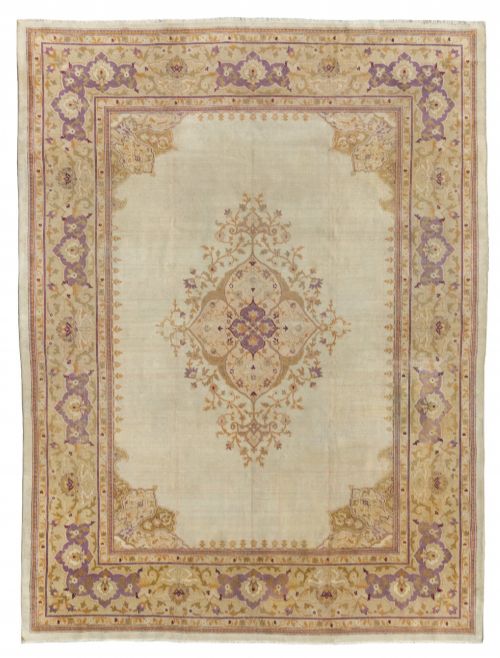


Large Decorative Floor Rug
A large decorative floor rug anchors a grand room with heavy wool pile, generous scale and centuries of woven tradition.
Large Decorative Floor Rug
A large decorative floor rug covers significant ground in a reception space, bringing room-scale presence to a period interior. These floor coverings span late nineteenth and early twentieth century production, offering substantial dimensions suited to high-ceilinged rooms.
The selection on this page centres on major woven formats from Persian, Turkish and North Indian workshops. Buyers find regional styles such as Heriz, Ushak, Sultanabad and Amritsar represented in room-scale formats.
Most pieces date between eighteen-eighty and nineteen-twenty, reflecting traditional patterns executed in wool and cotton foundations. Each rug provides a defined field and border arrangement designed to sit beneath major furniture groupings.
How they were made
Weavers constructed these carpets using wool pile knotted onto cotton or wool warp and weft foundations. Natural dyes imparted rich tones across the expansive fields, creating depth that develops character over decades of use.
Large formats required cooperative labour on upright looms, where multiple weavers followed traditional pattern maps. Edge finishes and ends were secured by hand to withstand heavy domestic traffic across grand interiors.
Current listings feature room-scale formats woven from wool and cotton, dating from eighteen-eighty to nineteen-twenty across Persian, Turkish and North Indian traditions.
What varies in quality
Quality rests in the handling of the wool and the crispness of the drawn design across a room-scale format. Superior examples display balanced proportions in their borders and harmonious saturation in their botanical or geometric motifs.
The integrity of the foundation and the uniformity of the knotting dictate how well a large carpet settles onto a timber floor. Finer execution in the weave allows the expansive field to lie flat and endure decades of walking.
The Large Decorative Floor Rug Glossary
- Warp
- The vertical threads stretched tightly on the loom before knotting begins. These form the structural skeleton of the carpet.
- Weft
- The horizontal threads passed between rows of knots to bind the structure together. They cross under and over the warp threads.
- Pile
- The upright cut ends of the knotted yarn that form the soft surface of the rug. Its density determines how the carpet feels underfoot.
- Field
- The central background area of the carpet enclosed by the borders. This space often displays medallions, repeating vines or open colour.
- Kilim
- A flat-woven carpet or textile produced without a pile. These pieces rely on interlocking weft threads to create geometric patterns.
Large Decorative Floor Rug: Frequently Asked Questions
How do I choose the right size for a room?
Measure your floor space to ensure the rug allows furniture legs to sit comfortably on the pile rather than teetering on the edge. Leave an even margin of exposed floor around the perimeter to frame the piece properly.
Consider the scale of your dining table or seating arrangement before selecting room-sized formats. A well-proportioned rug anchors the entire furniture layout without overwhelming the vertical dimensions of the room.
Where should a large floor rug be placed?
These generous carpets suit principal reception rooms, drawing rooms and large dining spaces where heavy foot traffic benefits from a soft, insulating surface. Their substantial dimensions fill open floor plans with warmth and visual weight.
Avoid damp areas or spaces exposed to direct, harsh sunlight that might strain historic dyes over time. Placing a quality underlay beneath the rug prevents slipping and cushions the foundation fibres against hard floorboards.
How do I care for antique wool carpets?
Vacuum the pile gently using suction only, avoiding beater bars that can pull at historic wool knots and warp threads. Lift and shake smaller sections rather than dragging the heavy textile across rough surfaces.
Rotate the rug every year to ensure even wear from foot traffic and sunlight exposure across the room. Professional cleaning should be undertaken sparingly by specialists familiar with antique vegetable dyes.
What defines an Ushak carpet?
Ushak carpets originate from the historic weaving centre in western Turkey, known for generous proportions and luminous wool. They typically feature grand floral motifs and softer, terracotta or ivory palettes.
These rugs became favored in European and American stately homes during the late nineteenth century because their decorative scale suited eclectic interiors. The looser knotting style gives them a relaxed, painterly quality compared to tighter Persian weaving.
How do I distinguish Heriz carpets?
Heriz carpets hail from northwest Persia and are renowned for bold geometric medallions and durable, heavy structures. Their robust wool and sturdy cotton foundations make them exceptionally resilient for busy rooms.
They often incorporate striking rust, navy and ivory tones arranged in robust corner spandrels and central stars. This architectural drawing style sets them apart from the curving floral vines seen in other Persian traditions.