


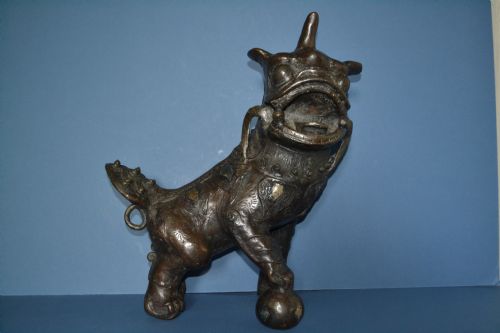
Large Bronze Lion
A large bronze lion brings immense presence to a room, cast in heavy metal as a guardian, a roaring beast or a classical sculpture.

Large Bronze Lion
When you search for a large bronze lion, you encounter everything from ferocious French animalier sculptures to temple guardians from Asia.
The pieces on this page span the nineteenth century and the early twentieth century, taking the form of free-standing figures, temple censers, door hardware and fireplace chenets.
Japanese Meiji period works and Chinese foo dogs sit alongside French animalier studies of crouching or roaring beasts.
Materials and Casting
These pieces are cast primarily in bronze, sometimes accompanied by brass, patinated bronze, or bronzed plaster and metal.
Surfaces receive varied treatments, including dark patination, verdigris, gilding, and occasional glass inlay.
Many sculptures incorporate bases of carved marble or raised metal stands to support the considerable weight of the metalwork.
Materials across these listings include bronze, brass, patinated bronze, marble, plaster, paint, and glass inlay.
Sculptural Detail and Finish
Quality rests in the crispness of the chase work, the vitality of the musculature and the nuance of the patination.
Signed works by known animalier sculptors or master Japanese bronze founders demonstrate superior anatomical precision and expressive power.
G. Gardet·Le Courtier·Antoine-Felix Bouré·Genryusai Seiya·G. Vastagh
The Large Bronze Lion Glossary
- Animalier
- A nineteenth-century artistic movement dedicated to the realistic portrayal of animals. French sculptors excelled in this genre.
- Foo Dog
- A traditional guardian lion of Chinese and Asian art, often depicted with a ball or as a pair guarding a temple entrance.
- Patination
- The chemical treatment or natural ageing process that colours the surface of bronze. It ranges from deep brown to bright verdigris.
- Censer
- An incense burner, frequently cast with lion mask handles or surmounted by a foo lion lid.
- Chenet
- A firedog or ornament placed at the front of a fireplace, sometimes cast in the form of rampant lions.
Large Bronze Lion: Frequently Asked Questions
What is a temple lion?
A temple lion is a traditional Asian guardian figure placed outside sacred spaces to ward off evil spirits. They often appear in pairs, with one holding a ball and the other a cub.
These bronzes served both religious and decorative purposes across China, Japan, Tibet and Thailand.
How do I care for a bronze sculpture?
Bronze requires very little maintenance beyond occasional dusting with a soft, dry cloth. Avoid using polishes or chemical cleaners that might strip the original patina.
Keeping the piece away from damp environments helps preserve surface treatments like verdigris and gilding.
What is animalier art?
Animalier art refers to nineteenth-century sculptures that focus on realistic depictions of animals in natural poses. French founders produced many of the most famous roaring and stalking lions in this style.
These works emphasise anatomical accuracy and dramatic tension.
How can I tell the period of a bronze lion?
Dating relies on stylistic clues, foundry marks, signature styles and the character of the patina. Nineteenth-century pieces often show distinct casting techniques and traditional wear.
Asian temple bronzes frequently reflect specific dynastic or Meiji period artistic conventions.