
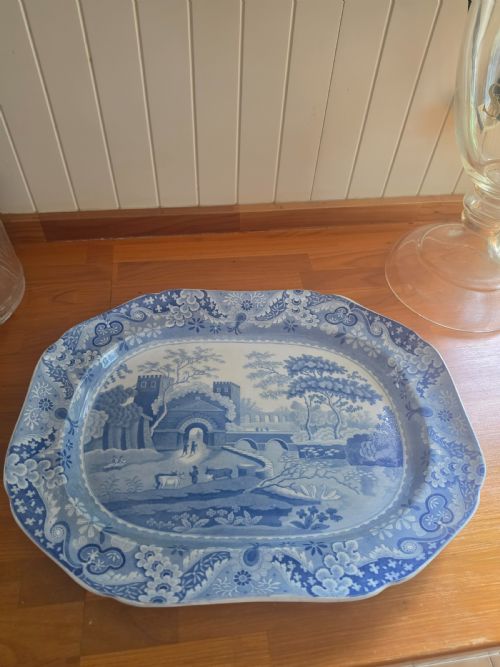



Large Blue Transferware Platter
A large blue transferware platter is a robust serving piece carrying printed cobalt scenes, designed to hold heavy joints at the dining table.
Large Blue Transferware Platter
A large blue transferware platter serves as a commanding centrepiece for historical dining, typically encountered in nineteenth-century earthenware and ironstone. These pieces range from Georgian meat plates to Victorian chargers, carrying dense blue printed scenes across expansive ceramic surfaces.
Buyers seeking a large blue transferware platter generally discover serving platters, meat dishes, and chargers decorated with pastoral landscapes, architectural views, or Chinoiserie motifs. The formats vary from deep serving platters with reservoirs to flat chargers intended for display or grand service.
How they were made
Potters produced a large blue transferware platter by applying a copperplate engraving onto tissue paper, which transferred the cobalt pigment onto the ceramic biscuit before glazing. This transfer print method allowed complex pictorial designs, such as Chinoiserie and landscape scenes, to be repeated with precision.
The body of a large blue transferware platter typically consists of earthenware, pearlware, ironstone, or stone china, finished with a transparent glaze. Firing in kilns produced the durable ceramic base required for heavy serving duties.
Reservoirs built into nineteenth-century carving platters ensured that greedy hounds beneath the mahogany table received an ample share of gravy.
What varies in quality
The quality of a large blue transferware platter rests upon the crispness of the cobalt transfer print and the depth of the ceramic body. Finer examples display sharp, detailed lines without smudging in the glaze, while lesser pieces exhibit blurred printing or uneven colour saturation.
Distinction in a large blue transferware platter also arises from the complexity of the maker's pattern, such as named topographical series or intricate Chinoiserie compositions, paired with a heavy, well-balanced ironstone or pearlware form.
Spode·Copeland and Garrett·Minton·Don Pottery·Elkin Knight and Bridgwood·Mason's Ironstone
The Large Blue Transferware Platter Glossary
- Transferware
- Pottery decorated by pulling an engraved copperplate impression onto paper and pressing it onto the ceramic body. This technique defined nineteenth-century mass production of blue and white tableware.
- Pearlware
- A refined earthenware body featuring a pale bluish glaze that pooled slightly in recesses, bridging the gap between creamware and true porcelain.
- Ironstone
- A heavy, durable ceramic patented for its strength, designed to resist chipping during heavy use at the dining table.
- Charger
- A large decorative plate or platter originally used for ceremonial service or placed beneath other courses.
- Chinoiserie
- European artistic style reflecting Chinese motifs, frequently adapted in blue transfer printing for romantic landscape scenes.
Large Blue Transferware Platter: Frequently Asked Questions
How were large platters used?
These large ceramic platters served roasted joints of meat and heavy fowl at the dining table. Some included reservoirs and drainers to catch juices during carving.
Over time, grand chargers also transitioned to wall display or sideboard decoration within Victorian homes.
How do I date a platter?
Dating relies on ceramic bodies, glaze characteristics, and maker marks stamped or printed on the reverse. Pearlware indicates earlier nineteenth-century manufacture, whilst ironstone and heavy earthenware became common later in the Victorian era.
Specific pattern names and series titles also help narrow the production window.
What is pearlware?
Pearlware is an early refined earthenware developed to rival Chinese porcelain by incorporating a subtle bluish tint into the transparent glaze. It appears frequently on pieces dating from the late eighteenth and early nineteenth centuries.
The pooling of the blue tint in crevices distinguishes it from standard creamware.
Can I use them for serving?
Most antique platters remain structurally sound for serving dry foods, though historic earthenware absorbs oils and warrants gentle hand washing. Many collectors prefer to utilise sturdy ironstone versions for occasional dining.
Displaying them on plate stands protects the glaze from modern cutlery wear.