
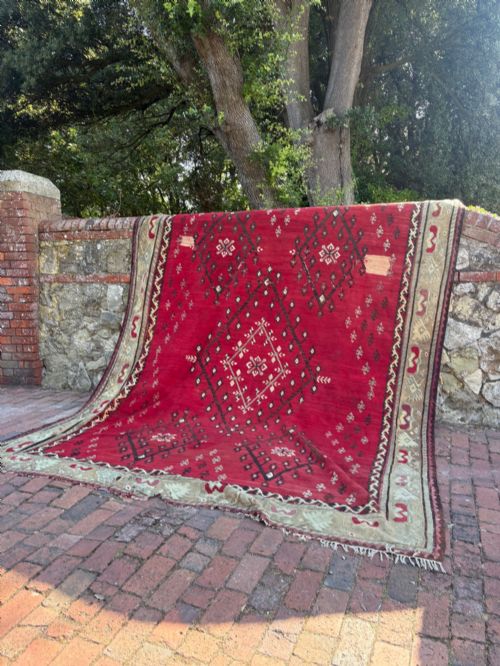


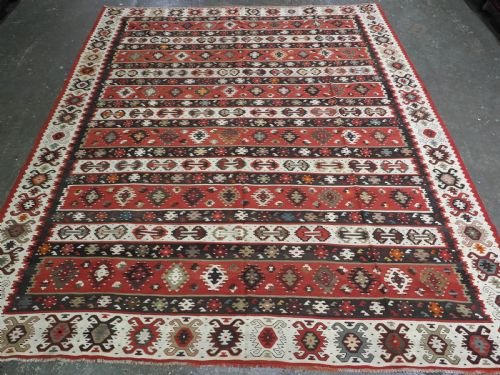
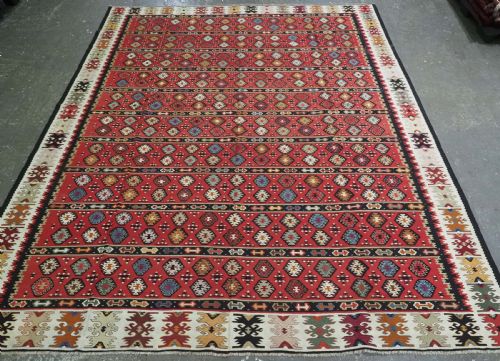


Large Kilim Carpet
A large antique kilim carpet brings floor-filling tribal pattern and flatweave texture to a room, drawn from regions across the Balkans, Anatolia and the Caucasus.
Large Kilim Carpet
When you search for a large antique kilim carpet, you encounter flatweave floor coverings spanning the late nineteenth century up to the nineteen-twenties. These textiles arrive from distinct weaving traditions including Anatolian, Caucasian, Bessarabian, and Balkan workshops.
You meet pieces defined by generous room dimensions, often constructed in joined sections or woven on wide looms. The forms include tribal runners, medallion carpets, and banded room-size formats.
The most common examples on this page date from around nineteen-twenty and showcase regional patterns such as Pirot, Sharkoy, and various tribal motifs. Each piece represents domestic or workshop weaving traditions from Central Asia, Turkey, and Eastern Europe.
How they were made
These carpets rely on wool and cotton foundations, utilising slit-weave techniques where weft threads loop back at the boundary of each colour block. This method produces flat, pileless textiles with sharp geometric edges and reversible designs.
Dyers employed natural or early aniline colourants to achieve the deep tones and pastel shades visible across the pieces. Weavers often worked in two parts, stitching separate panels together to create substantial room-size formats.
Several pieces feature the elusive bee motif, proving that nineteenth-century weavers liked to sneak pollinators onto the living room floor.
What varies in quality
Quality rests in the precision of the flatweave structure and the tightness of the wool tension across wide expanses. Finer examples display crisp geometric definition and balanced proportions within large medallion or banded layouts.
The sophistication of the dye palette and the integrity of the original wool foundation distinguish the upper tier of pieces. Expert historical repairs and well-preserved structural edges contribute significantly to the standing of an individual carpet.
The Large Kilim Carpet Glossary
- Kilim
- A flatweave carpet or rug produced by tightly interweaving horizontal and vertical threads without a pile. This technique creates a lightweight, reversible textile with characteristic geometric patterning.
- Slit-weave
- A weaving method where the weft threads return at the edge of a colour area, leaving a small slit in the fabric. This technique is standard in traditional flatweaves to define sharp pattern boundaries.
- Flatweave
- A textile constructed without knots or pile, formed purely by the interlacing of warp and weft threads. These pieces lie flat on the floor and served utilitarian and decorative roles in households.
- Bespoke
- Made to individual requirements or specific dimensions. In antique textiles, this often refers to custom workshop commissions for particular room sizes.
- Medallion
- A central decorative motif or focal ornament placed in the field of a carpet. These large geometric or floral designs anchor the symmetrical layout of the weaving.
Large Kilim Carpet: Frequently Asked Questions
How do I clean an antique kilim?
Surface dirt responds well to gentle, regular suction using a low-power vacuum without a rotating brush head. Professional specialist cleaning remains necessary for deeper washing to protect old wool fibres.
Avoid saturation and harsh chemical detergents that strip natural dyes from the flatweave surface. Air drying flat prevents distortion of the large carpet dimensions.
Are these carpets suitable for heavy foot traffic?
Flatweaves constructed from sturdy wool withstand normal walking when paired with a quality underlay. Placing a breathable rug pad underneath prevents slipping and cushions the textile against hard flooring.
Very delicate or timeworn examples benefit from placement in low-traffic spaces to preserve vulnerable areas. Rotating the carpet periodically balances wear across the surface.
How do I identify a Balkan kilim?
Balkan and Pirot or Sharkoy examples often feature precise banded designs and softer pastel palettes. These pieces typically date from the early twentieth century and show distinct European influences in their repeat motifs.
Comparing the border arrangements and colour transitions helps separate them from heavier Anatolian or Caucasian tribal weaves. Structural details in the wool assist in confirming the regional origin.
Why are some large kilims made in two parts?
Traditional vertical looms had width limitations that prevented weavers from producing expansive room-size carpets in a single piece. Craftspeople addressed this by weaving two separate runners and joining them neatly down the centre.
This construction method is a recognised feature of large format tribal and village weaving. The seam adds historical context without diminishing the utility of the floor covering.