


Lacquered Mantel Clock
A lacquered mantel clock brings hand-painted colour and metallic detail into a room, uniting functional timekeeping with decorative depth.
Lacquered Mantel Clock
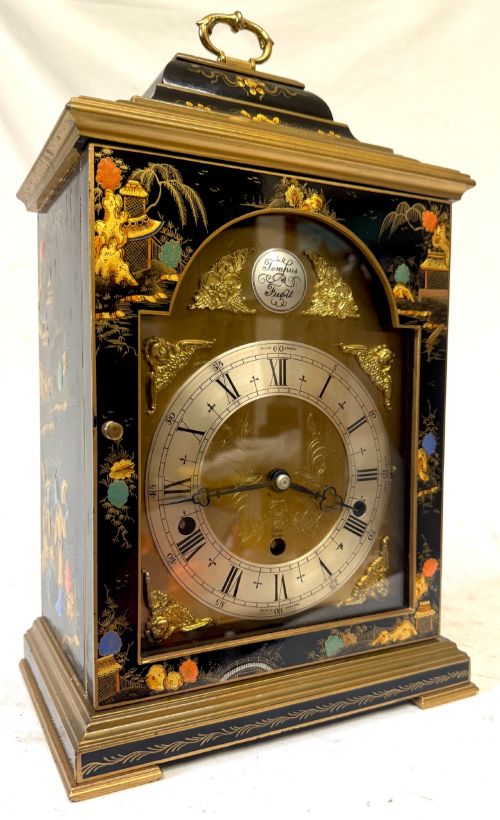
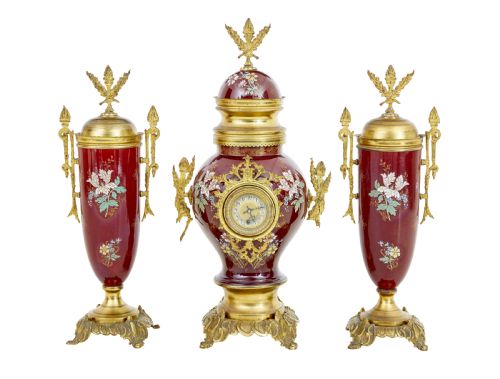
A lacquered mantel clock brings together portable timekeeping and decorative painted woodwork, frequently following Chinoiserie or 19th Century French styles. When you search for a lacquered mantel clock, you encounter bracket clocks, desk clocks, and complete garniture sets from the eighteenth century onwards.
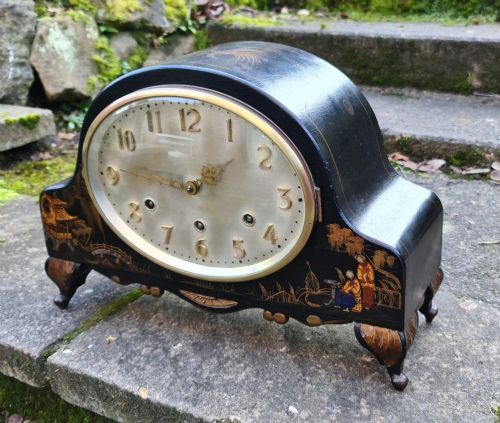
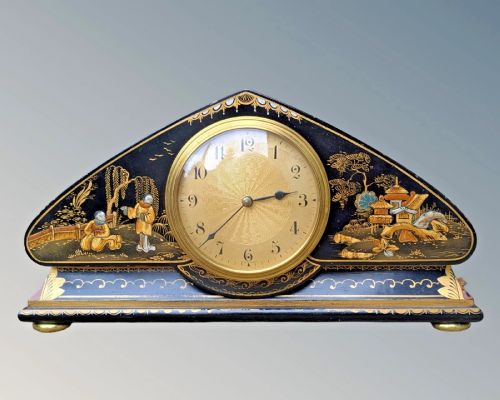
The most common versions on this page date from the Edwardian period and the early twentieth century, taking the form of compact architectural cases finished in green, blue, maroon, cream, or black lacquer. These pieces range from small bedside timepieces to larger eight-day striking bracket clocks intended for prominent placement on a mantelpiece.
Makers and origins span English workshops in London alongside French movements and decorative toleware schemes. While many examples adopt seventeenth or eighteenth-century aesthetic codes, the physical execution typically reflects later manufacturing dates spanning from eighteen-eighty to nineteen-sixty.
How they were made
Makers built the wooden carcasses of these clocks using timber foundations before applying multiple layers of lacquer to achieve a smooth ground. Artisans then decorated these surfaces with hand-painted gilt motifs, figures, and landscapes characteristic of Chinoiserie and Japanned ornamentation.
Mechanical components inside the wooden or toleware cases rely on brass plates, wheels, and escapements, sometimes paired with enamel dials or porcelain cartouches for the numerical hours. Gilt bronze fittings, cut glass, and cast brass bezels frequently frame the dial and protect the interior movement.
Listings feature lacquered mantel clocks spanning the eighteenth century to nineteen-sixty, constructed from wood, brass, glass, and gilt bronze.
What varies in quality
The distinction between standard production and superior work rests on the execution of the surface finish and the complexity of the internal movement. Hand-painted lacquer with layered gilt detail and depth separates fine decorative pieces from simpler applied finishes.
The sophistication of the timekeeping mechanism plays an equal role in separating examples, moving from basic timepieces to three-train musical movements or striking bracket clocks with alarm functions. The integration of quality materials like heavy brass mounts, enamel dials, and fitted glass panels defines the upper tier of the range.
James Smith·Chater And Son·Elliott London·Moser
The Lacquered Mantel Clock Glossary
- Chinoiserie
- European decorative style reflecting Chinese artistic influences, commonly featuring painted figures, pavilions, and landscapes on a lacquered ground.
- Bracket clock
- A portable table clock originally designed to sit on a wall bracket or a mantelpiece, often featuring an arched top and a carrying handle.
- Garniture set
- A matching set of decorative mantel ornaments, typically comprising a central clock flanked by matching vases or urns.
- Toleware
- Enamelled or lacquered sheet metal ware, shaped and decorated to resemble more costly materials.
- Escapement
- The mechanism within a clock that controls the release of power from the train to maintain the motion of the pendulum or balance wheel.
Lacquered Mantel Clock: Frequently Asked Questions
Where should I place a lacquered mantel clock?
These clocks suit prominent flat surfaces where the painted case and gilt details catch the light, such as a fireplace mantel, a sideboard, or a sturdy desk. Keep them away from direct sunlight and damp walls to protect the wooden carcass and the delicate lacquer finish.
Ensure the surface is level so the pendulum or balance wheel beats evenly. Placing the clock away from heavy vibrations ensures the internal movement keeps accurate time.
How do I wind an eight day clock?
Insert the winding key into the designated holes on the dial and turn it gently until you feel resistance. Do not overwind, as this can strain the internal spring mechanism.
For clocks with striking trains or alarms, make sure to wind all trains evenly so the clock functions as intended. Regular winding maintains steady tension on the movement.
What is the difference between a timepiece and a striking clock?
A timepiece simply measures and displays the hours and minutes without producing any sound. It contains a single train dedicated solely to the timekeeping function.
A striking clock includes additional gear trains that ring bells or gongs on the hour or the half-hour. Some advanced models also incorporate musical movements or alarms.
How can I tell an Edwardian Chinoiserie clock from an eighteenth century original?
Edwardian and early twentieth century reproductions or interpretations generally show standardised interior movements paired with machine-milled brass components, even when the exterior adopts an eighteenth century silhouette. The lacquer work on later pieces often exhibits a more uniform surface structure compared to early historic examples.
Examining the screw types, backplate signatures, and movement construction helps reveal the true period of manufacture. Many Edwardian pieces clearly state their style origins while housing reliable modern or late Victorian mechanisms.