
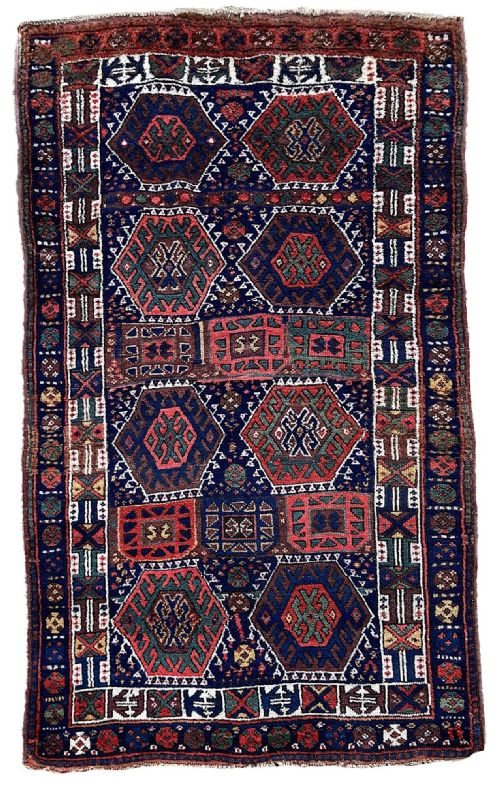


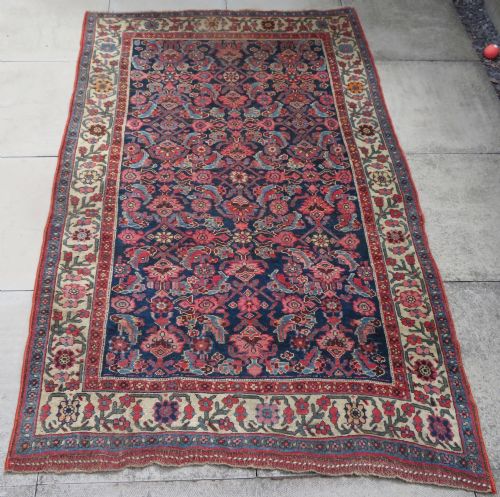


Kurdish Village Rug
A Kurdish village rug brings the geometric power of West Persian and Anatolian tribal weaving directly to your floor.
Kurdish Village Rug
A kurdish village rug is a hand-knotted tribal floor covering originating from regions such as West Persia, the Chahar Mahal Valley, and Eastern Anatolia. These pieces span periods from the nineteenth century through the early twentieth century, including examples dated around 1870, 1890, 1900, 1910, and 1920.
The format varies from compact area rugs to long hallway runners and narrow village made formats. Common regional attributions include Bijar, Kolyai, Hamadan, and Malatya Province.
How They Were Made
These textiles are constructed using wool on cotton foundations, knotted by hand in village workshops and nomadic encampments. The handling of the wool gives each piece a dense, durable handle suitable for daily use on floors and hallways.
Colour is imparted using natural dyes that yield rich, earthy tones across the field and borders. The interaction of these traditional dyestuffs creates the characteristic depth found in genuine nineteenth and early twentieth century tribal weaving.
The selection includes pieces spanning from 1870 to 1920, utilising wool foundations and natural dyes across Anatolian and Persian tribal styles.
What Varies in Quality
Quality in a kurdish village rug rests upon the crispness of the tribal design and the handling of the wool. Pieces with distinct hooked medallions, shrub motifs, or animal figures display greater graphic clarity.
The precision of the weave and the integrity of the natural dyes separate standard utility pieces from exceptional tribal examples. Region of origin, such as the workshops of Bijar or the Chahar Mahal Valley, also influences the structural density.
The Kurdish Village Rug Glossary
- Medallion
- A central ornamental motif set into the field of the rug. Hooked versions are typical of Kurdish and tribal weaving.
- Runner
- A long, narrow carpet format designed for corridors, hallways, and stairs. Several examples appear in both nineteenth and twentieth century dimensions.
- Natural Dyes
- Colouring agents derived from plants, minerals, and insects rather than synthetic compounds. They produce the variegated tones seen in older village rugs.
- Tribal
- A designation for rugs produced by nomadic or village groups rather than city manufactories. These designs reflect traditional motifs passed down through generations.
Kurdish Village Rug: Frequently Asked Questions
Where were kurdish village rugs made?
These rugs originate from tribal and village communities across West Persia and Eastern Anatolia. Specific production centres include the Hamadan region, Malatya Province, and the Chahar Mahal Valley.
Weavers in these areas utilised local materials and traditional designs handed down through generations of Kurdish tribes.
How do I care for an old rug?
Place a quality underlay beneath the rug to reduce friction and prevent slipping on hard floors. Vacuum gently without using a beater bar brush.
Rotate the rug periodically to ensure even foot traffic and exposure to light. Professional cleaning should be undertaken by specialists familiar with antique wool and natural dyes.
What is a runner rug used for?
Runners provide a durable and decorative surface for narrow spaces such as hallways, corridors, and landings. Their elongated format directs movement through a home while softening hard flooring.
Historical examples offer hardwearing wool construction designed specifically for areas of heavy foot traffic.
How can I tell the age of a rug?
Age is assessed through structural analysis, material examination, and design characteristics. Indicators include hand-spun wool, natural dye palettes, and regional knotting techniques associated with nineteenth and early twentieth century production.
Comparative study of archived examples helps establish whether a piece belongs to the 1870, 1900, or 1920 eras.