
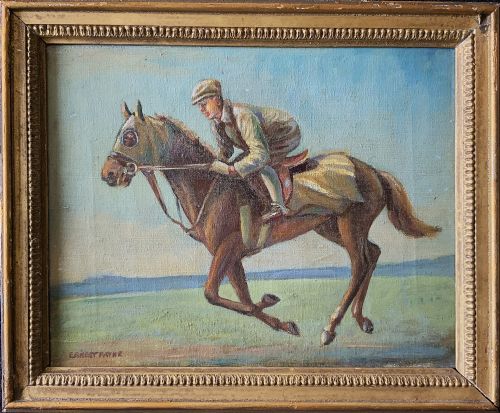
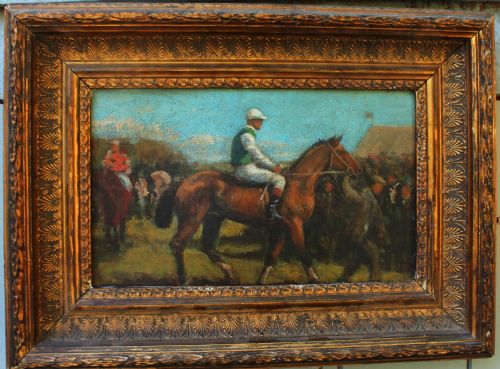


Jockey Oil Painting
A jockey oil painting captures the speed and colour of the turf, bringing the energy of the Victorian and Edwardian racecourse straight to your wall.
Jockey Oil Painting
A jockey oil painting depicts thoroughbred horses and their riders, spanning Victorian equestrian art through to mid-century French expressionism. These works capture specific moments in racing history, from the tension before the start to triumphant finishes at historic courses like Newmarket and Kempton Park.
The pieces on this page are most commonly rendered in oil on canvas or oil on board, frequently housed within period gilded wood frames. They range from detailed realist studies by named artists to atmospheric impressions and naive folk art interpretations.
Buyers seeking a jockey oil painting will find works varying from formal portraits of famous racehorses and their jockeys up, such as Persimmon with Jack Watts, to dynamic paddock scenes and steeplechase action.
Materials and technique
Artists built these works using oil paint applied to prepared canvas or wooden board, allowing for rich colour blending and textured brushwork. This medium enabled painters to capture the sheen of a horse's coat and the vivid hues of racing silks.
Many of these works are presented in gilded wood or giltwood frames that complement the traditional equestrian subject matter. The physical construction combines standard stretched canvas supports with robust wooden framing designed to protect the fine art within.
At least one horse on this page found fame sharing a name with a royal thoroughbred owned by King Edward VII.
Assessing quality and depth
Quality in these works rests upon the artist's ability to render the anatomy of both horse and rider with anatomical conviction and dynamic energy. Superior examples demonstrate a careful handling of light across the silks and muscle structure, moving beyond stiff portraiture to convey genuine motion.
The historical documentation associated with the painting also shapes its standing. Pieces that identify specific winning horses, named jockeys like Fred Archer, and documented owners command greater historical interest than anonymous or generic sporting scenes.
Ernest Payne·Alfred Munnings·Gabriel Dauchot·Alfred Wheeler·Isaac Cullin·John Parker Davis·Frank Giggs
The Jockey Oil Painting Glossary
- Canvas
- A heavy woven fabric stretched across a wooden frame to serve as a support for oil paint. It provides a flexible and durable surface favoured by traditional painters.
- Giltwood
- Wood that has been coated with a thin layer of gold leaf or gilt powder. It is commonly found on traditional frames surrounding 19th-century fine art.
- Equestrian realism
- An artistic style focused on the accurate and lifelike representation of horses and riders. It prioritises precise anatomical detail and realistic lighting.
- Oil on board
- A painting technique where oil paint is applied directly to a rigid wooden or composition panel rather than stretched fabric. This method offers a firm surface often used for smaller studies.
Jockey Oil Painting: Frequently Asked Questions
How do I care for an old oil painting?
Keep the canvas away from direct sunlight and damp environments to prevent the paint from cracking or fading. Dust the surface very gently with a soft, dry brush without applying pressure.
Avoid using water, chemical cleaners, or modern household sprays on either the painted canvas or the gilded frame. Professional conservation is recommended if the canvas slackens or the paint layer shows signs of instability.
Where should I hang equestrian art?
These works suit traditional studies, living rooms, and hallways where the rich tones of oil paint and gilded frames complement wooden furniture. Pair them with neutral wall colours to let the vibrant hues of the racing silks stand out.
Ensure the hanging location maintains a stable room temperature away from radiators and fireplaces. Proper placement protects the wooden stretcher frames and canvas from warping over time.
How can I tell the period of a painting?
Examine the materials of the canvas, the construction of the wooden stretcher, and the style of the frame for clues about the era. Victorian pieces often feature heavier gilded wood frames and darker, more restrained tonal palettes compared to mid-century works.
Look for inscriptions on the reverse of the canvas or board, which frequently record the names of the horse, jockey, racecourse, or artist. These contemporary notes provide reliable dating evidence for the artwork.