


Japanned Tray Table
These japanned tray table pieces bring hand-painted chinoiserie and lacquered surfaces to everyday rooms, offering a practical surface with historic character.
Japanned Tray Table
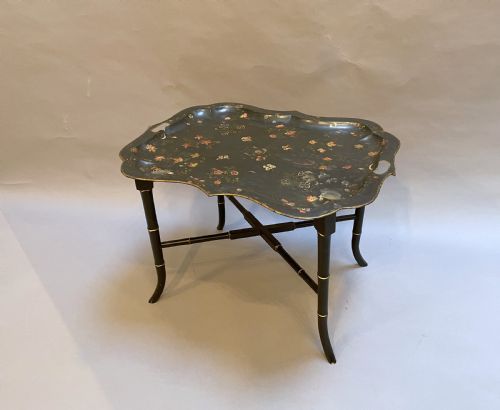
A japanned tray table combines a portable serving tray with a folding or fixed stand, creating a versatile occasional piece for the home. The form unites a deep tray top with a supporting base, often designed so the tray lifts off independently.
Most examples encountered here date from the eighteenth, nineteenth, and early twentieth centuries, spanning the Georgian, Regency, and Victorian periods. These pieces frequently manifest in forms such as occasional tables, side tables, and coffee tables.
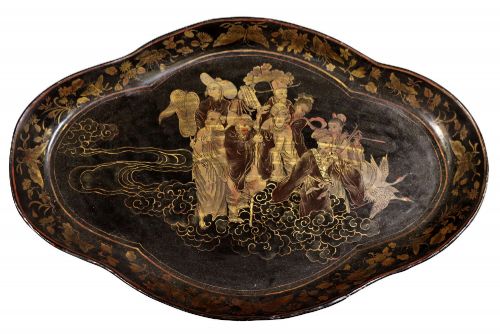
The decorative schemes rely heavily on chinoiserie motifs, featuring hand-painted figures, pagodas, and landscapes in gold leaf against dark lacquered grounds. Makers adapted these surfaces from earlier serving trays, mounting them onto stands to serve as functional furniture.
How they were made
Construction typically involves papier-mâché, lacquered timber, or metal toleware, built up in layers to create a rigid, smooth foundation for decoration. Artisans applied successive coats of varnish and dark lacquer, sanding between applications to achieve a durable finish.
Gold leaf and hand-mixed pigments were applied directly onto the prepared ground to build up intricate orientalist scenes and floral borders. Many nineteenth-century trays were subsequently paired with later wooden stands, adapting the original portable vessels into freestanding tables.
A surprising number of these sophisticated serving trays spent their retirement elevated on wooden legs to hold afternoon teacups.
What varies in quality
Quality rests upon the crispness of the hand-painted detailing and the depth of the lacquer layers. Finer specimens display meticulous gold leaf work and delicately rendered figures rather than simple stencilled motifs.
The integrity of the original material foundation, whether papier-mâché, lacquered timber, or toleware, dictates the longevity of the piece. Tables where the tray and stand share a unified period of origin generally command greater interest from collectors.
Jennens And Bettridge·Henry Clay
The Japanned Tray Table Glossary
- Japanning
- European imitation of East Asian lacquerwork, created by applying layers of varnish and heat-treating the surface. This technique was widely used on eighteenth and nineteenth-century trays and furniture.
- Papier-mâché
- A composite material made from paper pulp or layers of paper bound with glue, pressed and dried to form a tough, lightweight board. It provided a smooth, stable base for lacquering and painting.
- Toleware
- Painted or enamelled sheet metalware, often formed into trays and decorative vessels. The metal base was finished with dark japanned grounds and painted details.
- Occasional table
- A small, movable table designed for specific, intermittent use within a room. These pieces function easily as side or coffee tables.
Japanned Tray Table: Frequently Asked Questions
Are the trays removable from the stands?
Many traditional examples feature a loose tray resting on a folding or fixed wooden base, allowing the upper section to be lifted off independently. Some later iterations integrate the tray more permanently onto the supporting structure.
Examining the underside reveals whether the tray sits on battens or is secured with fixings to the stand.
How do I care for a lacquered surface?
Lacquered and japanned surfaces require gentle dusting with a soft, dry cloth to prevent scratching the delicate varnish layers. Direct sunlight and excessive moisture should be avoided to protect the underlying gold leaf and painted details.
Wax polishes are generally unnecessary and can sometimes damage historic finishes if applied incorrectly.
What is the difference between papier-mâché and toleware?
Papier-mâché is a sturdy composite material formed from compressed paper pulp and binders, offering a smooth, lightweight foundation for intricate painting. Toleware utilises sheet metal as a base, providing a heavier and more rigid metallic structure.
Both materials received similar japanning treatments, but their tactile weight and edge profiles differ distinctly.
How can I tell a Regency table from a Victorian one?
Regency pieces often display neoclassical proportions and refined chinoiserie motifs associated with the early nineteenth century. Victorian examples frequently embrace heavier ornamentation and robust papier-mâché forms.
Comparing the style of the hand-painted figures and the construction of the wooden stand helps clarify the period of manufacture.