
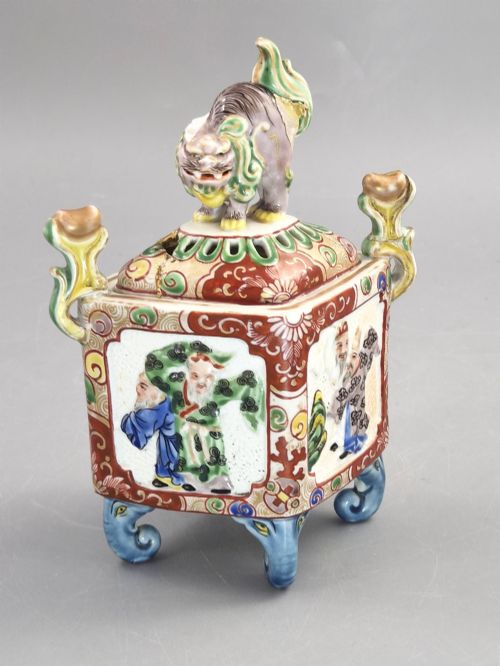


Japanese Porcelain Foo Dog
A japanese porcelain foo dog brings fierce protection and vibrant colour to a mantelpiece, rooted in centuries of kiln craft.
Japanese Porcelain Foo Dog
When you search for a japanese porcelain foo dog, you are looking at guardian lions modelled as figures, lidded jars, incense burners, and vases from the nineteenth century. These pieces encompass forms such as koro, temple figures, and lidded vessels originating from Meiji period kilns and Imari style workshops.
The most common examples you will meet on this page date from the Victorian era down to nineteen twenty, taking the form of Kutani models, Hirado guardian lions, and Imari style lidded vases. They capture the traditional Buddhist lion, known locally as the shishi or karashishi, often paired with brocade balls or serving as finials on jars.
Makers shaped these guardian figures in porcelain, applying cobalt underglaze, enamel, and gold leaf to articulate the curling manes and muscular frames. You encounter them individually or as pairs, ranging from small cabinet figures to large decorative vases.
Materials and production methods
Potters shaped these figures from fine white porcelain clay, throwing vessel bodies on the wheel or moulding intricate guardian lion sculptures by hand. They utilised cobalt underglaze for foundational blue details before firing the porcelain at high temperatures.
After the initial kiln phase, artisans applied overglaze enamels and gold leaf to enrich the surface with intricate floral and geometric patterns. Gilding and meticulous enamel work provided the vibrant palette characteristic of Kutani and Imari styles.
Guard your tea leaves with a fierce ceramic lion resting atop an incense burner lid.
Distinctions in execution and finish
The division between standard commercial output and superior work rests on the crispness of the modelling and the precision of the hand-painted enamel. Master modellers rendered the musculature and facial expressions of the guardian lions with immense energy, whereas lesser pieces appear stiff and formulaic.
The application of gold leaf and overglaze enamel also separates tiers of quality, with finer specimens retaining vibrant, densely layered pigments and intact gilding across the porcelain surface. Potteries achieved greater depth where the cobalt underglaze remained sharp beneath the glaze without blurring.
Samson
The Japanese Porcelain Foo Dog Glossary
- Karashishi
- A traditional guardian lion or Buddhist dog depicted with a curly mane and fierce expression. Sculptors rendered these mythical beasts to ward off evil spirits.
- Kutani
- A style of Japanese porcelain known for bold overglaze enamels and extensive use of gold. Kilns in the Kutani region produced vibrant figures and large decorative vases.
- Imari
- A traditional Japanese porcelain aesthetic characterised by cobalt blue underglaze combined with iron red and gilt overglaze decorations. European markets eagerly imported these brightly coloured wares during the nineteenth century.
- Koro
- A traditional Japanese incense burner fitted with a pierced lid. These vessels often feature guardian lions seated upon the cover as finials.
- Cobalt underglaze
- A blue pigment applied to raw porcelain clay before glazing and firing. This durable decoration withstands high kiln temperatures without fading.
Japanese Porcelain Foo Dog: Frequently Asked Questions
What is a japanese porcelain foo dog?
A japanese porcelain foo dog is a ceramic representation of the guardian lion or shishi, modelled as a standalone figure, an incense burner, or a vessel finial. These pieces draw on traditional Buddhist iconography designed to protect spaces from malevolent forces.
Craftsmen across nineteenth-century Japan produced these guardian figures in various regional styles, most notably Kutani and Imari. They served both decorative and ritual functions in domestic and export markets.
How were they used historically?
Historically, guardian lions stood near entryways or upon household altars to ward off evil and safeguard the inhabitants. Lidded jars and koro incense burners brought these protective motifs into daily domestic rituals.
Over time, international demand turned these functional ritual objects into popular decorative ornaments for Victorian and Edwardian drawing rooms. Their vibrant enamels and gilt details made them striking display pieces.
How do I care for antique porcelain?
Antique porcelain requires gentle handling, as overglaze enamels and gold leaf can wear down with abrasive cleaning. Dust the surface regularly with a soft, dry brush.
Keep these pieces away from direct sunlight to preserve the vibrancy of the cobalt underglaze and red enamels. Avoid using water or chemical cleaners on items featuring delicate gilding.
How do I distinguish Kutani from Imari styles?
Kutani porcelain typically relies on heavy overglaze enamels, featuring rich greens, purples, and extensive gold leaf to depict figures and natural scenes. The focus rests heavily on pictorial storytelling and dense surface decoration.
Imari pieces rely on a distinct palette combining cobalt blue underglaze with iron red and gilt highlights, often arranged in geometric and floral panels. The underlying porcelain body and decorative layout differ noticeably between the two traditions.