
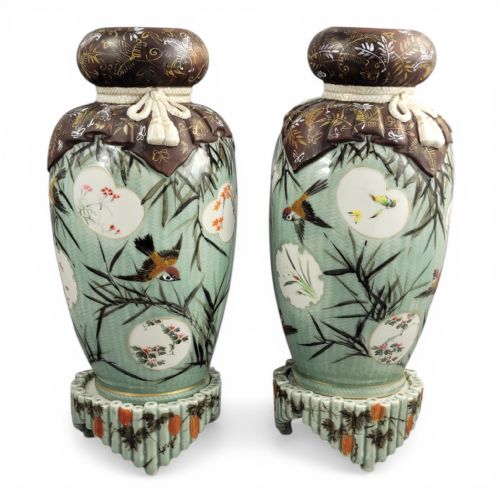


Japanese Porcelain Floor Urns
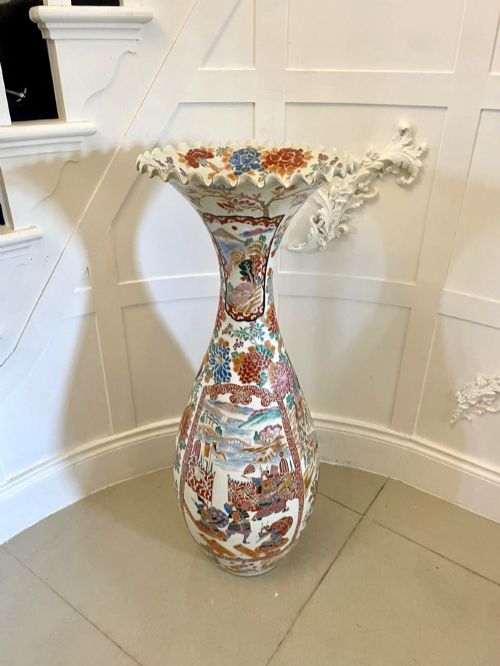
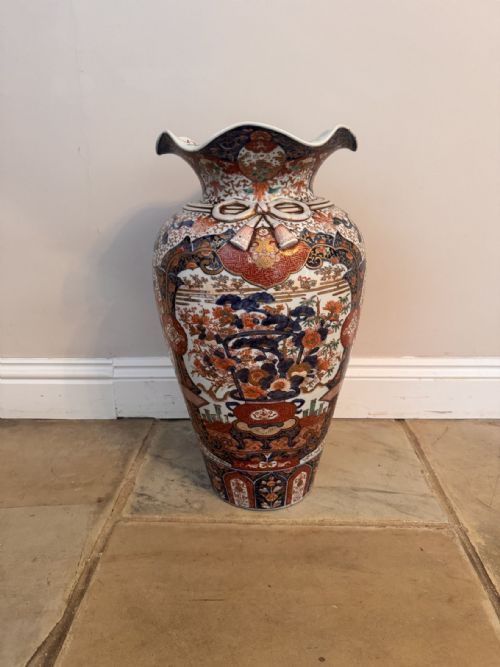
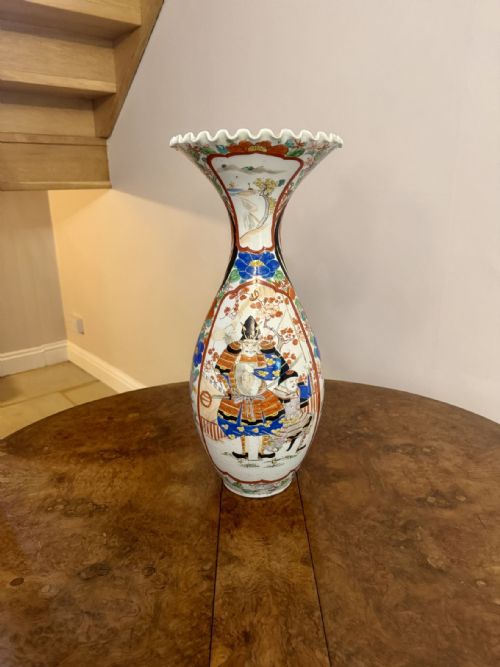
Japanese porcelain floor urns are substantial decorative vessels originating primarily from the nineteenth and early twentieth centuries, commanding attention in large interior spaces.
Japanese Porcelain Floor Urns
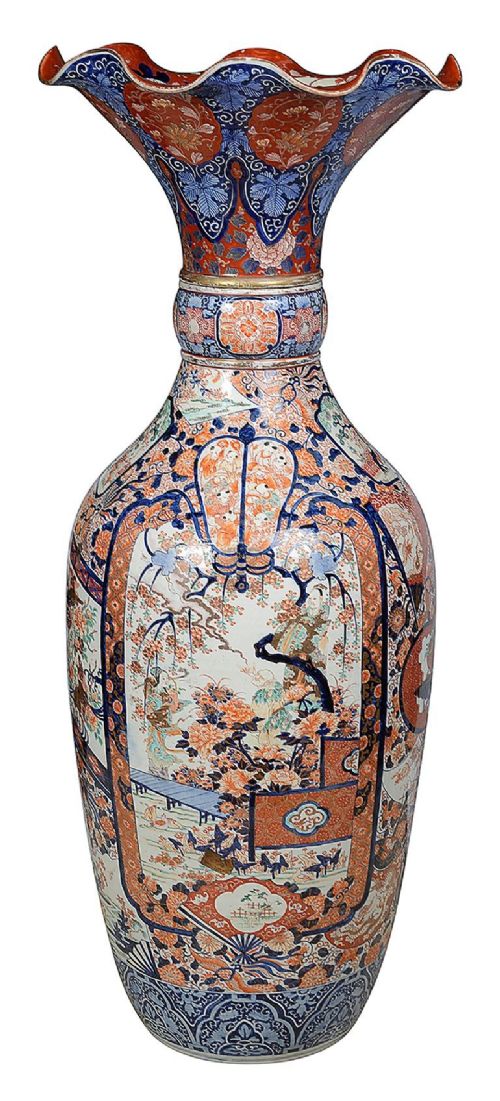
These grand vessels appear predominantly as floor-standing vases, floor vases, and tall lidded urns created during the Meiji period and the nineteenth century. Buyers searching for japanese porcelain floor urns encounter large-scale Imari palette pieces, Satsuma wares, and Kutani ceramics designed for export and domestic display.
The forms range from monumental pairs reaching over four feet in height to single bulbous, flared, and two-handled vases. Many rest on matching original porcelain stands or incorporate wood and lacquer panels into their presentation.
Dating spans the late nineteenth century through to the early decades of the twentieth century, encompassing export workshops and specific regional kilns.
Materials and construction
Makers utilised porcelain and earthenware bodies as the foundation for these large vessels, shaping them into towering floor-standing forms that required immense skill in the kiln to prevent warping. Artisans applied complex glazes alongside enamel decoration, gold leaf, and gilt highlights.
Surface ornamentation frequently combined traditional ceramic painting with supplementary elements such as lacquer over black paint and geometric inset panels. Original porcelain and wooden stands provided structural support for the heaviest monumental pairs.
The listings show Japanese porcelain floor urns dating from 1880 through to 1920, predominantly spanning the 19th Century and the Meiji period.
Evaluating craftsmanship and execution
Quality rests in the precision of the hand-painted enamel and the richness of the Imari palette or Satsuma gilding. Superior examples demonstrate disciplined brushwork and careful control during high-temperature firing, avoiding muddy colours or uneven glaze pooling.
The scale and ambition of the form also distinguish the range, as monumental pairs with original matching stands represent exceptional achievements by period potteries.
Kato Sanhei·Fukagawa
The Japanese Porcelain Floor Urns Glossary
- Imari palette
- A traditional decorative scheme utilising rich cobalt blue, iron red, and gold on a white porcelain ground. This style dominates nineteenth-century export production.
- Satsuma
- Earthenware pottery characterised by a fine crackle glaze, typically decorated with intricate polychrome enamels and raised gold leaf. It is frequently associated with the Meiji period.
- Meiji Period
- The era spanning from 1868 to 1912, marking a prolific period for Japanese ceramic export arts. Pieces from this time often display ambitious scale and detailed ornamentation.
- Kutani
- A style of Japanese porcelain and pottery known for bold colour palettes, often featuring greens, blues, yellows, and purples. Kutani floor vases often incorporate flared necks.
- Spill vase
- A tall, narrow vessel originally designed to hold wooden spills used for lighting fires or candles. In larger formats, these function as decorative floor cylinders.
Japanese Porcelain Floor Urns: Frequently Asked Questions
How were Japanese floor urns originally displayed?
These large vessels were placed directly on the floor in grand hallways, antechambers, and prominent reception rooms. Their considerable height allowed them to anchor empty corners and balance high ceilings.
Pairs were often positioned symmetrically around doorways or hearths to create an imposing visual impact in late nineteenth-century interiors.
What is the difference between Imari and Satsuma?
Imari pieces are made of hard porcelain and are traditionally decorated in cobalt blue and iron red with added gold. They present a crisp, resonant ceramic body.
Satsuma pieces utilise an earthenware body covered in a characteristic network of fine crackle glaze, serving as a textured base for dense enamel and gilt painting.
How do I identify a Meiji period piece?
Meiji period ceramics correspond to the dates of the Meiji Emperor's reign between 1868 and 1912. The items from this era often show a strong focus on international export markets, combining traditional motifs with ambitious scale.
Many bear period signatures or factory marks associated with this prolific era of Japanese craftsmanship.
Can these large vases hold water?
While technically ceramic vessels, floor urns of this size and age are generally treated as decorative objects rather than functional planters. The weight of water and soil can stress antique bodies and delicate interior glazes.
Using them dry preserves the structural integrity of the nineteenth-century porcelain and earthenware.