

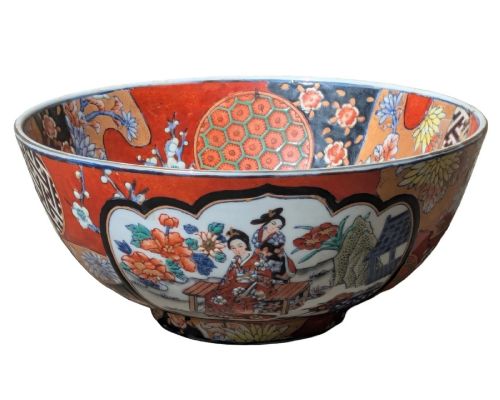
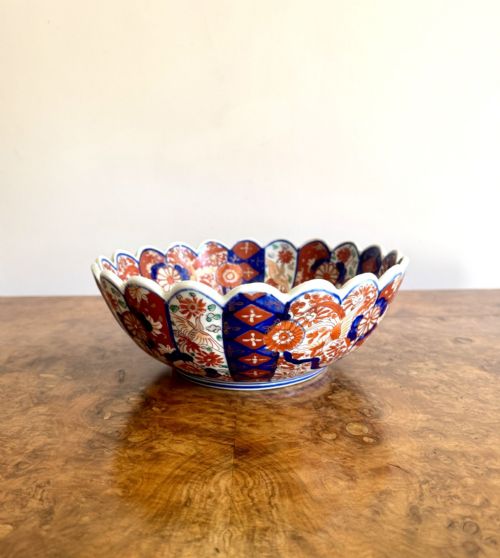


Japanese Imari Punch Bowl
A Japanese imari punch bowl brings rich cobalt blue, enamel, and gold leaf into a room, offering centuries of ceramic history.
Japanese Imari Punch Bowl
A japanese imari punch bowl is a decorative vessel rooted in centuries of ceramic tradition, appearing here across the 17th century, 19th century, Showa period, and Edwardian era. These pieces generally take the form of large decorative bowls or centrepieces, often shaped with distinctive scallop edges.
The items you encounter span multiple periods of production, ranging from early Edo and Genroku output to Meiji export wares and later 1930s examples. Buyers look to these vessels to anchor a room with traditional form and historic character.
How they were made
Potters built these bowls from porcelain, applying cobalt blue beneath the glaze before adding layers of enamel over the glaze. This foundational technique created the deep blue tones characteristic of the tradition.
Workshops then incorporated gold leaf and gilding to highlight intricate patterns across the surface. Firing these materials together bonded the metallic accents with the vitreous glaze.
The selection spans four distinct centuries, ranging from 17th century Genroku examples to 1930s Showa period porcelain.
What varies in quality
The distinction between standard output and finer examples rests on the crispness of the painted cobalt blue and the precision of the enamel work. Superior bowls display clean lines and harmonious balance across the scallop edge.
The application of gold leaf and gilding also separates tiers of production, with better pieces retaining rich metallic details that complement the underlying porcelain body.
The Japanese Imari Punch Bowl Glossary
- Porcelain
- A hard, white, translucent ceramic fired at high temperatures. It forms the vitrified body of these bowls.
- Cobalt blue
- A deep blue pigment derived from cobalt oxide used for underglaze painting. This colour remains stable at high kiln temperatures.
- Enamel
- Opaque or translucent glass applied over the fired glaze. It provides the secondary palette of colours on the bowl.
- Gold leaf
- Gold beaten into extremely thin sheets for decoration. It adds metallic highlights to the ceramic surface.
- Scallop edge
- A border shaped into a series of continuous curves. This contour appears frequently on the rims of these decorative bowls.
Japanese Imari Punch Bowl: Frequently Asked Questions
What is a Japanese Imari punch bowl?
A Japanese imari punch bowl is a porcelain vessel decorated in distinctive blue, enamel, and gold palettes. These pieces were produced for export and domestic use across multiple centuries.
They function primarily as decorative centrepieces, bringing historical ceramic art into modern interiors.
How do I date a Japanese Imari bowl?
Dating relies on stylistic markers, potting techniques, and the specific characteristics of the cobalt blue and enamel decoration. Pieces span from the 17th century Edo period through the Meiji era and into the 20th century.
Examining the foot ring and the weight of the porcelain helps establish the likely period of manufacture.
Where were these bowls made?
These bowls originated in Japan, specifically centred around the town of Arita in Hizen province. Kilns in this region produced porcelain for both the domestic market and European export.
Export wares often reflected tastes popular in Britain and Europe during the 19th and early 20th centuries.
How do I live with an Imari bowl?
Living with these bowls involves placing them on sturdy tables or sideboards where their colourful patterns can be seen. Their durable porcelain body makes them suitable for daily display in a home.
Owners typically keep them away from areas of high traffic to protect the overglaze enamels and gilding.
What colours define Imari ware?
Imari ware is traditionally defined by a palette of underglaze cobalt blue and overglaze iron red, complemented by gold leaf. This combination creates a striking contrast against the white porcelain ground.
Additional enamel colours such as green, yellow, and black frequently appear in the floral and geometric panels.