

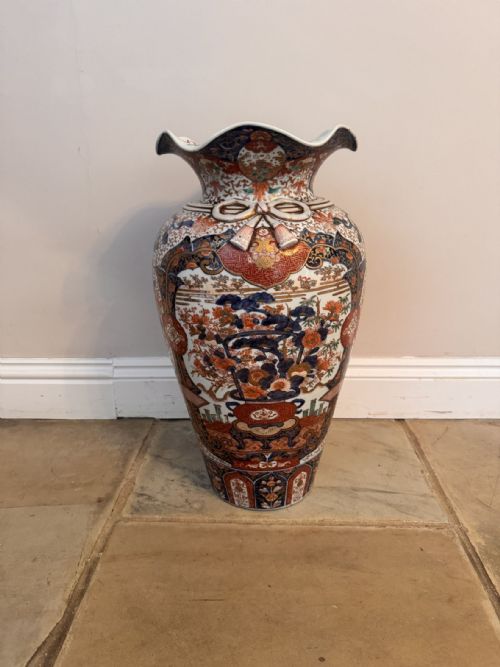


Japanese Baluster Floor Vases
Japanese baluster floor vases are large ceramic vessels designed for grand interiors, bringing imposing scale and intricate painted detail to a room.
Japanese Baluster Floor Vases
These Japanese baluster floor vases comprise substantial ceramic vessels originating from the nineteenth century, including the Meiji period. Buyers will frequently encounter impressive pairs alongside individual floor-standing pieces.
The inventory demonstrates distinct traditional styles, notably Japanese Imari, Satsuma, and Kutani. These forms are characterised by their sweeping curves, rising from a narrow base to a wider body before flaring at the neck.
Originating largely from the late nineteenth century, these objects served both domestic display and export markets. Their impressive physical presence makes them natural focal points in large hallways and principal reception rooms.
How japanese baluster floor vases were made
Makers utilised porcelain and earthenware as the primary structural bodies for these large vessels. The clay was thrown or moulded into the traditional baluster silhouette before undergoing high-temperature firing.
Decoration relied heavily on intricate enamel painting, frequently enhanced with gold leaf and gilt detailing. These surface applications were meticulously hand-painted over the glaze to create the complex patterns characteristic of Imari, Satsuma, and Kutani wares.
Japanese Baluster Floor Vases Retail Price Guide 2026
Typical asking prices for japanese baluster floor vases among the pieces listed under this phrase on Sellingantiques today, from the lower quarter to the upper quarter. They describe what is for sale here now, not the wider market.
Some nineteenth-century makers built vases so tall they required reinforced kilns just to survive the firing process.
What varies in quality
The precision and density of the hand-painted enamel work distinguish finer examples from standard production. Superior pieces exhibit exceptional control in the fine linework and rich application of gold leaf.
Scale and proportion also dictate the standing of a piece, with monumental heights and balanced symmetry commanding greater visual authority. The crispness of the underlying porcelain or earthenware form further separates the workshops.
Kinkozan
The Japanese Baluster Floor Vases Glossary
- Baluster
- A architectural form characterised by a swelling lower body tapering to a narrower neck, which defines the silhouette of these vases. This shape provides stability for tall ceramic objects.
- Imari
- A traditional Japanese style of porcelain decoration featuring deep cobalt blue, iron red, and gilt highlights. Pieces in this style were extensively produced for export during the nineteenth century.
- Kutani
- A style of Japanese coloured porcelain known for bold palettes, often dominated by greens, blues, yellows, and purples. These wares frequently incorporate elaborate figurative and floral motifs.
- Satsuma
- An earthenware pottery type with a characteristic ivory-coloured, crackled glaze that provides a canvas for detailed polychrome and gilt painting. This ware was particularly popular during the Meiji period.
- Meiji Period
- The era in Japanese history spanning from 1868 to 1912, marked by the opening of trade with the West and a surge in the production of decorative arts.
Japanese Baluster Floor Vases: Frequently Asked Questions
Where should I place a floor vase?
These large vessels suit grand spaces such as entrance halls, landings, or spacious living rooms where their scale can be fully appreciated without obstruction.
Position them directly on the floor away from heavy foot traffic to protect their historic enamel and gilt surfaces from accidental impact.
How do I identify Meiji period pieces?
Meiji period vessels generally date between 1868 and 1912, a time when Japanese export ceramics reached new heights of technical and artistic ambition.
Look for distinctive stylistic markers such as dense Imari palettes, Kutani pictorial scenes, or the characteristic crackled glaze of Satsuma earthenware.
Are these vases meant for fresh flowers?
Historic floor vases of this scale were primarily manufactured as decorative objects for display rather than functional containers for water and fresh stems.
Placing water inside antique porcelain or earthenware can risk damaging the historic body and internal glaze, so dry arrangements or empty display are advised.
What is the difference between Imari and Kutani?
Imari wares are defined by their distinctive palette of underglaze cobalt blue and iron red, frequently enriched with gold leaf upon a porcelain body.
Kutani pieces often display a broader, more vibrant spectrum of enamel colours, frequently featuring detailed figurative narratives across porcelain surfaces.