


Jacobean Revival Settle
These jacobean revival settle examples are sturdy oak hall benches built for heavy domestic traffic, giving your entranceway practical character.
Jacobean Revival Settle
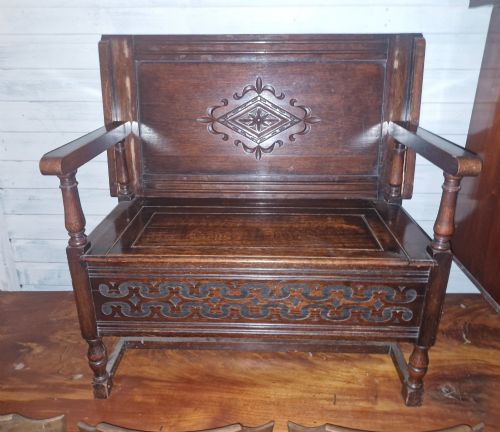
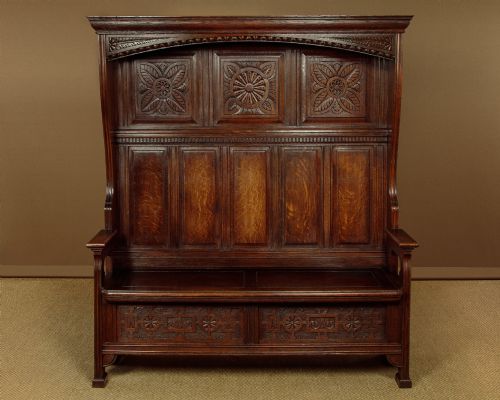
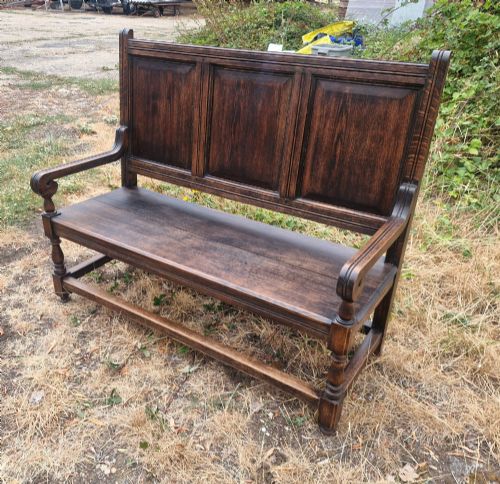
A jacobean revival settle takes the heavy, high-backed seating form of the seventeenth century and reinterprets it across the Victorian, Edwardian and early twentieth century periods. You will encounter these primarily as oak hall seats, box settles and monks benches designed for hallways and reception rooms.
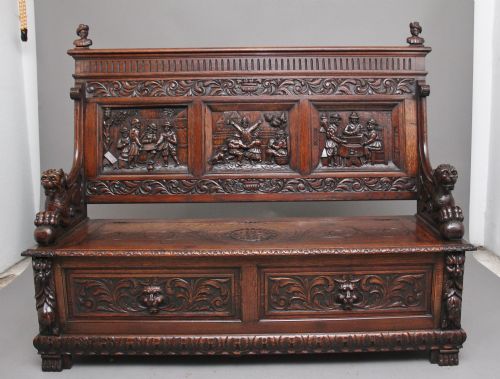
The versions most common on this page date from the late nineteenth century through to the nineteen thirties, drawing heavily on Gothic revival and Victorian baronial design elements. They function as both bench seating and storage furniture through lift-up lids or fold-over tops.
How they were made
These pieces rely entirely upon solid oak timbers, joined with traditional framing and panel construction to handle the weight of daily use in busy halls. Metal and iron hinges support the heavy lift-up lids and fold-over mechanisms found on many variants.
Carving forms the primary decorative technique, utilising deep relief work to render traditional motifs, panels and occasional green man masks. Some variations incorporate textile elements such as fabric, velvet and fringe details on upholstered components.
Listings span from the eighteen eighties through the nineteen thirties, showing consistent reliance on solid oak as the primary timber.
What varies in quality
Depth and crispness of the carved ornamentation separate standard production pieces from finer examples, as does the selection of the oak timber itself. Heavier proportions and more sophisticated panel construction indicate a higher standard of workshop output.
The cleverness of the mechanics in convertible pieces, such as monks benches that fold from seat to table, dictates the sophistication of the build. Better examples maintain tight joints and smooth movement in their lift-up lids and folding tops over decades of use.
The Jacobean Revival Settle Glossary
- Settle
- A wooden bench with a high back, solid arms and often a box base for storage. They were originally placed near firesides to block draughts.
- Monks bench
- A convertible piece of furniture with a hinged back that folds down to form a table top over a box seat. It is a popular multi-functional variant.
- Box settle
- A bench featuring a compartment beneath the seat accessed by lifting the lid. This provided essential storage in historical hallways.
- Green man
- A sculptural architectural motif representing a human face surrounded by or sprouting foliage. It appears frequently in revival carving.
- Panelled
- Construction method utilising framed wooden panels that float within grooves to accommodate seasonal wood movement. This prevents splitting in large oak surfaces.
Jacobean Revival Settle: Frequently Asked Questions
Where should I put a settle?
A jacobean revival settle fits naturally in a spacious hallway, boot room or large landing where its solid proportions balance open wall space.
Because many examples include lift-up seats or fold-over tops, they also serve as practical storage furniture for daily items while providing sturdy seating.
How do I date a settle?
Dating relies on observing the timber finish, construction methods and the specific revival style influences present in the carving and proportions.
Pieces from the Victorian and Edwardian periods often display crisp machine assistance alongside hand carving, whereas earlier items show entirely hand-worked joinery.
What is a monks bench?
A monks bench is a compact form of settle featuring a hinged back that folds down flat over the armrests to create a table surface.
This dual-purpose design allowed smaller rooms to serve multiple functions without needing separate tables and chairs.
Are these benches comfortable?
These wooden benches feature upright high backs and solid oak seats designed for posture and durability rather than lounging.
Owners often add loose cushions, fabric pads or textiles to soften the seat for everyday use in a modern home.