

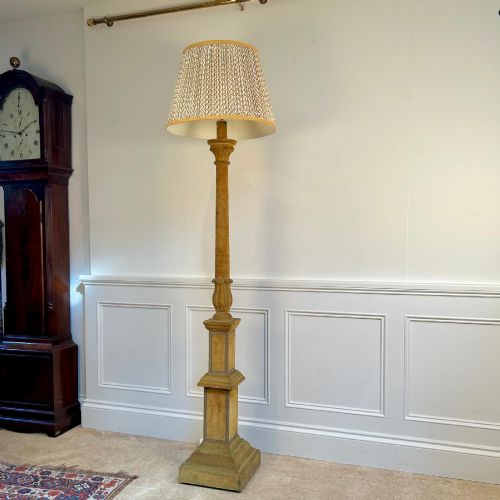


Italian Standard Lamp
An italian standard lamp brings sculptural presence to a room, combining dramatic height with centuries of decorative tradition.
Italian Standard Lamp
An italian standard lamp functions primarily as a floor-standing lighting fixture or decorative torchere, designed to anchor a room with height and illumination. When searching for an italian standard lamp, buyers encounter pieces ranging from nineteenth-century antiques to vintage twentieth-century examples.
The forms typically draw upon historical aesthetics, frequently channeling Florentine, Venetian, and broader Baroque styles. Many pieces take the shape of fluted columns, balusters, or elaborate figural standards.
Makers and workshops often utilised regional design idioms, producing both matched pairs and individual statement pieces. Buyers frequently find lamps fashioned from carved timber, complete with specialised stands or bases.
How they were made
Traditional construction relies heavily on carved wood foundations, shaped into intricate forms before receiving surface decoration. Artisans applied layers of gesso to smooth the timber substrate and create crisp relief details.
Gilding represents a defining technique, utilising gold leaf or applied gold paint to achieve a luminous finish. Polychrome paint and marbleised effects frequently appear alongside gilt surfaces, particularly on Venetian and Florentine pieces.
Italian Standard Lamp Retail Price Guide 2026
Typical asking prices for italian standard lamp among the pieces listed under this phrase on Sellingantiques today, from the lower quarter to the upper quarter. They describe what is for sale here now, not the wider market.
Listings feature periods spanning from the Victorian era and the nineteenth century through to 1930.
What varies in quality
The depth and crispness of the hand-carving dictate the visual distinction of the piece, where deep undercut foliage surpasses shallow profiling. The application of gold leaf and the subtlety of polychrome paint layers also separate standard production from superior craftsmanship.
Structural integrity within the wooden column or base determines longevity, particularly regarding stability at height. Original surface patination preserved over decades holds greater appeal than heavy-handed modern intervention.
The Italian Standard Lamp Glossary
- Giltwood
- Wood that has been decorated with gold leaf or gold powder. This finish gives the lamp its characteristic metallic sheen.
- Gesso
- A plaster-like mixture applied to wood to create a smooth surface for carving and gilding. It allows for sharp, detailed ornamentation.
- Torchiere
- A tall floor lamp designed to direct light upwards. These pieces often feature decorative standards reminiscent of historical candle stands.
- Polychrome
- The practice of decorating architectural elements or sculpture in a variety of colours. It adds painterly depth to carved wooden surfaces.
- Baroque
- A flamboyant artistic style originating in Italy, characterised by exuberant motion and elaborate ornamentation. It heavily influences the decorative vocabulary of these lamps.
Italian Standard Lamp: Frequently Asked Questions
What is an italian standard lamp?
An italian standard lamp is a tall floor-standing lighting fixture, often carved from wood and finished with gold leaf or painted decoration. These pieces draw upon historical design traditions originating in Italy.
They serve both functional lighting purposes and as sculptural decorative objects within an interior space.
How do I date an italian standard lamp?
Dating relies on examining the construction methods, the type of gesso and gilding applied, and stylistic indicators such as Baroque or Florentine motifs. Nineteenth-century examples often show deeper hand-carving and distinct patination.
Twentieth-century pieces from the 1920s and 1930s may incorporate similar historical revivals but exhibit different wood drying characteristics and surface wear.
Where were these lamps placed?
These tall floor lamps were traditionally positioned in principal reception rooms, grand hallways, or beside seating areas to provide ambient upward illumination. Their substantial height made them effective corner pieces.
They were designed to be viewed from all angles, functioning as independent sculptural elements within a room scheme.
Are these lamps usually found in pairs?
While many pieces survive as single standards, matched pairs do appear, particularly from the nineteenth and early twentieth centuries. Pairs were originally commissioned to balance grand architectural spaces.
Single lamps frequently function as reading lights or focal points next to large pieces of furniture.