
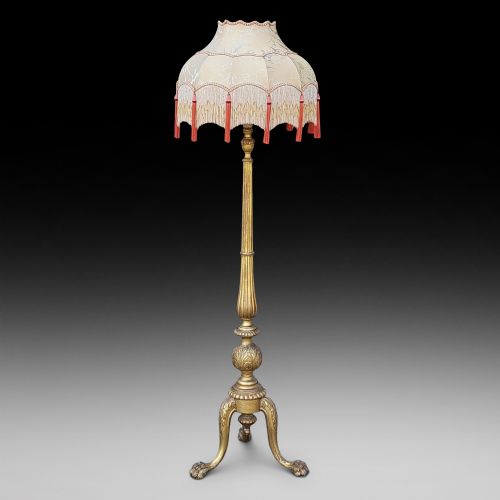
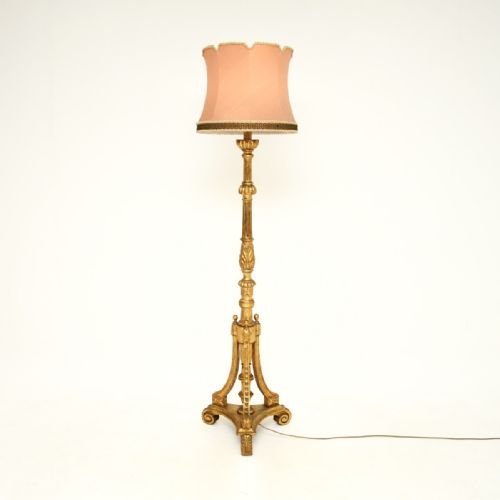


Giltwood Floor Lamp
These giltwood floor lamp examples bring stately height and golden warmth to a room, offering grand illumination through traditional craftsmanship.
What They Are
A giltwood floor lamp brings height and illumination to a room, functioning as both a practical light source and a sculptural furnishing. These tall pieces stand on weighted bases, rising through carved columns to support shades or candle fittings.
Most examples found here date from the nineteenth and early twentieth centuries, drawing heavily upon historical European design vocabularies. Buyers encounter Italian Baroque styles alongside neoclassical revival pieces and French chateau influences.
The inventory includes both single standards and matched pairs, with forms ranging from simple turned columns to elaborate torcheres. Many originate from Italian workshops, while others reflect English interpretations of eighteenth-century aesthetics.
How They Were Made
These lamps rely upon a wooden core that is typically carved by hand from solid timber. Artisans shape the wood into fluted columns, acanthus leaves, and scrollwork before applying preparatory layers.
Gesso provides a smooth bed over the carved wood, allowing fine details to remain sharp beneath the metallic finish. Gold leaf or surface gilding is then applied by hand, sometimes complemented by painted accents in green or red.
Fabric elements such as velvet shades or silk linings complete the construction, contrasting with the hard, reflective metallic surfaces of the wooden standards.
Retail Price Guide 2026
Typical UK retail prices for giltwood floor lamp, calculated from the Sellingantiques database of over a million retail prices indexed since 2003. This retail price guide relies exclusively on Sellingantiques data; no external sources or auction records are used, so the figures do not describe the wider market.
Some of these tall golden standards began life as candle-bearing torcheres before accepting the modern intrusion of electricity.
What Varies in Quality
The depth and crispness of the hand carving separate simpler standards from more ambitious sculptural pieces. Superior examples display undercut foliage and confident asymmetry that reflect skilled artisan training rather than mechanical repetition.
The application of the gold leaf and the preparation of the underlying gesso dictate how light catches the surface. Finishes that retain a soft, burnished glow show greater sensitivity than flat, uniform paints.
The Giltwood Floor Lamp Glossary
- Giltwood
- Wood that has been coated with thin sheets of gold leaf or metallic powder. This finish provides a warm, reflective surface that brightens dark corners.
- Gesso
- A plaster-like mixture applied to wood to create a smooth surface for gilding. It holds fine detail well and builds up the relief of carved ornaments.
- Torchere
- A tall decorative stand originally designed to hold a candle or censer. In later periods, these forms were adapted to hold electric lamp fittings.
- Standard lamp
- A traditional British term for a floor lamp. It denotes a tall vertical post supported by a heavy base designed to stand directly on the floor.
- Baroque style
- An ornate design aesthetic characterised by dramatic curves, rich ornamentation, and dynamic movement. It influences many of the Italian pieces found here.
Frequently Asked Questions
What is a giltwood floor lamp?
A giltwood floor lamp is a tall vertical lighting fixture featuring a wooden structure coated in gold leaf or metallic gilt. These pieces combine functional illumination with decorative carving inspired by historical European aesthetics.
They serve as prominent vertical accents in a room, often placed beside seating areas or in corners where height and ambient light are required.
How do I date a giltwood floor lamp?
Dating relies upon examining the style of the carving, the method of construction, and the materials used in the core and finish. Pieces from the nineteenth and early twentieth centuries often adopt earlier Baroque or neoclassical revival motifs.
Evidence of hand-tooling on the timber and the composition of the gesso layers beneath the gilding help distinguish older pieces from later reproductions.
Where were these lamps made?
The recorded pieces originate primarily from Italian workshops, particularly in Florence, as well as from English makers. Italian examples often embrace exuberant Baroque and Florentine carving styles.
English pieces from the early twentieth century frequently draw upon neoclassical Adam revival designs, showing a more restrained approach to ornamentation.
How do I integrate one into a room?
These tall standards work best where vertical presence and warm, reflected light can balance existing furniture. They anchor empty corners or stand gracefully behind large armchairs.
The gold leaf finish pairs well with traditional textiles like velvet and silk, reflecting natural and artificial light to soften a space.