


Italian School Landscape Artwork
Italian school landscape artwork brings sunlit vistas, classical ruins and Mediterranean coasts straight into the room.
Italian School Landscape Artwork
Italian school landscape artwork spans centuries of European painting, covering expansive rural views, pastoral scenes and coastal harbours. Buyers examining this page encounter oil paintings on canvas and wood panel alongside framed works on paper.
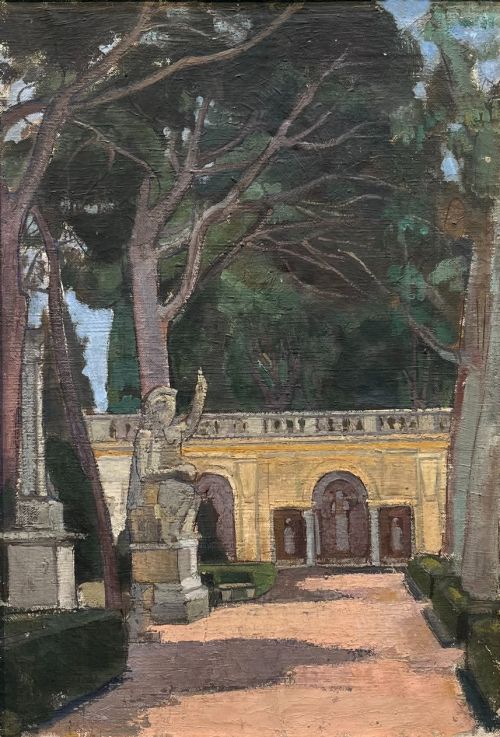
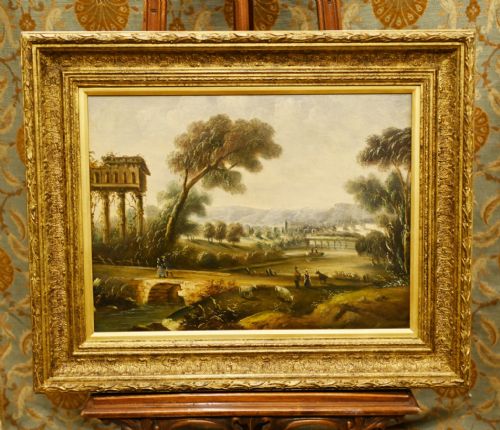
Many works adopt traditional European and Italian Baroque idioms, depicting architectural ruins, cavalry skirmishes or figures beside ancient trees. Others capture local maritime life, including boats and coastal waters under Mediterranean light.
Materials and construction methods
Painters applied oil paint to stretched canvas or prepared wood panels, building rich surfaces with layered brushwork. Many works incorporate delicate gouache on paper, particularly for topographical coastal views.
Surviving pieces retain their original or period framing, constructed from wood and finished with giltwood or gold leaf. Protective glass often shields works on paper and gouache paintings from environmental wear.
A painted dog quietly waits while figures roam a pastoral landscape.
Assessing quality in landscape paintings
Quality rests upon the handling of light, atmospheric perspective and the depth of the composition. Finer examples display confident brushwork in rendering foliage, architecture and distant mountainous horizons.
The preservation of the paint layer and the integrity of the original support influence the standing of a piece. Intact surfaces without excessive restoration reveal the artist's original touch and tonal balance.
Fernando Del Basso·Giulio Cecchini·Giacomo Nani·Thomas Brabazon Aylmer
The Italian School Landscape Artwork Glossary
- Gouache
- An opaque water-based paint that dries to a matte finish. It was frequently utilised for bright topographical scenes and coastal views.
- Giltwood
- Wood carved and coated with gold leaf or metallic powder. It forms the decorative frames common on 18th and 19th-century paintings.
- Pastoral
- A genre of art depicting rural or idealized pastoral life. These scenes typically incorporate shepherds, classical ruins, lakes and mountains.
- Grand Tour
- A traditional trip through Europe undertaken by upper-class Europeans. Travellers collected regional paintings and gouaches as mementos of Italy.
Italian School Landscape Artwork: Frequently Asked Questions
What periods do these landscapes cover?
The listings span from the eighteenth century through the nineteenth century and into the mid-twentieth century. This timeline captures shifting European approaches to landscape painting.
Examples range from eighteenth-century oil paintings of architecture and pastoral views to nineteenth-century coastal scenes and twentieth-century interpretations.
How were these paintings constructed?
Artists utilised oil paint on canvas or wood panels, while others worked in gouache on paper. These materials were paired with wooden frames finished in giltwood and gold leaf.
Many pieces retain glass protection, particularly works on paper and gouache paintings, safeguarding the delicate pigments from dust and moisture.
Where do these scenes usually depict?
The artworks focus primarily on Italian subjects, including Rome, Naples, Sorrento, Capri and Civita Castellana. These locations reflect the enduring appeal of the Italian landscape to painters and travellers.
Views often feature Mediterranean coasts, lakeside mountains, ancient architecture and pastoral countryside settings.
How do I display framed artwork safely?
Hang paintings away from direct sunlight and steady heat sources to protect the canvas, wood panel and paint layers. Maintaining stable room humidity prevents warping in wooden supports and frames.
Ensure wall fixings match the weight of the piece, particularly for larger framed oil paintings or multi-part sets.