


Italian Marquetry Chest
An italian marquetry chest brings sophisticated geometric or pictorial wood inlay into a room, offering both generous storage and striking decorative presence.

Italian Marquetry Chest
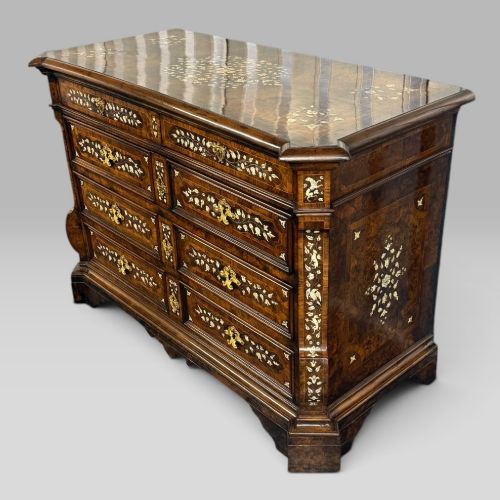
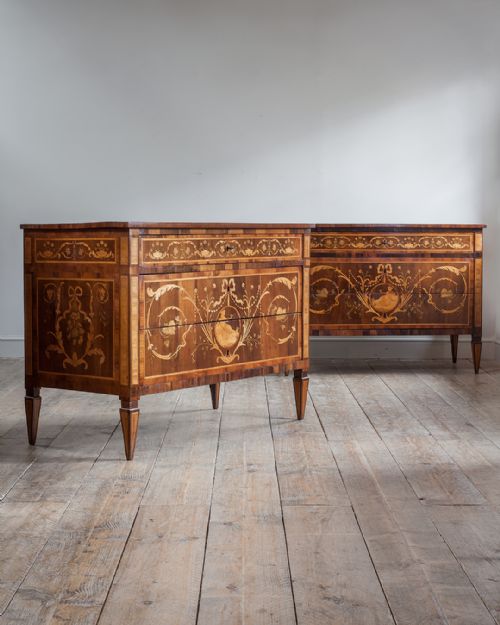
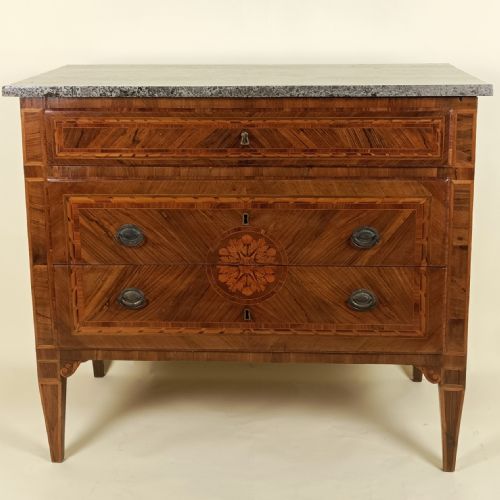
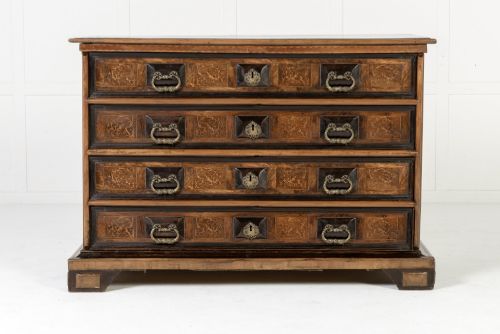
An italian marquetry chest appears in several distinct configurations, most commonly as a commode with drawers or a smaller table casket. These pieces originate from various periods including the eighteenth and nineteenth centuries, spanning regional styles from Lombardy and Sorrento to broader Baroque and Neoclassical movements.
The standard commode form dominates the selection, often featuring bombe contours or straight fronts enriched by elaborate surface decoration. Alongside these larger chests, smaller decorative boxes and cabinets demonstrate the same meticulous inlay traditions on a miniature scale.

Materials and Construction
Cabinetmakers constructed the carcase using primary woods such as walnut and fruitwood, frequently enhanced by burl walnut, kingwood, or ebonised wood veneers. Surface enrichment relied on precise cutting and fitting of contrasting timbers, sometimes supplemented by bone inlay, brass, or ormolu mounts and marble tops.
Makers formed complex pictorial or geometric patterns by assembling thin veneers of various woods into the surface design. Additional decorative depth was achieved through specialised techniques like Sorrento Ware production and intricate bone-inlaid detailing on revival pieces.
Listings feature walnut, fruitwood, burl walnut, and ebonised wood alongside decorative additions like bone inlay, brass, and marble.
Craftsmanship and Proportion
Superior examples display exceptional precision in the cutting and alignment of the wood veneers, where grain direction and contrasting tones create a seamless pictorial effect. The fluidity of the carcase lines, particularly on bombe commodes, separates masterwork joinery from simpler production.
The refinement of secondary materials, such as finely chased ormolu mounts, well-fitted marble slabs, and intact bone inlay, indicates the original workshop's standing. Finer pieces maintain crispness in their intricate surface patterns without visible distortion in the underlying timber structure.
The Italian Marquetry Chest Glossary
- Marquetry
- The art of applying pieces of veneer to a structure to form decorative patterns and pictures. This technique defines the visual character of these chests through contrasting woods.
- Commode
- A low chest of drawers originating in France and widely adopted in Italy during the eighteenth century. These pieces usually stand on elegant legs and serve both storage and display functions.
- Bombe
- A swelling or outward curving contour found on the sides and front of furniture carcases. This curvilinear form requires advanced woodworking skill to execute properly.
- Ormolu
- Gilded bronze used for decorative mounts and hardware on high-status furniture. It adds a metallic contrast to the wooden surfaces.
- Sorrento Ware
- Decorative woodwork produced in the Italian town of Sorrento, typically featuring micro-mosaic inlays and olive wood construction. Small caskets and boxes frequently showcase this specialised regional craft.
Italian Marquetry Chest: Frequently Asked Questions
What is an italian marquetry chest?
An italian marquetry chest is a storage piece, such as a commode or casket, decorated with intricate wood veneer patterns. These furnishings date from various periods including the eighteenth and nineteenth centuries.
Craftsmen utilised woods like walnut, fruitwood, and kingwood to create geometric or pictorial designs across the surfaces. They range from large bedroom and reception commodes to small tabletop caskets.
Where were these chests made?
These pieces originated in various regions of Italy, with specific stylistic centres like Lombardy and Sorrento producing distinct designs. Workshops in these areas developed local traditions in veneer work and inlay.
Pieces also reflect broader movements such as Italian Baroque, Neoclassical, and Renaissance revival styles. Regional preferences heavily influenced the choice of woods and motifs.
How do I care for an antique chest?
Maintain these pieces by keeping them away from direct sunlight and extreme humidity fluctuations, which can affect the delicate veneer. Dust gently with a dry, soft cloth.
Avoid using silicone-based polishes or harsh chemical cleaners that may damage the historic wood surfaces and bone inlay. Professional conservation is recommended for any structural or surface maintenance.
How can I tell the period?
Dating relies on examining the construction methods, wood types, and stylistic vocabulary of the piece. Eighteenth-century examples often feature Neoclassical or Baroque proportions, while later nineteenth-century items may show revival characteristics.
Hardware, secondary timbers, and the specific style of the marquetry patterns provide further clues to the era of manufacture. Comparing the carcase construction to known regional timelines helps confirm the age.