


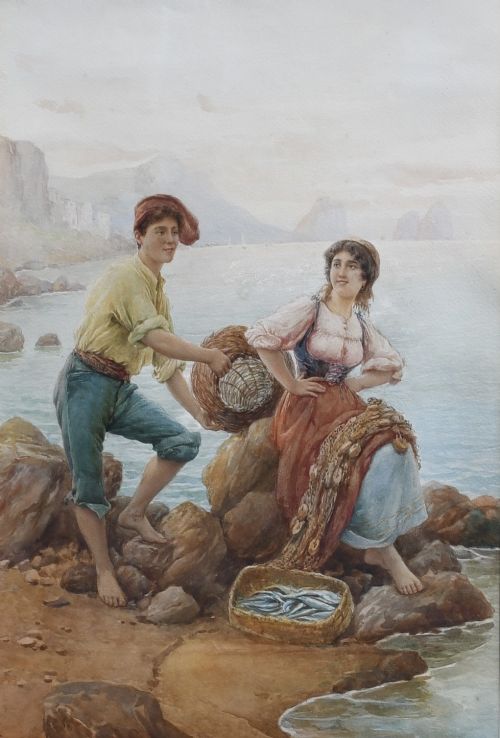


Italian Landscape Watercolour
When you search for an italian landscape watercolour, you are looking at paper works capturing views of Venice, Rome and the Campagna.
Italian Landscape Watercolour
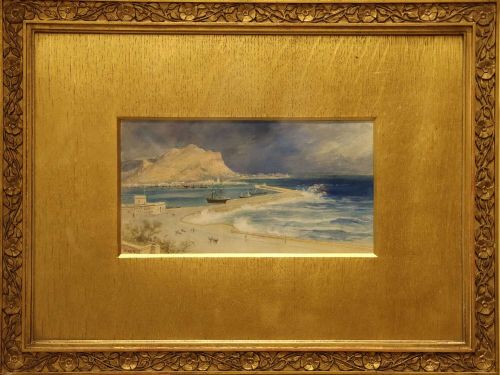
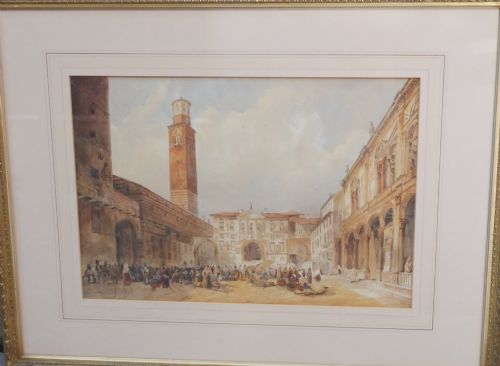
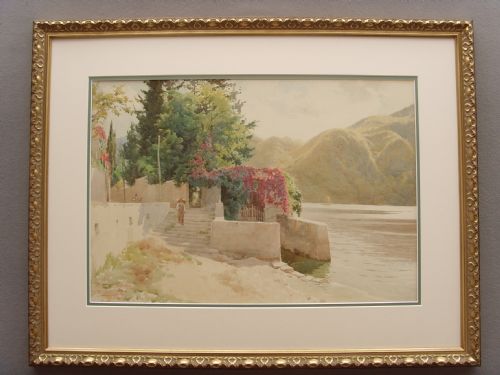
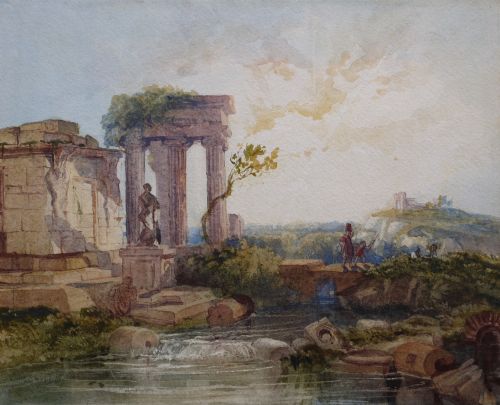
An italian landscape watercolour captures the light and topography of the Mediterranean, from the canals of Venice to the Roman ruins of the Campagna. These paintings record the travels of artists through regions such as Tivoli, Florence and Naples, often produced during the Victorian era or the height of the Grand Tour. The most common examples on this page are framed works on paper depicting historical architecture, lakes and coastal scenes.
The subjects range from intimate studies of rural figures to wide vistas of the Grand Canal, painted on location or completed in studios from earlier sketches. Works span from the nineteenth century into the early twentieth century, reflecting shifting tastes in romanticism and classical topography. Buyers find both single sheets and paired sets documenting specific Italian landmarks.
How They Were Made
Artists applied watercolour pigment onto paper or card, sometimes utilising bodycolour to build opaque highlights and depth in architectural stonework and water. The works are typically preserved behind glass and housed within wood frames, occasionally featuring gilded wood or gold leaf detailing that complements the subject matter.
Techniques relied on transparent washes to capture the warmth of the Italian sun, combined with precise pencil or pen underdrawings to define classical buildings and figures. The support materials range from standard artist paper to embossed card, reflecting the diverse methods available to travellers and resident painters alike.
Italian Landscape Watercolour Retail Price Guide 2026
Typical asking prices for italian landscape watercolour among the pieces listed under this phrase on Sellingantiques today, from the lower quarter to the upper quarter. They describe what is for sale here now, not the wider market.
Listings feature works executed on paper, card and glass, spanning the nineteenth century through the Edwardian period.
What Varies in Quality
The distinction between works rests on the surety of the brushwork, the management of atmospheric light, and the precision of the architectural perspective. Superior examples demonstrate a confident handling of pigment that evokes the heat and distance of the landscape without overworking the paper.
Framing and preservation also set pieces apart, as original glazed settings and minimal foxing protect the integrity of the delicate pigments. The depth of the composition and the artist's ability to render human figures naturally within the vast Italian scenery separate standard topographical records from masterly works.
Richard Principal Leitch·Thomas Ellison·Richard Henry Wright·Carlo Ferranti·Robert George Talbot Kelly·Franz Knebel·Benedetto Salviati·Hercules Brabazon Brabazon·Charles H Poingdestre·David Law·Wilfred Knox·Ettore Ascenzi·Henry Wimbush·John D Walker·T Williams·Arthur Severn·Helen Donald-Smith·Thomas Brabazon Aylmer·John Varley·Arthur John Black·A E Martin·M Argeles·William Page
The Italian Landscape Watercolour Glossary
- Grand Tour
- A traditional trip through Europe undertaken by upper-class Europeans, resulting in the commissioning of local art and landscape views. These watercolours served as tangible records of foreign travel.
- Bodycolour
- Watercolour mixed with a white pigment to make it opaque, allowing artists to add highlights and solid areas of light. It is frequently seen in nineteenth-century depictions of architecture.
- Campagna
- The countryside surrounding Rome, characterised by rolling hills, ancient aqueducts and classical ruins. It was a primary subject for landscape painters seeking picturesque antiquity.
- Foxing
- Brown spots and discolouration that appear on old paper due to chemical reactions over time. Its presence is common in works kept in humid conditions.
- Wash
- A thin, fluid layer of watercolour paint spread evenly across the paper to create sky or water effects. Masters achieved great luminosity through controlled layering of these washes.
Italian Landscape Watercolour: Frequently Asked Questions
What is an italian landscape watercolour?
These works are paintings executed in water-soluble pigments on paper, depicting scenes across Italy. They typically feature recognizable landmarks, ruins, lakes, or coastal views.
Created by artists recording their travels or working locally, they range from small observational studies to large exhibition pieces.
How were these watercolours displayed?
Historically, these paintings were framed behind glass to protect the fragile paper and water-soluble pigments from dust and moisture. Many retain their period wooden or gilded frames, which reflect the framing styles of the nineteenth and early twentieth centuries.
Collectors continue to mount them behind glass using acid-free materials to ensure long-term preservation.
How do I date an antique watercolour?
Dating relies on stylistic clues, artist signatures, inscriptions on the reverse, and the physical characteristics of the paper and framing. Nineteenth-century works often carry specific studio dates or exhibition labels that help establish a timeline.
Examining the watermark on the paper can also provide a reliable window of production.
Where were these paintings created?
Many were painted on the spot by travelling artists visiting popular stops along the Italian itinerary, including Venice, Rome, Naples and Florence. Others were composed back in home studios using preliminary sketches and watercolours brought back from the journey.
Venice and Rome remain the most frequently recorded locations in this tradition.