
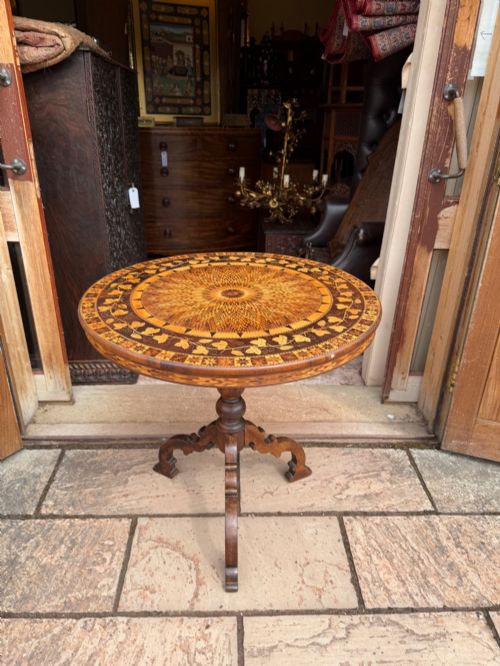
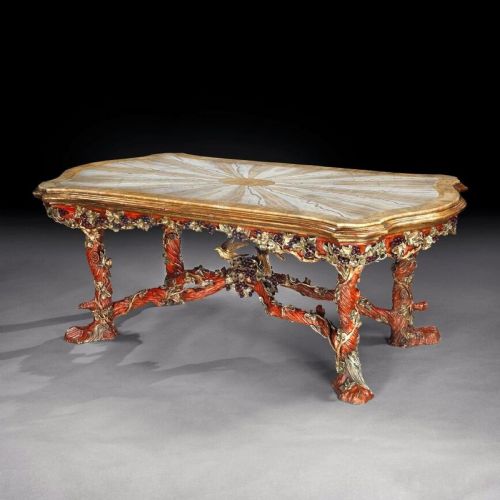


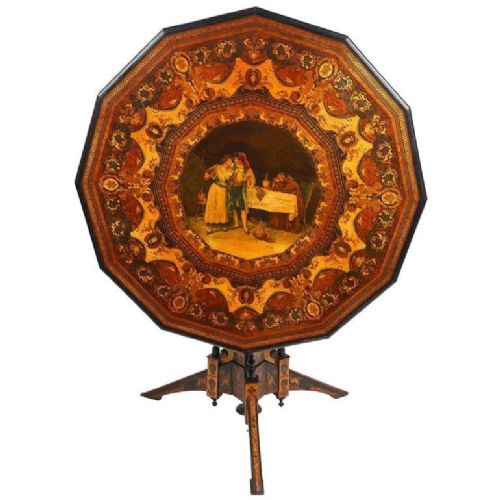
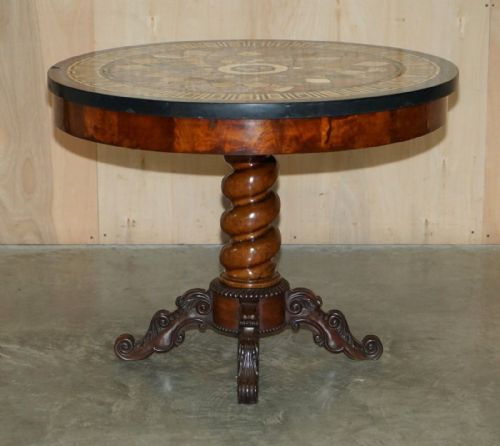


Italian Inlaid Centre Table
These Italian inlaid centre table examples bring rich marquetry and polished stone directly to the middle of a room.
Italian Inlaid Centre Table
An Italian inlaid centre table is a freestanding piece designed to anchor a room, appearing in forms such as occasional tables, coffee tables, and side tables. Buyers seeking an Italian inlaid centre table encounter works ranging from the eighteenth century through to the early twentieth century.
The materials span walnut, mahogany, and olive wood, frequently combined with marble tops, pietra dura, and bone inlay. Sorrento ware and Florentine designs dominate the visual styles seen across these surfaces.
Pedestal formats and tilt-top mechanisms appear frequently, alongside low centre tables and traditional round coffee table shapes. These tables often reflect Grand Tour influences and regional craftsmanship from Sorrento and Florence.
Materials and construction methods
Cabinet makers utilised walnut, fruitwood, and mahogany as foundational timbers, shaping them into pedestals and frames. Ebonised finishes sometimes provide a dark contrast to lighter marquetry designs.
Complex surface patterns rely on fruitwood inlay, bone, and intricate marquetry to create pictorial or geometric scenes. Meanwhile, heavy stone elements incorporate marble, scagliola, and pietra dura specimen panels set directly into the wooden tops.
Some tables feature birds rendered entirely in polished stone, bringing feathered detail to the middle of the drawing room.
Factors that distinguish the work
Quality rests in the precision of the marquetry and the complexity of the stone work. Fine pictorial inlays and well-fitted specimen marble panels require considerable skill to execute cleanly.
The choice of timber and the stability of the pedestal base also separate standard production from finer workshops. Heavier stone tops demand robust structural support beneath the table surface.
Amleto Bertoni·Almerico Gargiulo
The Italian Inlaid Centre Table Glossary
- Marquetry
- A decorative technique where small pieces of wood veneer are arranged on a structure to form pictorial designs. It creates intricate surface patterns across the table top.
- Pietra dura
- An artistic method of using cut and fitted polished coloured stones to create images. This technique appears on high-status table tops.
- Scagliola
- A composite substance made from glue, natural pigments, and selenite that mimics true marble. It allows for detailed decorative borders and faux stone panels.
- Sorrento ware
- Woodwork produced in the Italian town of Sorrento featuring micro-mosaic inlay and botanical motifs. These pieces often utilise olive wood and fruitwood.
- Specimen marble
- A table top composed of numerous small geometric or sliced samples of different coloured marbles. Each sample is polished and arranged into a cohesive geometric pattern.
Italian Inlaid Centre Table: Frequently Asked Questions
Where should I place a centre table?
A centre table stands freely in the middle of a room rather than against a wall, allowing the top to be viewed from all sides.
Ensure there is adequate surrounding space to walk around the piece comfortably.
How do I care for a marble top?
Stone and marble surfaces require gentle cleaning with a damp cloth and mild soap, avoiding acidic substances that can etch the polish.
Use coasters and protective pads to prevent scratches on both wooden and stone areas.
What is the difference between marquetry and inlay?
Marquetry covers the entire surface in a veneer puzzle of different woods, whereas inlay involves carving into a solid wood base to insert contrasting materials like bone.
Both techniques create patterned surfaces but utilise different structural methods.
How do I identify a Sorrento piece?
Sorrento tables often display distinct geometric marquetry, floral motifs, and local woods such as olive and fruitwood.
Many examples also feature tilt-top mechanisms designed for easy storage when not in use.