
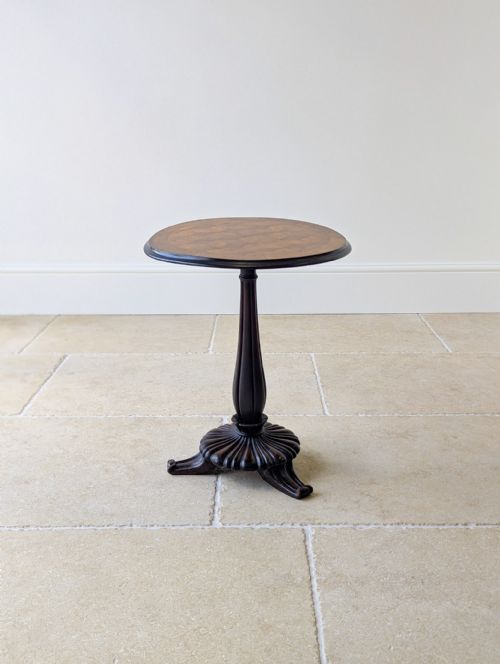
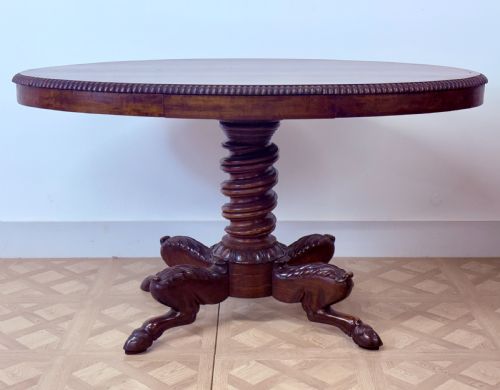
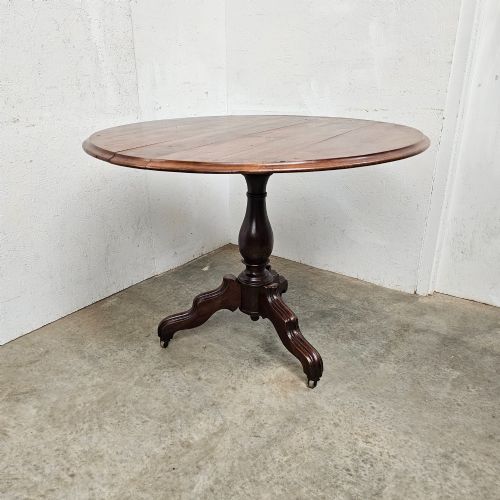


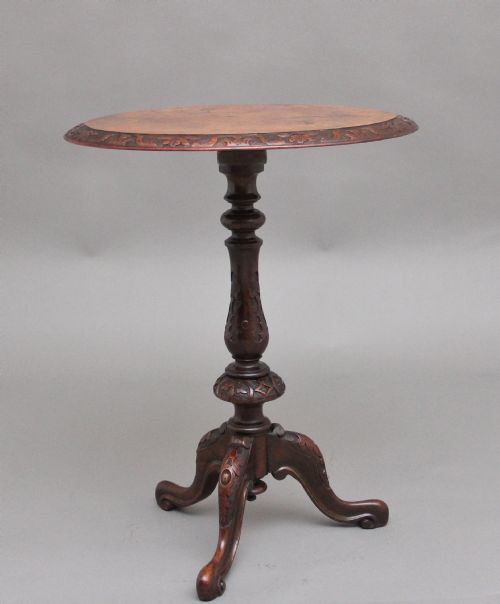


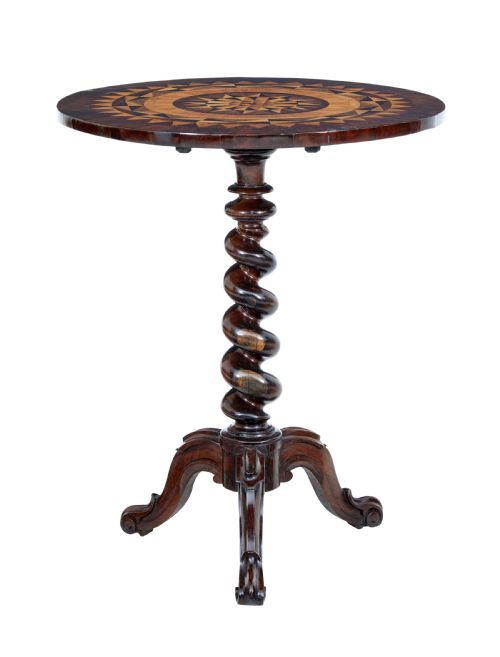
Dark Walnut Tilt Table
A dark walnut tilt table brings rich timber grain and clever space-saving design into a room, tilting upright when floor space matters.
Dark Walnut Tilt Table
When you search for a dark walnut tilt table, you are looking at practical nineteenth-century furniture that combines rich wood tones with a pivoting top mechanism. These pieces span the Georgian, Regency, William IV, and Victorian eras, taking forms such as loo tables, wine tables, and occasional tables.
The versions you are most likely to meet on this page feature circular or oval tops supported by tripod bases. They serve well beside a chair or in the centre of a room, offering a surface that folds away vertically when not in use.
How they were made
Cabinet makers utilised solid walnut and applied burr walnut or figured walnut veneers to create striking surface patterns. Wood inlay and marquetry often decorate the tops, adding floral or geometric motifs set into the darker timber.
Supporting structures frequently combine walnut and mahogany, resting on tripod legs carved or shaped to balance the weight of the pivoting top. Brass fittings occasionally appear on the tilt mechanisms and secret drawers.
Materials span solid walnut, burr walnut, figured walnut veneer, mahogany, fruitwood, brass, wood inlay, and marquetry.
What varies in quality
The quality of a dark walnut tilt table rests largely on the choice of veneer and the precision of the marquetry. Figured and burr walnut with deep, natural figuring command attention, whereas plain timber surfaces show less variation in tone.
Engineering also separates the ordinary from the superior. A well-fitted tilt mechanism holds the top steady in both horizontal and vertical positions without wobble, and the tripod base joins cleanly to the central pillar.
The Dark Walnut Tilt Table Glossary
- Tilt top
- A hinged table top that pivots from horizontal to vertical. This allows the piece to stand flat against a wall when not in use.
- Burr walnut
- A prized wood veneer taken from the warted growths of walnut trees. It yields swirling, highly decorative grain patterns.
- Marquetry
- The art of applying small pieces of veneer to a structure to form decorative patterns. It often incorporates lighter woods against a dark walnut background.
- Tripod base
- A support structure featuring three legs radiating from a central pillar. This design provides stable footing for a pivoting table top.
Dark Walnut Tilt Table: Frequently Asked Questions
How do I use a tilt table?
Release the catch beneath the top to pivot the surface into a vertical position. This saves floor space in smaller rooms.
Lower the top back to horizontal and secure the catch whenever you need a flat surface for lamps or drinks.
What is burr walnut?
Burr walnut comes from the abnormal growth knots on walnut trees. The timber yields intricate, swirling grain patterns.
Cabinet makers slice this wood into thin veneers to cover larger table surfaces for decorative effect.
How do I date a walnut table?
Examine the timber choices, construction methods, and decorative styles. Georgian and Regency pieces show different leg turning than Victorian examples.
Inlay styles and the presence of marquetry also help place the piece within the nineteenth century.
Where should I place an occasional table?
These tables fit comfortably beside seating in a living room or serve as lamp tables in a hallway. Their compact tripod bases make them versatile.
You can also tilt the top against a wall as a decorative panel when floor space is tight.