



Italian Giltwood Seating
These italian giltwood seating pieces bring monumental presence and carved luxury into a room, offering exceptional decorative flair through centuries of craftsmanship.
Italian Giltwood Seating
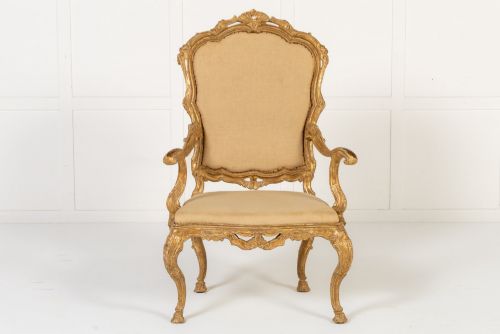
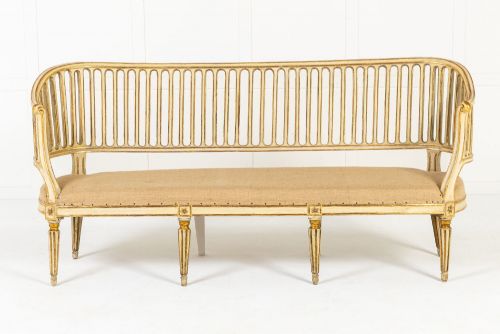
Italian giltwood seating encompasses an array of grand furnishings, including armchairs, settees, sofas, window seats, and stools originating from the eighteenth and nineteenth centuries. Buyers searching for italian giltwood seating encounter forms shaped by distinct historical periods such as the Georgian era, eighteen eighty, and nineteen hundred.
The objects span prominent design movements including Italian Rococo, Italian Neoclassical, Renaissance Revival, Italian Empire, and Italian Baroque. Armchairs and various stool forms emerge most frequently in this selection, often appearing in matched pairs alongside larger settees and tete a tete sofas.
Origins trace directly to Italian workshops where artisans produced elaborately carved frames finished with gold or silver leaf. These forms serve both functional seating roles and monumental decorative statements within grand domestic interiors.
Materials and Construction Techniques
Makers shaped these frames primarily from solid wood, employing detailed hand carving to achieve ornate structural motifs before applying surface finishes. Giltwood, silver gilt, painted wood, and gesso provide the foundational metallic and pigment layers across the carved wooden surfaces.
Upholstery completed the forms, utilising traditional textiles such as fabric and linen to pad seats and backs. The combination of carved wooden frames with applied gilding and soft upholstery defined the standard workshop methodology for these pieces.
Italian Giltwood Seating Retail Price Guide 2026
Typical asking prices for italian giltwood seating among the pieces listed under this phrase on Sellingantiques today, from the lower quarter to the upper quarter. They describe what is for sale here now, not the wider market.
One persistent eighteenth-century sofa design practically demands hushed whispers and immediate gossip, functioning as a dedicated piece for two people to chat face-to-face.
Assessing Quality and Execution
The distinction between tiers rests upon the depth, crispness, and complexity of the hand carving executed across the wooden frame. Superior examples display fluent botanical or scrollwork details that retain sharpness through the layers of gesso and gold leaf.
Scale and proportion further differentiate the pieces, with large-scale or matched pairs commanding greater presence than single, modest forms. The integrity of the original gilt or painted surface remains a primary indicator of historical preservation and superior workshop execution.
The Italian Giltwood Seating Glossary
- Giltwood
- Wood that has been coated with a thin layer of gold leaf or powder over a preparation base such as gesso. This technique creates a radiant, metallic surface finish on carved furniture frames.
- Gesso
- A plaster mixture applied to wood surfaces as a smooth preparation layer before gilding or painting. It allows carvers to achieve fine relief details.
- Curule stool
- An ancient Roman stool form featuring intersecting curved legs shaped like an X. Nineteenth-century interpretations revived this classical seating geometry.
- Tete a tete sofa
- A specialised double seat designed for two people to converse while sitting in an S-shaped configuration. These frames often feature elaborate carved giltwood decoration.
- Savonarola chair
- A folding armchair constructed from multiple wooden slats in a scissors configuration. This Renaissance revival form carries deep historical association with Italian design.
Italian Giltwood Seating: Frequently Asked Questions
What periods do these pieces date from?
The inventory spans multiple centuries, with items originating from the eighteenth century, the nineteenth century, and around nineteen hundred. Specific stylistic influences also draw from Georgian and earlier historical eras.
Craftsmen across these different periods applied distinct regional aesthetics, shifting from exuberant Rococo curves to restrained Neoclassical lines while retaining foundational gilding techniques.
Are these seats comfortable to use?
Many of these pieces are upholstered with traditional fabric or linen to provide usable padding for seating. However, their primary function historically leaned toward formal display in grand reception rooms.
Buyers should consider the historic upholstery methods and frame dimensions when planning daily seating use in modern living spaces.
How do I identify a window seat?
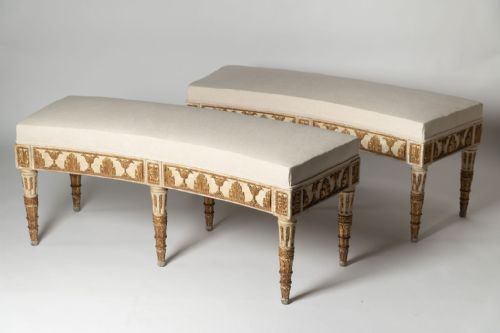
Window seats are long, bench-like forms designed specifically to fit within the architectural recess of a window bay. They offer low profiles and elongated proportions suited for resting near glass.
Examples in this collection demonstrate matching pairs and carved wooden frames finished with gilt or paint.