




Italian Bronze Classical Urns
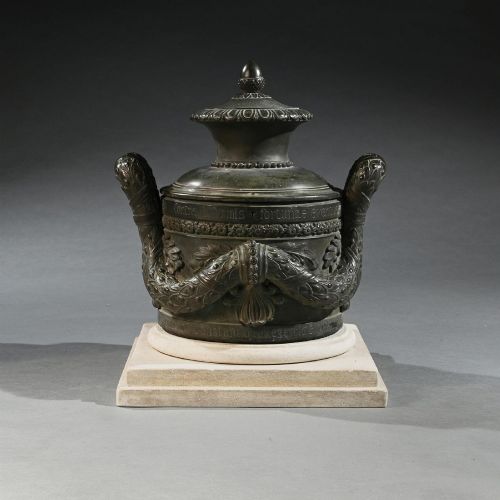
Italian bronze classical urns are heavy, patinated pieces brought home by travellers, channelling antique forms from Roman tastes.
Italian Bronze Classical Urns
When you search for Italian bronze classical urns, you encounter decorative vessels shaped by nineteenth-century workshops for travellers on the Grand Tour. These souvenir pieces draw directly on ancient Roman and Greek archaeology, adopting the profiles of campana urns, Warwick vases, and classical tazzas.
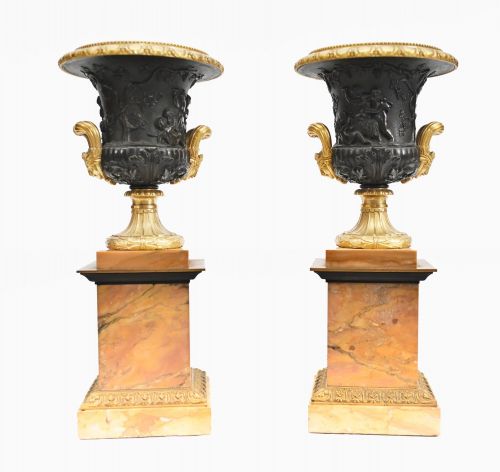
The objects on this page range from cabinet-sized posy vases and drinking cups to large display planters and lidded vessels. Many rest upon contrasting bases of rouge griotte marble or stone, reflecting the architectural details seen by tourists in Italy.
Most examples date from the Victorian era and the later nineteenth century, though earlier eighteenth-century locking vessels also appear. They function primarily as decorative objects for a mantelpiece, table, or sideboard, continuing a long tradition of classical interior display.
How they were made
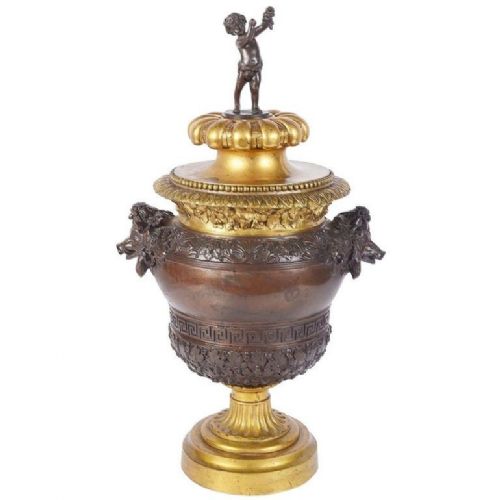
The primary material across these listings is bronze, often worked with a dark patination or enriched with ormolu and gilt bronze details. Metal casters utilised traditional foundry methods to reproduce ancient forms, sometimes pairing the metal with brass or stone.
Certain pieces incorporate carved marble bases, such as rouge griotte, providing a heavy structural foundation for the bronze body. Surface finishing involved meticulous chasing and patination to give the new souvenirs an antique character.
Materials recorded across the inventory include patinated bronze, gilt bronze, brass, and rouge griotte marble bases.
What varies in quality
The division between standard souvenirs and superior pieces lies in the crispness of the casting and the depth of the chasing. Finer examples display sharp relief work on figures such as Bacchus or cherubs, while simpler items show softer lines.
The choice of secondary materials also alters the character of the object, particularly the selection of marble for the base and the richness of the applied patination.
The Italian Bronze Classical Urns Glossary
- Campana urn
- A bell-shaped vessel with a flaring rim and a pedestal foot, modelled after ancient examples discovered at archaeological sites in Italy.
- Grand Tour
- A traditional trip through Europe undertaken by upper-class travellers in the eighteenth and nineteenth centuries to study classical art and antiquities.
- Ormolu
- Gilt bronze ornamentation applied to furniture, clocks, and decorative vessels, created by firing a mercury and gold amalgam onto the metal surface.
- Tazza
- A shallow bowl or cup raised on a stem and foot, frequently produced in bronze during the nineteenth century as a classical souvenir.
- Rouge griotte
- A deep red, mottled marble quarried in France and frequently utilised for the bases of nineteenth-century decorative bronzes.
Italian Bronze Classical Urns: Frequently Asked Questions
What are Italian bronze classical urns?
These pieces are nineteenth-century decorative metalwork items created in Italy as souvenirs for travellers exploring classical antiquities.
They replicate ancient Roman and Greek vessel forms, serving as ornamental objects for the home.
How were they used originally?
Tourists purchased them as reminders of their travels through Italy, displaying them on mantelpieces and tables in their homes.
While some functioned as small vases or planters, most were purely decorative expressions of classical taste.
How do I care for bronze urns?
Dust the surface gently with a soft, dry cloth to prevent the accumulation of dirt within the cast details.
Avoid using harsh metal polishes or liquid cleaners, which can strip away the historic patination from the bronze.
How can I tell the period?
Examine the casting quality, the type of patina, and any associated materials like marble bases to gauge the manufacturing era.
Nineteenth-century Grand Tour souvenirs typically display specific styles associated with Victorian revivalism and archaeological discoveries.