




Pair of Bronze Ewers
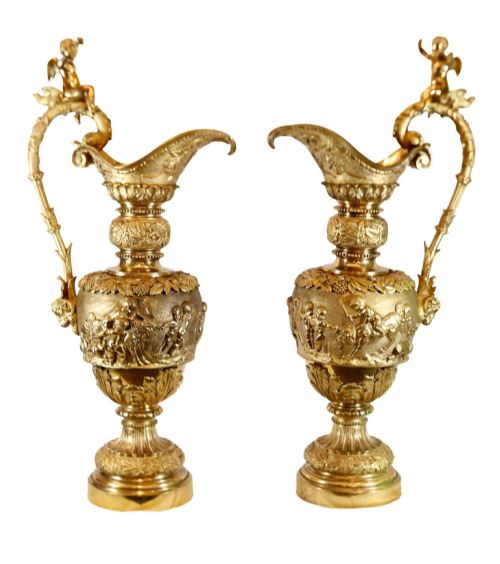
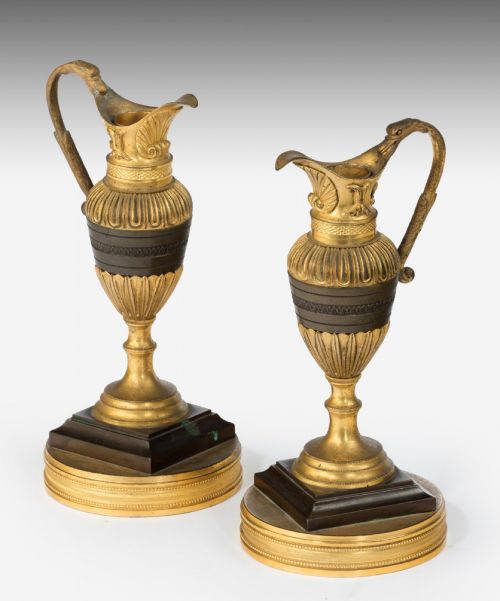
These pair of bronze ewers bring nineteenth-century neoclassical grandeur to a room, offering ornamental symmetry and sculptural presence.
Pair of Bronze Ewers
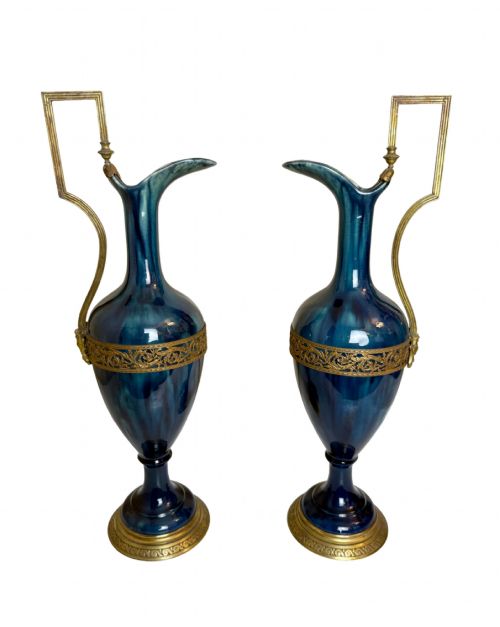
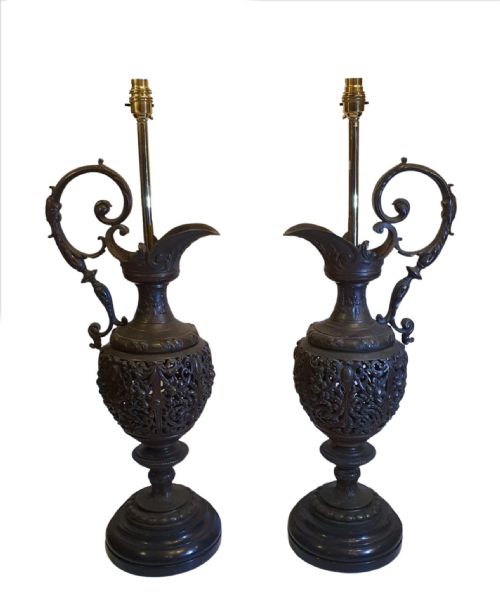
A pair of bronze ewers represents matching decorative vessels modelled on antique water jugs and wine pitchers, appearing predominantly in nineteenth-century forms. These pieces span Victorian, Grand Tour, and Renaissance revival styles, often manifesting as purely ornamental objects or occasionally converted into table lamps.
The materials paired with bronze include ormolu, gilt bronze, marble, porcelain, and cobalt glass, reflecting French and Italian workshops. Buyers encounter ornate handles and classical motifs that echo ancient Greek and Roman vessel shapes.
Factors of quality
Chasing and finishing determine the crispness of detail on cast figures and foliage, distinguishing superior metalwork from softer castings. The depth of the bronze patina and the quality of the ormolu gilding indicate the original workshop standard.
Integrity of secondary materials, such as the mounting of marble bases and the clarity of glass or porcelain inserts, defines the overall execution of the pair.
Listings feature nineteenth-century dates including specific years like 1840, 1850, 1860, 1870, 1880, and 1890, alongside broader Victorian periods.
Clodion
The Pair of Bronze Ewers Glossary
- Ewer
- A large jug with a wide spout and handle, traditionally used for pouring water but produced in the nineteenth century as purely decorative art.
- Ormolu
- Finely ground high-carat gold applied to bronze through a mercury amalgamation process, or later via electroplating, creating a bright golden surface.
- Grand Tour
- A nineteenth-century travel phenomenon where wealthy collectors acquired classical antiquities and reproduction bronzes in Italy and France.
- Patinated bronze
- Metal treated with chemical solutions to produce a controlled surface colour, ranging from deep brown to greenish tones.
- Renaissance Revival
- A nineteenth-century artistic movement that revived sixteenth-century decorative motifs, visible in the heavy relief ornamentation of these vessels.
Pair of Bronze Ewers: Frequently Asked Questions
How were bronze ewers used?
Nineteenth-century households placed these vessels on sideboards, mantelpieces, or pedestals as part of formal interior decoration. Their classical forms suited the neoclassical and Renaissance revival tastes of Victorian collectors.
Some examples were later adapted into table lamps by running electrical wiring through the central body.
What styles do these ewers follow?
The available pieces predominantly display nineteenth-century French and Italian aesthetics, including Grand Tour souvenirs and Renaissance revival designs. These styles draw heavily on classical antiquity, featuring sculptural handles and mythological motifs.
Victorian makers also combined bronze with porcelain, brass, and glass to create ornate ornamental vases and pitchers.
How do you date a pair of bronze ewers?
Dating relies on casting techniques, patination methods, and stylistic indicators associated with the nineteenth century. Victorian and Grand Tour pieces often show specific assembly methods in the bronze mounts and bases.
Comparison with documented works after sculptors like Clodion helps place pieces within the broader nineteenth-century production period.