

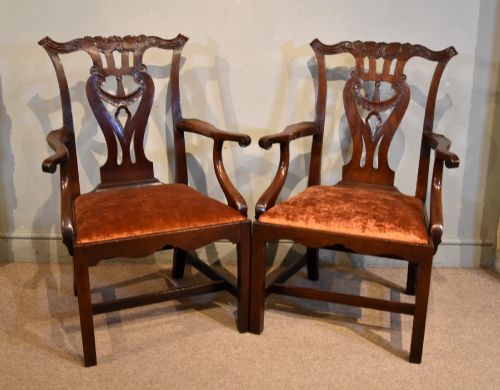
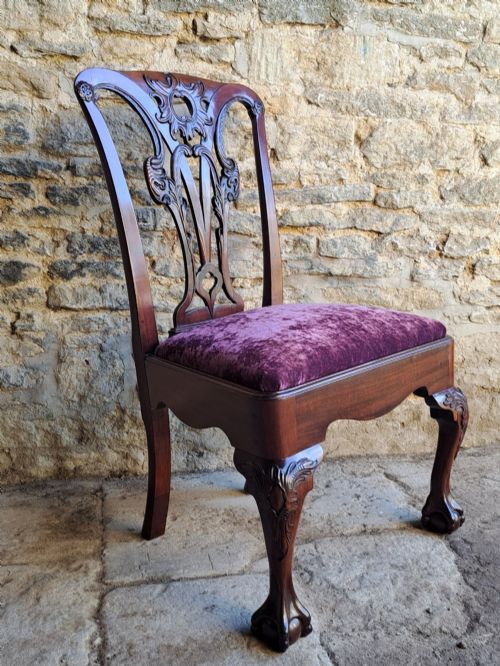


Irish Georgian Dining Chairs
Irish Georgian dining chairs bring robust timber, carved detail and generous proportions to the table, making them a prized choice for traditional dining rooms.
Irish Georgian Dining Chairs
The selection ranges from mid-eighteenth-century originals to later revival interpretations executed in George II and Chippendale styles. These dining chairs frequently feature distinct regional carving characteristics that set them apart from their English counterparts.
How they were made
Cabinetmakers utilised dense timbers like mahogany, red walnut, oak and dark hardwood to construct these chairs, ensuring robust frames capable of enduring daily use. Upholstery materials such as leather, velvet and various textiles were applied to seats, often fastened with brass tacks.
Joinery techniques relied on pegged mortise and tenon joints to secure the heavy frames, while skilled artisans carved intricate motifs directly into the timber. Later revival sets from the twentieth century replicated these traditional methods using similar hardwood materials.
Irish Georgian Dining Chairs Retail Price Guide 2026
Typical asking prices for irish georgian dining chairs among the pieces listed under this phrase on Sellingantiques today, from the lower quarter to the upper quarter. They describe what is for sale here now, not the wider market.
Several dining chairs rely on nineteenth-century copies seamlessly grafted onto eighteenth-century frames, proving that historical repair work can be an art form itself.
What varies in quality
The depth and crispness of the timber carving separate standard examples from superior pieces, with finer chairs exhibiting sharper relief and more confident execution. The choice of primary wood also dictates quality, particularly where highly figured mahogany or rich red walnut is employed.
Originality of the frame construction and the integrity of the timber influence the standing of a set. Pieces that retain their structural harmony without excessive timber replacement command greater appreciation among collectors.
Robert Strahan Dublin
The Irish Georgian Dining Chairs Glossary
- Side chair
- A dining chair without arms, designed to fit neatly along the sides of a dining table. These form the majority of standard seating sets.
- Armchair
- A seating piece featuring supportive armrests, traditionally placed at the heads of a dining table. These often mirror the carved details of matching side chairs.
- Red walnut
- A dense hardwood variety frequently utilised in eighteenth-century Irish furniture production. It possesses a warm reddish hue that deepens with age.
- Revival style
- A later design movement that reinterprets historical aesthetics, such as the George II style pieces produced in the twentieth century. These embrace earlier forms using period-appropriate materials.
- Mahogany
- A heavy, durable imported timber favoured for its rich dark grain and strength. It serves as the primary material for the majority of these seating pieces.
Irish Georgian Dining Chairs: Frequently Asked Questions
How do I spot an Irish Georgian dining chair?
Irish examples often display heavier proportions, bolder carving and distinctive timber choices like red walnut or dark mahogany compared to English equivalents. Look closely at the stretcher arrangement and the depth of the splat for regional characteristics.
Examination of the timber underneath and the joinery methods will further clarify the origin. Consulting provenance records helps confirm attribution to Irish workshops.
How should I care for antique hardwood chairs?
Maintain the timber by keeping chairs away from direct heat sources and sudden temperature fluctuations that can dry out the wood. Occasional application of appropriate wax polish helps nourish the surface and preserve the finish.
Inspect the joinery periodically to ensure frames remain stable during regular use. Professional conservation is recommended for any significant structural issues.
Can I mix side chairs and armchairs?
Pairing armchairs at the table ends with side chairs along the sides follows traditional dining room arrangements. Ensure the wood tone and style remain consistent to maintain a cohesive appearance across the set.
Many period sets were originally configured with a matching pair of armchairs and several side chairs. This creates a balanced look suitable for formal dining spaces.