
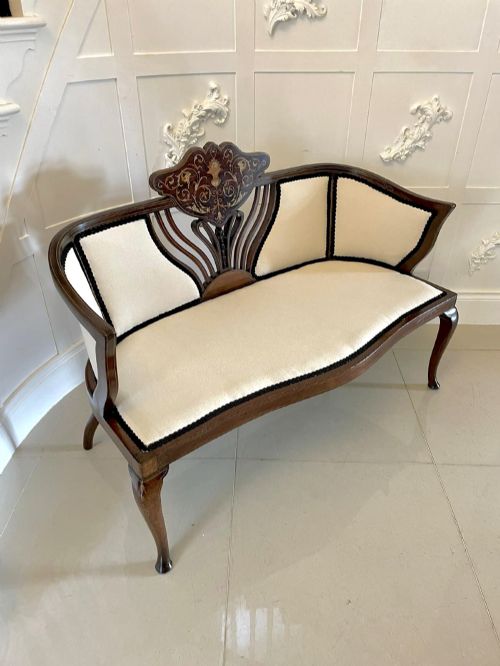


Inlaid Wooden Loveseat
An inlaid wooden loveseat brings handcrafted marquetry and rich timber into a room, offering intimate seating with distinct period character.
Inlaid Wooden Loveseat
When you search for an inlaid wooden loveseat, you encounter nineteenth-century and early twentieth-century settees, salon sofas, and chair-back settees designed for refined interiors.
The pieces appearing here span Victorian, late Victorian, and Edwardian eras, alongside Edwardian Art Nouveau and revivalist styles such as Sheraton Revival and Hepplewhite Revival.
Mahogany forms the primary timber across the selection, paired frequently with satinwood, boxwood inlay, and marquetry inlay to create decorative focal points.
How they were made
Cabinetmakers utilised solid timber frames, principally mahogany, constructed to support upholstered seats and textile coverings.
Decoration relied on contrasting woods, employing satinwood and boxwood inlay alongside detailed marquetry patterns embedded directly into the wooden surfaces.
One salon settee waits patiently for re-upholstery, eager for a fabric makeover after a century or so of service.
What varies in quality
The standard of an inlaid wooden loveseat rests upon the precision of its marquetry and the crispness of the timber framing.
Examples incorporating delicate satinwood and boxwood inlay display greater artisan skill than plainer structural frames.
The Inlaid Wooden Loveseat Glossary
- Marquetry Inlay
- Decorative wood veneers applied in geometric or pictorial patterns onto the structural timber. This technique defines the visual ornamentation of many period settees.
- Satinwood
- A lustrous tropical timber utilised for contrasting inlay work and decorative banding. Its pale golden colour provides a striking contrast against darker mahogany.
- Sheraton Revival
- A late nineteenth-century design movement inspired by eighteenth-century neoclassical furniture. Pieces in this style often feature elegant tapering legs and refined inlay.
- Salon Settee
- An upholstered seating form intended for formal reception rooms rather than heavy daily lounging. These frames prioritise decorative grace and slender proportions.
- Boxwood
- A dense, pale wood frequently chosen for fine stringing and delicate inlay details. Craftsmen employed it to trace clean borders around panel designs.
Inlaid Wooden Loveseat: Frequently Asked Questions
What periods do these settees come from?
The pieces originate primarily from the Victorian, late Victorian, and Edwardian eras, spanning from the late nineteenth century into the early twentieth century.
Revival styles from these periods also draw heavily on earlier eighteenth-century aesthetics, particularly Sheraton and Hepplewhite designs.
What woods are used in the frames?
Mahogany serves as the principal timber for the structural frames across the selection. Satinwood and boxwood appear frequently as contrasting elements for inlay work.
Textiles and fabric upholstery are standard for the seating portions, often complementing the wooden marquetry.
How do I identify a revival style?
Revival pieces emulate the proportions and decorative motifs of earlier Georgian eras while utilising late nineteenth-century manufacturing techniques. Look for specific labels referencing Sheraton or Hepplewhite revivals.
The integration of denser marquetry and distinct Edwardian Art Nouveau touches often clarifies the actual manufacturing period.