





Brown Wood Upholstered Sofa
These brown wood upholstered sofa designs combine traditional timber frames with textiles, offering comfortable seating for period and country house interiors.
Brown Wood Upholstered Sofa
When you search for a brown wood upholstered sofa, you are looking at substantial seating built from timbers like mahogany, walnut, and rosewood, paired with textile coverings. These pieces span several distinct historical eras, ranging from the eighteenth century through the Victorian and Edwardian periods.
You are most likely to meet nineteenth-century examples and Edwardian variations on this page, alongside earlier eighteenth-century forms. The selection includes settees, banquette sofas, and chaise longues, often reflecting French or English design influences.
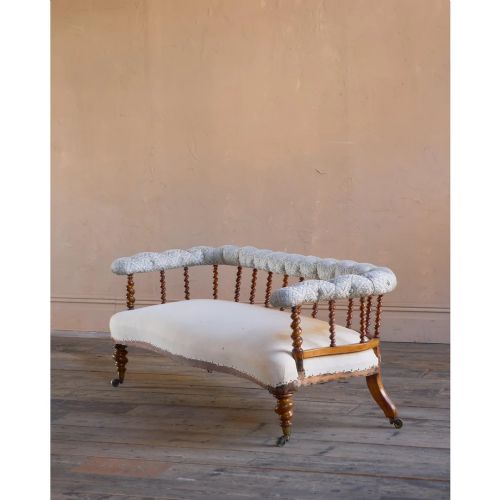
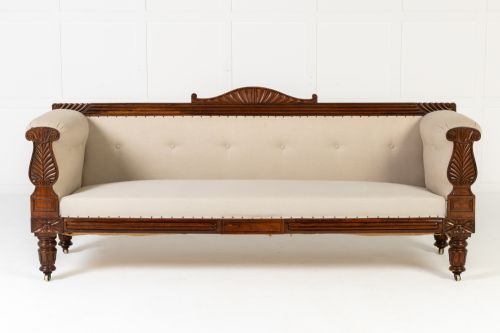
The frames utilise visible wooden elements such as carved walnut, inlaid mahogany, or spindle backs, which frame the upholstered seating areas. Makers such as C. Hindley & Sons and Hampton & Sons contributed to this tradition of sturdy wooden framework paired with soft coverings.
How they were made
These pieces are constructed from dense timbers, principally mahogany and walnut, alongside rosewood for finer examples. The woodwork involves skilled joinery, turning, and carving, yielding bobbin-turned legs, spindle backs, and serpentine front frames.
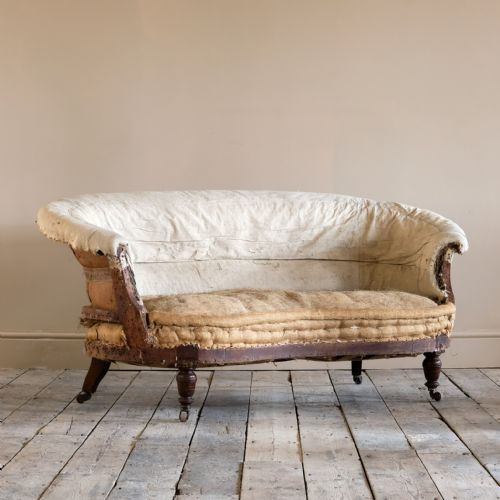
Upholstery techniques rely on traditional foundation materials like calico, hessian, and stuffing, finished with decorative textiles. Velvets, leather, and patterned fabrics are secured to the wooden frames, occasionally accented with brass details or cane work.
Some nineteenth-century makers clearly decided that straight legs were entirely optional when bobbin turning existed.
What varies in quality
The distinction between a standard piece and a superior example lies in the crispness of the woodwork and the integrity of the timber. Finely carved walnut or intricately inlaid mahogany displays a depth of craftsmanship that simpler turned frames lack.
Proportion and structural balance also separate the ranges. Pieces with harmonious lines, such as serpentine fronts or well-balanced chair-back designs, demonstrate a higher standard of period design execution.
C. Hindley & Sons·Hampton & Sons·Morison & Co - Edinburgh
The Brown Wood Upholstered Sofa Glossary
- Banquette sofa
- A long upholstered seating form designed for wall placement, often featuring padded backrests and decorative trim. These pieces frequently appear in nineteenth-century French contexts.
- Serpentine front
- A furniture front shaped in a wavy line, curving outward in the centre and inward at the sides. This contour requires precise woodwork during construction.
- Bobbin turned
- A style of wood turning that resembles a string of bobbins or spools carved along the length of the leg or stretcher. It is characteristic of specific nineteenth-century seating designs.
- Cane
- Material woven from rattan plants to form open decorative panels on chair backs and settee frames. It provides a lightweight contrast to solid walnut or mahogany timbers.
Brown Wood Upholstered Sofa: Frequently Asked Questions
What periods do these sofas cover?
The selection spans from the eighteenth century through the Regency and Victorian eras, extending into Edwardian times. Each period brings distinct aesthetic choices in timber selection and upholstery.
You will encounter styles ranging from Georgian and Regency to French Louis XV and Belle Epoque designs, reflecting the prevailing interior tastes of their respective decades.
Which woods are most common?
Mahogany and walnut form the backbone of the timber structures seen in these listings. These woods were chosen for their strength and rich grain patterns.
Rosewood also appears in select Regency examples, offering a darker and denser alternative for formal reception rooms.
How do I identify a settee from a sofa?
Settees often retain visible wooden framing around the back and arms, such as chair-back designs or exposed carved walnut structures. They frequently echo the lines of dining chairs.
Sofas in this range tend to be fully upholstered or feature more extensive padding, prioritising cushioned comfort over exposed timber joinery.
Where were these pieces used historically?
These seating options served principally in formal drawing rooms, parlours, and country house reception spaces. They were designed to accommodate guests in comfort while displaying the household's taste.
Chai lounges and banquette sofas specifically catered to private resting areas or specialised salon settings during the nineteenth century.