



Inlaid Wooden Armchair Pair
An inlaid wooden armchair pair brings genuine architectural presence to a room, offering matched seating with decorative contrast.
Inlaid Wooden Armchair Pair
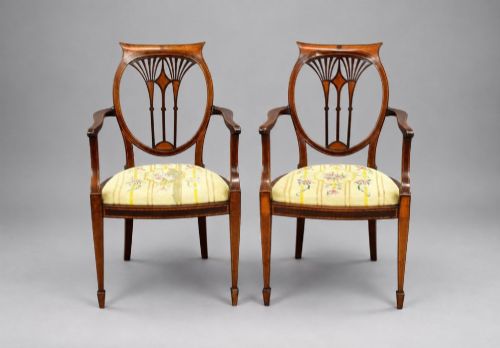
An inlaid wooden armchair pair consists of matching seated furniture constructed from woods like mahogany, satinwood, walnut, and hardwood, often detailed with contrasting stringing or metalwork. The selection on this page ranges from Edwardian and Sheraton Revival carvers to Regency elbow chairs, Victorian library desks seats, and occasional chairs.
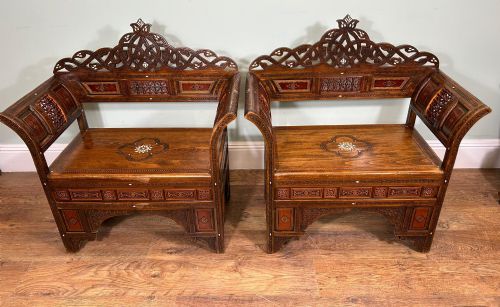
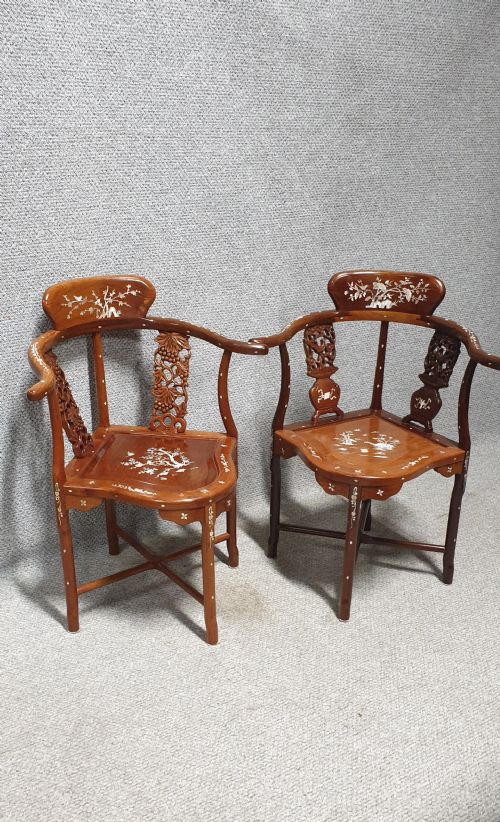
Buyers will encounter distinct regional interpretations alongside traditional British cabinet-making forms. These span from Damascus Syrian Moorish designs and Chinese horseshoe shapes to Anglo-Indian hardwood pieces and Oriental corner chairs.
The configurations span formal dining armchairs, library desk chairs, and salon seating. Many examples date from the Edwardian era and around nineteen twenty, alongside nineteenth-century and Regency specimens.
How these chairs were made
Construction relies on solid timbers such as mahogany, walnut, and regional hardwoods, shaped to form structural frames for elbows, corner seats, and library chairs. Joinery techniques secure the uprights and rails to support daily sitting.
Decoration is achieved through contrasting satinwood inlay, brass wire, and metal embellishments set directly into the wooden surfaces. Upholstery and fabric elements are added to seats and backrests for comfort.
Inlaid Wooden Armchair Pair Retail Price Guide 2026
Typical asking prices for inlaid wooden armchair pair among the pieces listed under this phrase on Sellingantiques today, from the lower quarter to the upper quarter. They describe what is for sale here now, not the wider market.
Several pairs incorporate horseshoe shapes and Syrian Moorish motifs, proving that Victorian and Edwardian sitting rooms enjoyed worldly travels.
Distinctions in quality
The standard of an inlaid wooden armchair pair depends on the crispness of the joinery and the precision of the inlay work. Finer examples display meticulous alignment in contrasting wood veneers and metal stringing.
Design ambition also divides the range, separating straightforward utilitarian seating from elaborate Moorish, Sheraton Revival, or Chinese Qing Dynasty interpretations. The integrity of the underlying hardwood frame remains paramount.
The Inlaid Wooden Armchair Pair Glossary
- Inlay
- A decorative technique where pieces of contrasting material, such as satinwood or brass, are inserted into recessed cavities in the wood surface.
- Carver
- An armchair, traditionally placed at the head of a dining table, featuring supportive wooden arms.
- Elbow chair
- An alternative term for an armchair, highlighting the structural wooden rests designed to support the arms.
- Corner chair
- A seat designed to fit into the corner of a room, featuring a diagonal orientation and a wrap-around backrail.
- Stringing
- A narrow strip of contrasting wood or material embedded in furniture to create fine linear decoration.
Inlaid Wooden Armchair Pair: Frequently Asked Questions
What rooms suit an inlaid wooden armchair pair?
These matched chairs work effectively in studies, libraries, and drawing rooms where dual seating adds symmetry. They provide functional placement around desks or as occasional accent pieces.
The distinct styles, from Edwardian satinwood to Moorish Damascus work, allow them to anchor traditional interiors or complement eclectic spaces.
How do I identify Edwardian inlaid armchairs?
Edwardian examples often feature lighter timbers such as mahogany enhanced with delicate satinwood inlay or Sheraton Revival motifs. They frequently take the form of salon, corner, or library desk chairs.
Construction from this period typically balances decorative refinement with sturdy domestic utility.
What is the difference between a carver and an elbow chair?
A carver traditionally denotes a dining armchair with integrated wooden armrests, designed to match a set of single dining chairs. An elbow chair is a broader term used for any chair featuring structural arm supports.
Both forms appear across nineteenth-century and twentieth-century British and revival styles.
How should I care for inlaid wooden chairs?
Maintain the timber and inlay by keeping the chairs away from direct sunlight and sudden temperature fluctuations. Regular dusting with a soft cloth preserves the polished surface.
Avoid excessive moisture to protect both the wood veneers and any integrated brass or fabric elements.