

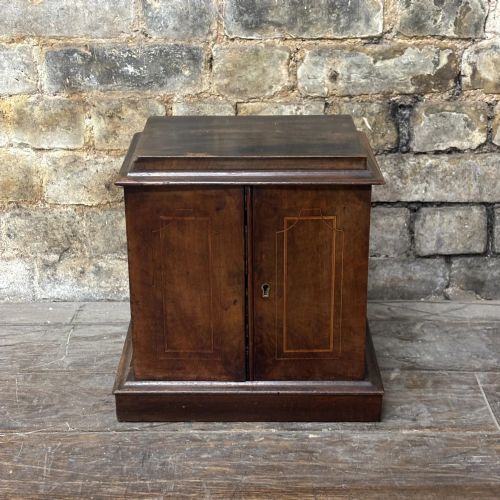
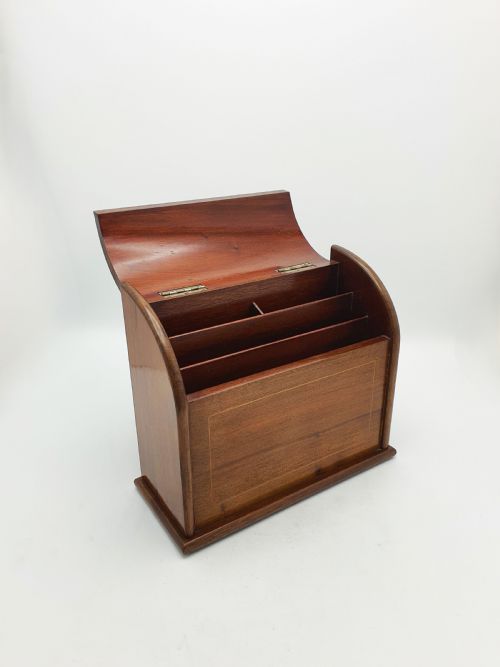


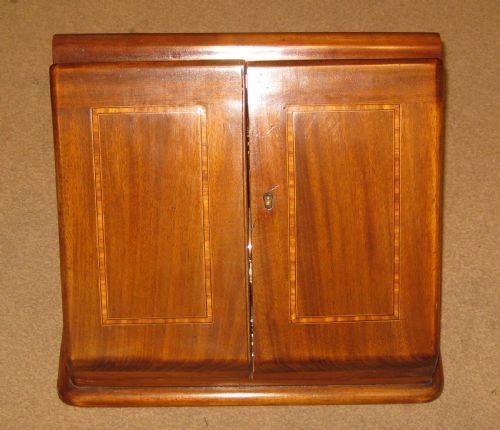

Inlaid Wood Letter Box
An inlaid wood letter box organises your desk with period craftsmanship, bringing rich materials and classic proportions to your workspace.
Inlaid Wood Letter Box
An inlaid wood letter box serves as a functional desktop container for correspondence and stationery, appearing in various forms from simple hinged-lid tidies to compartmentalised cabinets. These desk accessories surface most frequently in Victorian and Edwardian iterations, reflecting the domestic correspondence habits of the nineteenth and early twentieth centuries.
The materials span mahogany, walnut, rosewood, and coromandel, often embellished with boxwood stringing, mother-of-pearl, or intricate Tunbridge ware mosaics. You encounter forms labelled as stationery boxes, correspondence chests, and letter holders alongside desk tidies.
Origins stretch from standard British workshop productions to Anglo-Indian carved wood examples and specialised makers such as Edmund Nye. Each piece combines practical desk storage with decorative wood inlay.
How they were made
Cabinetmakers constructed these boxes using dense hardwoods like mahogany, walnut, and rosewood as a stable carcass. Surfaces received decorative treatment through contrasting wood veneers, boxwood stringing, and geometric mosaic patterns such as Tunbridge ware.
Detailing involved meticulous additions of mother-of-pearl inlay, carved bone, and brass mounts or banding. Interiors were fitted with partitions and divisions specifically sized to sort letters and writing paper.
Inlaid Wood Letter Box Retail Price Guide 2026
Typical asking prices for inlaid wood letter box among the pieces listed under this phrase on Sellingantiques today, from the lower quarter to the upper quarter. They describe what is for sale here now, not the wider market.
Listings feature mahogany, walnut, rosewood, and coromandel boxes spanning the Georgian, Victorian, and Edwardian periods.
What varies in quality
The sophistication of the timber selection and the precision of the inlay work dictate the standing of a piece. Finer examples display complex Tunbridge ware micro-mosaics, well-figured rosewood or coromandel veneers, and integrated brass hardware.
Construction methods also separate standard desk boxes from superior cabinetwork, visible in the snugness of hinged lids, the integrity of internal stationery dividers, and documented maker attributions.
Edmund Nye·C.G. Hope Hastings
The Inlaid Wood Letter Box Glossary
- Tunbridge Ware
- A type of woodwork featuring minute mosaic tiles created from naturally coloured woods to form pictorial or geometric designs. This technique reached its height in nineteenth-century Kent.
- Stationery Box
- A desk accessory designed with internal divisions to hold writing paper, envelopes, and correspondence. These often feature sloping lids or vertical cabinet doors.
- Stringing
- A narrow inlay of contrasting wood used to outline panels, drawers, or box lids. It provides a delicate linear border to the main timber surface.
- Pietra Dura
- The technique of inlaying cut and fitted polished coloured stones into a stony base to form designs. On these boxes, stone panels are set flush into the wooden lid.
- Coromandel
- A heavy, durable tropical timber featuring dark brown or black grain patterns with dramatic figuring. It was prized for high-end Victorian luxury boxes.
Inlaid Wood Letter Box: Frequently Asked Questions
How were these boxes used?
In periods before email, households and offices relied on these boxes to keep writing paper organised and to sort incoming correspondence. Interiors often featured tiered slots or labelled partitions for answered and unanswered letters.
They sat upon writing tables, desks, and library surfaces as both functional items and decorative desk furniture.
How do I date an inlaid wood letter box?
Dating relies on observing the prevailing wood choices, hardware styles, and inlay techniques of different eras. Georgian and Victorian pieces frequently utilise mahogany and rosewood, whilst Edwardian examples often show lighter satinwood or simpler mahogany construction.
Specific decorative styles like Tunbridge ware or documented maker signatures also help establish a more precise timeframe.
How do I care for a wood letter box?
Maintain these boxes by keeping them out of direct sunlight and away from rapid temperature changes that can dry out old timber and crack veneers. Occasional dusting with a soft, dry cloth preserves the polished surface.
Avoid using modern liquid polishes or silicone sprays, which can build up and damage antique finishes.