



Inlaid Walnut Office Desk
An inlaid walnut office desk brings warmth and pattern to a workspace, combining figured timber with delicate stringing.
Inlaid Walnut Office Desk
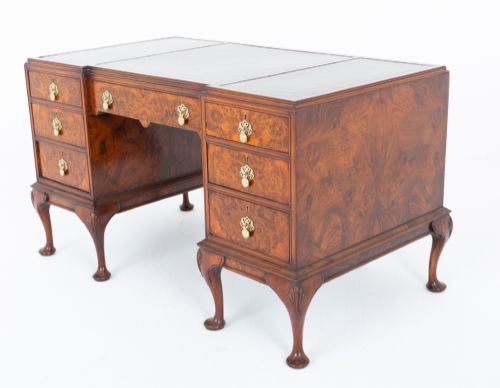
An inlaid walnut office desk encompasses several distinct forms from the nineteenth and early twentieth centuries, including compact writing tables, pedestal desks, and bureau bookcases. These pieces draw on Victorian and Edwardian manufacturing traditions, alongside revival aesthetics such as Queen Anne and Louis XVI styles.
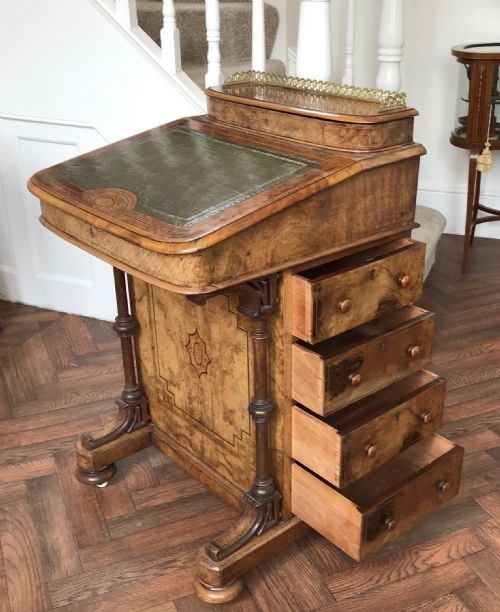
The most common examples encountered on this page are Victorian davenports and writing tables constructed from burr walnut. Such pieces rely on freestanding formats and fitted interiors, reflecting the domestic and professional requirements of their original owners.
Materials and construction
Makers utilised walnut timber and burr walnut veneer over secondary woods to achieve rich grain patterns across flat surfaces. These surfaces are framed by contrasting stringing and banding executed in boxwood and satinwood.
Writing surfaces frequently incorporate inset leather panels tooled with gilt borders. Structural detailing is further enhanced through cast brass mounts and hardware.
Primary materials include burr walnut, plain walnut, and walnut veneer, accented with boxwood and satinwood inlay alongside green leather writing surfaces.
Assessing quality in walnut desks
Quality rests primarily on the selection of the burr walnut veneer and the precision of the boxwood and satinwood inlay. Finer examples display continuous, carefully matched grain patterns across drawers and writing flaps.
Construction methods also distinguish better pieces, visible in the dovetailing of drawers, the integration of secondary timbers, and the retention of original brass fittings and tooled leather inserts.
Gill & Reigate
The Inlaid Walnut Office Desk Glossary
- Burr walnut
- A figured veneer sliced from the knot growths of walnut trees. It yields complex, swirling grain patterns highly valued for furniture surfaces.
- Davenport
- A compact writing desk featuring a sloping lid and drawers opening to one side. It originated in the early nineteenth century and remained popular through the Victorian era.
- Stringing
- Thin inlay lines of contrasting wood set flush into the surface. It defines the edges and geometric panels of many Edwardian and Victorian pieces.
- Pedestal desk
- A large freestanding desk comprising two supporting banks of drawers beneath a main writing surface. These pieces often feature leather writing inserts.
- Marquetry
- The art of forming decorative patterns using fitted veneers of different woods. It appears on more elaborate bureau bookcases and desks.
Inlaid Walnut Office Desk: Frequently Asked Questions
What is a davenport desk?
A davenport is a compact writing desk with a sloping top and side drawers. It provides a small footprint suitable for sitting rooms.
Victorian makers built these with internal stationery compartments and hinged lids for correspondence.
How do I care for walnut veneer?
Walnut furniture requires protection from direct sunlight and excessive heat to prevent the veneer from drying and lifting. Regular dusting with a soft cloth maintains the finish.
Avoid chemical polishes that can degrade the polish and wax surfaces over time.
Are these desks suitable for daily work?
These historical desks accommodate modern laptops and paperwork, provided the writing height aligns with standard chairs. Many feature drawers for storage.
Pedestal models and writing tables offer generous surface areas for daily administrative tasks.
How do I identify the period?
Dating relies on construction techniques, hardware styles, and timber selection. Victorian examples often display rich burr walnut and heavy proportions.
Edwardian interpretations tend to incorporate lighter satinwood banding and refined stringing details.