



Inlaid Walnut Bombe Commode
An inlaid walnut bombe commode brings sweeping continental curves and rich timber grain into a room, offering both striking form and practical storage.
Inlaid Walnut Bombe Commode
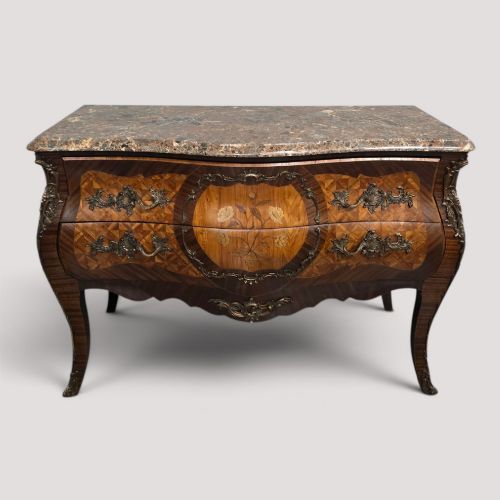
An inlaid walnut bombe commode is a swelling chest of drawers defined by rounded, bulbous fronts and sides that taper outwards and back inwards towards the base. These pieces draw heavily on continental European design traditions, particularly the exuberant styles of the eighteenth and nineteenth centuries.
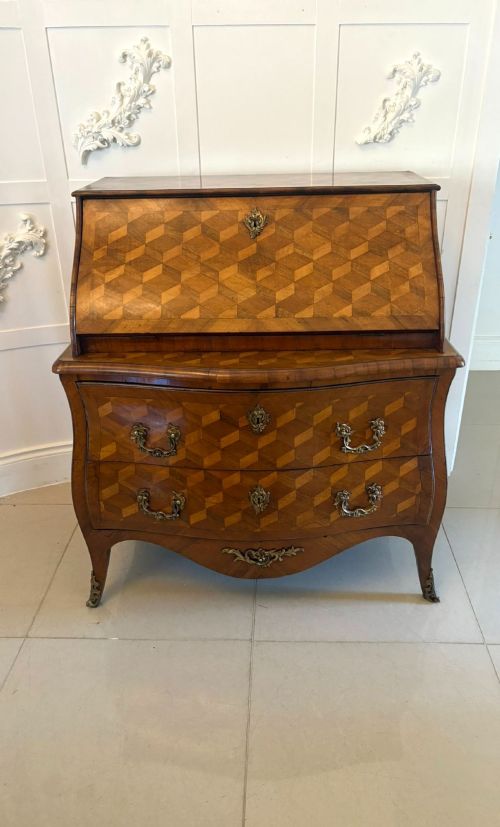
The versions most commonly met on this page span the nineteenth century, alongside earlier eighteenth-century examples and later revivals up to the early twentieth century. They typically manifest as freestanding commodes, chests of drawers, or occasionally bureaux, frequently finished with decorative marquetry.
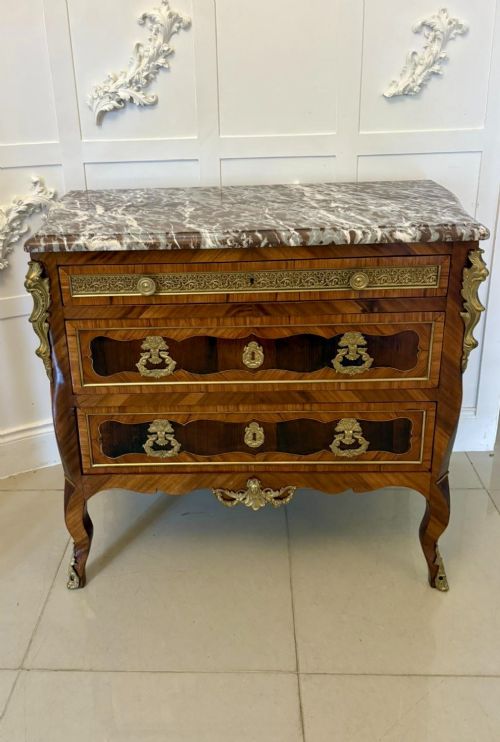
Makers across Italy, France, and the Netherlands adopted this distinct swollen silhouette, often pairing the figured timber with marble tops and cast metal mounts. Buyers encounter diverse regional interpretations, from Dutch marquetry bureaus to French Louis XV revival pieces.
How they were made
Craftsmen built these commodes using substantial timber carcases covered in fine veneers of walnut, burr walnut, and fruitwood. The distinctive curved bombe shape required skilled timber bending and shaping to achieve the swelling contours of the front and sides.
Marquetry decoration was meticulously cut and fitted into the timber surfaces, creating elaborate floral or geometric patterns using contrasting woods. Cabinetmakers then added brass, ormolu, and marble elements to complete the structural and decorative composition.
Inlaid Walnut Bombe Commode Retail Price Guide 2026
Typical asking prices for inlaid walnut bombe commode among the pieces listed under this phrase on Sellingantiques today, from the lower quarter to the upper quarter. They describe what is for sale here now, not the wider market.
Some nineteenth-century makers hid secret compartments inside bureau variants, designed to keep love letters safe from prying eyes.
What varies in quality
The standard of an inlaid walnut bombe commode rests upon the precision of the cabinetwork and the complexity of the timber veneers. Finer pieces display seamless application of burr walnut and intricate marquetry that flows naturally across the curved drawer fronts.
The integration of secondary materials also dictates the tier of the piece, with weighty marble tops and chased ormolu mounts indicating superior workshop production. Simpler regional interpretations rely more heavily on plain walnut surfaces and understated brass hardware.
The Inlaid Walnut Bombe Commode Glossary
- Bombe
- A French term describing furniture with outward-swelling or bulging fronts and sides. This distinctive contour requires advanced shaping techniques to construct.
- Marquetry
- Decorative patterns formed by fitting contrasting veneers onto a structural surface. Craftsmen utilise various coloured woods to create pictorial or geometric designs.
- Ormolu
- Gilded bronze mounts applied to furniture for decorative effect. These cast metal details accent the corners, handles, and apron of the commode.
- Burr walnut
- Timber taken from a tree growth that produces swirling, highly figured grain patterns. Cabinetmakers prize this material for its rich visual texture on veneered surfaces.
Inlaid Walnut Bombe Commode: Frequently Asked Questions
What is a bombe commode?
A bombe commode is a chest of drawers characterised by its distinct swelling, convex sides and front. Originating in continental Europe, it became a staple of Rococo and Baroque furniture design.
The curved profile demands advanced carpentry skills, distinguishing these statement pieces from straight-sided chests of drawers.
How do I date an inlaid walnut commode?
Dating relies on examining the construction methods, timber choice, and prevailing style indicators like Louis XV revival or Dutch Baroque. Eighteenth-century pieces generally show different internal timber preparation compared to nineteenth-century revivals.
Hardware styles, secondary woods, and the complexity of the marquetry also help narrow down the period of manufacture.
Where were these commodes made?
These pieces originate primarily from continental European workshops, with strong representation from France, Italy, and the Netherlands. Each region developed distinct regional interpretations of the curved silhouette.
French makers favoured ornate ormolu and marble tops, while Dutch workshops specialised in intricate floral marquetry across bureaus and chests.
How should I place one in a room?
An inlaid walnut bombe commode functions well as a focal point in a living room, hallway, or bedroom due to its sculptural form. The curved profile means it requires sufficient surrounding space to be fully appreciated.
Pairing the piece with minimal surrounding decor allows the figured walnut grain and decorative mounts to stand out.