
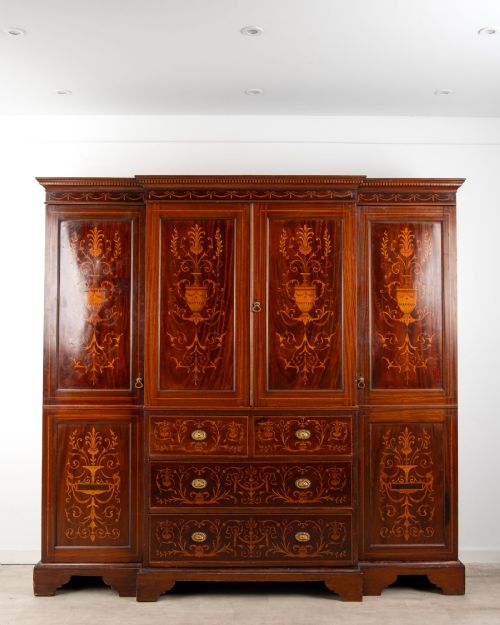
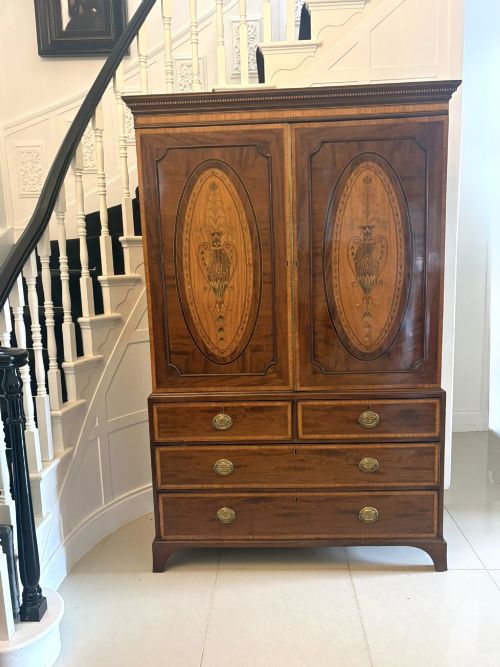
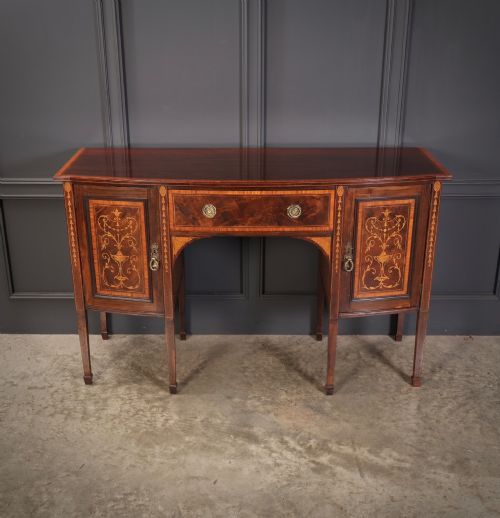
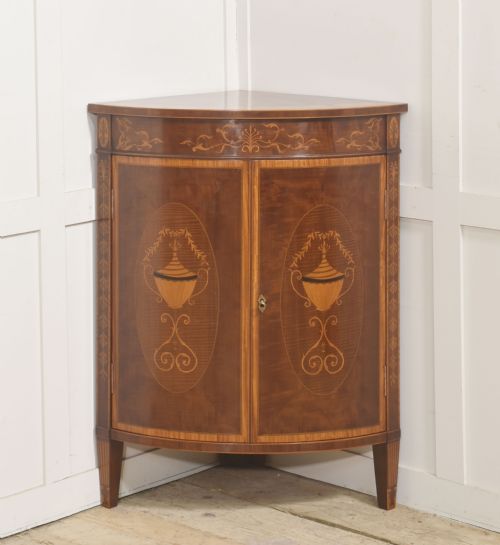


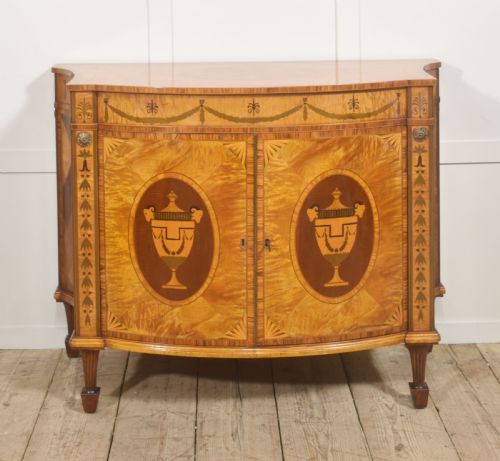


Inlaid Urn Marquetry Cabinet
An inlaid urn marquetry cabinet brings classical elegance to a room through precise wood veneers.
Inlaid Urn Marquetry Cabinet
The selection ranges widely across forms, including sideboards, display cabinets, and bureau bookcases alongside compactum wardrobes. Pieces stretch from the Georgian and William IV eras into the Edwardian period, often styled in the Sheraton Revival and Neoclassical tastes.
How they were made
Cabinet makers utilised solid woods like mahogany, walnut, and rosewood for the structural carcase, applying fine veneers over the core surfaces. Boxwood and satinwood provide contrasting tones for detailed banding and geometric stringing.
Marquetry designs employ delicate wood sections assembled to form classical urns and botanical motifs, fitted flush into the primary timber. Brass handles, glass panels, and fine fruitwood inlays complete the construction of these decorative items.
What varies in quality
The standard of an inlaid urn marquetry cabinet rests on the precision of the veneer cutting and the harmony of the timber selection. Finer examples display meticulous shading within the marquetry urns, creating a convincing sense of depth.
Structural integrity and the retention of original brass fittings and glass set superior pieces apart from simpler workshop productions. The sophistication of the Neoclassical design and the crispness of the boxwood stringing dictate the upper tier of the range.
Edwards and Roberts·Keeble London
The Inlaid Urn Marquetry Cabinet Glossary
- Marquetry
- Decorative woodwork where small pieces of veneer are assembled to form pictorial patterns and urn motifs. This technique requires immense skill to ensure each piece fits tightly within the timber ground.
- Satinwood
- A lustrous, yellowish timber native to India and Ceylon, prized for its bright appearance in fine furniture. Makers utilised it extensively for contrasting panels and decorative banding.
- Demi-lune
- A half-moon shape characteristic of side cabinets and tables designed to sit flush against a wall. This curved form became particularly popular during the Neoclassical and Sheraton Revival periods.
- Compactum
- A large fitted wardrobe combining hanging space, drawers, and shelving within a single multi-door structure. These functional pieces often feature intricate inlaid detailing across the front panels.
- Stringing
- Thin lines of contrasting wood inlaid into grooves on table tops, drawer fronts, and cabinet doors. This linear decoration frames the primary timber and accentuates the geometric form.
Inlaid Urn Marquetry Cabinet: Frequently Asked Questions
What periods do these cabinets date from?
The pieces span from the Georgian and William IV eras through the Victorian period, with a strong representation of Edwardian and Sheraton Revival work dating around nineteen hundred.
Craftsmen across these decades continuously drew upon Neoclassical design principles, adapting urn motifs and satinwood banding to suit changing domestic tastes.
How should I care for satinwood and rosewood?
Keep cabinets away from direct sunlight and strong heat sources to prevent the delicate wood veneers and boxwood stringing from drying out or lifting over time.
Apply a traditional beeswax polish sparingly and buff with a soft cloth to maintain the natural lustre of the polished mahogany and rosewood surfaces.
Where were these cabinets placed in a home?
Side cabinets and demi-lune pieces typically stood in drawing rooms or formal dining spaces to display porcelain and store smaller household items.
Music cabinets and bedside versions served specific utilitarian roles in private parlours and bedrooms, combining practical storage with refined decorative marquetry.
How do I identify Sheraton Revival pieces?
Sheraton Revival furniture from the late nineteenth and early twentieth centuries mimics the light proportions, tapered legs, and classical motifs popularized by Thomas Sheraton in the eighteenth century.
Look for symmetrical urn marquetry, satinwood panels, and delicate bellflower swags executed with late Victorian or Edwardian manufacturing techniques.