



Brown Satinwood Credenza
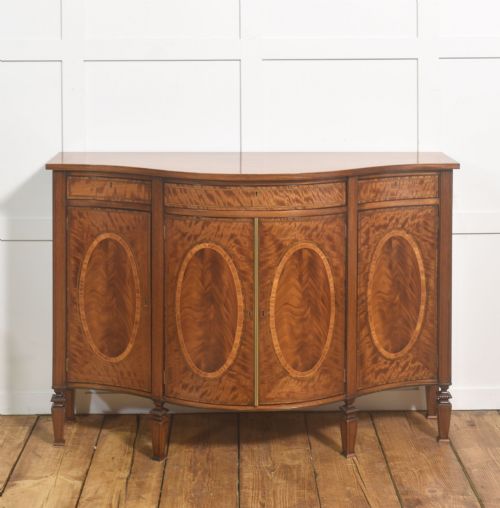
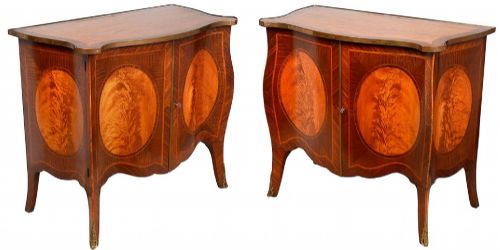
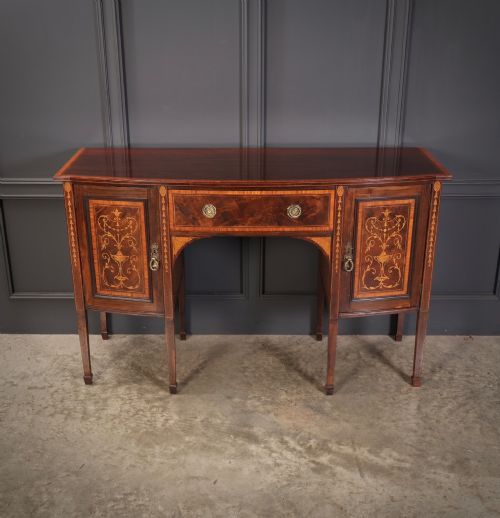
These brown satinwood credenza pieces bring refined neoclassical elegance to a dining room or hall, prized for their rich timber figures and delicate marquetry.
Brown Satinwood Credenza
A brown satinwood credenza search typically leads you to sophisticated sideboards, commodes, and side cabinets spanning the eighteenth century through the Edwardian era. You will frequently encounter Sheraton Revival interpretations alongside authentic George III pieces, reflecting a strong taste for neoclassical symmetry and curved fronts.
The objects serve primarily as formal storage and display surfaces, taking bow-front, serpentine, or demi-lune shapes. Most examples blend satinwood with contrasting timbers like mahogany and rosewood, establishing the rich tonal depth characteristic of these forms.
Materials and construction methods
Cabinetmakers constructed these pieces using solid and veneered timbers, pairing a primary body of satinwood or mahogany with intricate boxwood and ebony stringing. Marquetry panels incorporate varied exotic woods to create floral or geometric motifs across doors and drawer fronts.
Structural details include hand-cut dovetails for drawers and applied brass hardware such as galleries and handles. Crossbanding frames the primary grain patterns, stabilising the timber while accentuating the natural luminescence of the wood.
Listings span the eighteenth century to the twentieth century, with nineteenth-century mahogany and Edwardian Sheraton Revival satinwood dominating the available forms.
Distinguishing quality across pieces
Quality rests upon the precision of the cabinetwork and the subtlety of the timber selection, particularly in the crispness of the boxwood inlay and the matching of veneer grains. Superior examples display seamless joins on curved serpentine or demi-lune fronts, where lesser pieces may show minor timber shrinkage or simpler geometric banding.
The distinction also lies in the depth of the marquetry and the architectural integrity of the piece, such as the weight of the brass mounts and the internal secondary timbers. Finer workshops invested greater time in hand-finishing internal drawer linings and ensuring symmetrical grain flow across the entire facade.
Gillows·Edwards and Roberts
The Brown Satinwood Credenza Glossary
- Crossbanding
- A narrow strip of veneer applied to the border of a panel with the grain running perpendicular to the centre. This technique frames the primary wood figure and prevents warping.
- Marquetry
- Decorative patterns formed by fitting together small pieces of veneered wood of various colours and grains. It differs from inlay by covering the entire surface rather than being set into hollowed recesses.
- Demi-lune
- A half-moon shape characteristic of commodes and side cabinets designed to sit flat against a wall. This profile became particularly popular during the neoclassical revival periods.
- Serpentine
- A curved line that undulates gently, convex in the centre and concave at the sides. Executing this shape requires exceptional skill in timber bending and joint construction.
Brown Satinwood Credenza: Frequently Asked Questions
How do I care for satinwood furniture?
Keep these timber pieces away from direct sunlight and sudden temperature shifts to protect the delicate veneers and natural resins. Regular dusting with a soft, dry cloth maintains the surface sheen without the need for heavy modern polishes.
Apply a traditional beeswax sparingly once or twice a year to nourish the wood and preserve the depth of the grain. Avoid placing damp items or plastic containers directly on the polished top to prevent ring marks.
Are these pieces suitable for modern dining rooms?
These cabinets provide substantial storage for tableware and linens while adding architectural presence to a contemporary interior. Their compact footprints and refined proportions allow them to integrate easily into hallway or living space schemes.
The warm golden tones of the timber complement neutral walls and minimalist furniture styles. They function equally well as serving surfaces during dining or as standalone display pieces.
How do I distinguish George III from Sheraton Revival?
Authentic George III pieces date from the eighteenth century and show period-specific hand tool marks alongside naturally aged patination. The timber construction and internal secondary woods reflect eighteenth-century workshop practices.
Sheraton Revival pieces date from the late nineteenth and early twentieth centuries, drawing direct inspiration from earlier designs. They often display machine-assisted precision alongside revival marquetry techniques typical of the Edwardian period.
What is the function of a brass gallery?
A brass gallery consists of a decorative rail fixed to the upper perimeter of a sideboard or server. Its original purpose was to prevent glassware and decanters from sliding off the surface during busy household service.
Today, the gallery adds a distinct vertical accent and frames the timber top. It serves as a useful indicator of Regency and revival dining furniture styles.