




Inlaid Parlour Settee
An inlaid parlour settee brings decorative woodwork and upholstered comfort together, offering a refined focal point for a sitting room.
Inlaid Parlour Settee
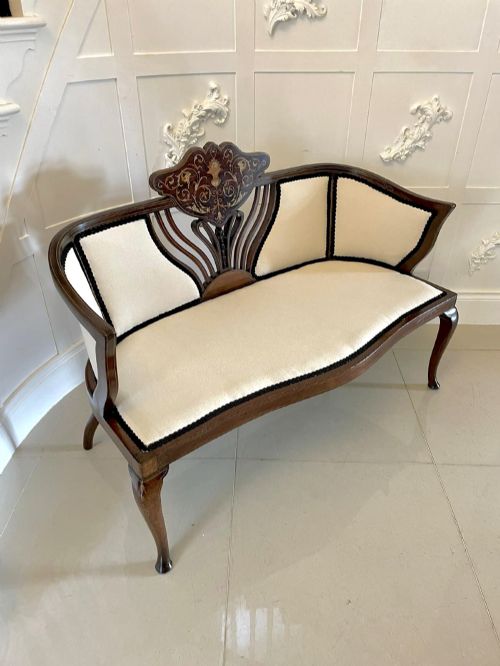
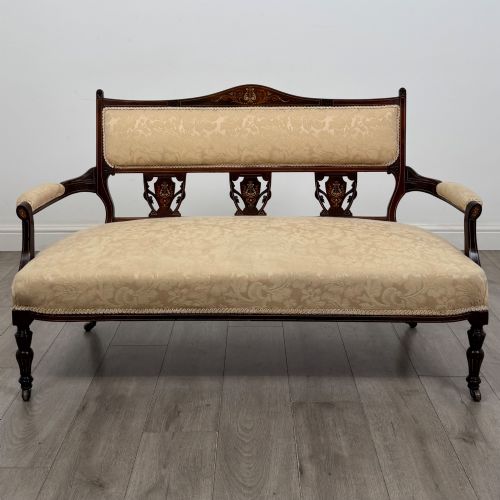
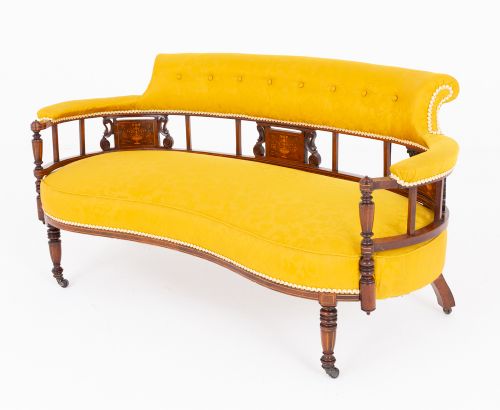
An inlaid parlour settee is a formal two-seater or multi-seater sofa designed for reception rooms, combining timber frames with textile upholstery. These pieces appear frequently from the Victorian and Edwardian eras, spanning the late nineteenth and early twentieth centuries.
Buyers encounter various timber frameworks, most commonly mahogany and rosewood, enriched with contrasting wood elements. The form ranges from simple salon seats to components of larger parlour or boudoir suites alongside matching armchairs.
The style reflects the prevailing tastes of the periods, including Sheraton Revival influences, Edwardian Art Nouveau, and occasional French Empire or Chinese export designs. Many examples serve as freestanding focal points in a drawing room or bedroom setting.
How they were made
Cabinetmakers constructed the structural frames from dense hardwoods like mahogany and rosewood, ensuring stability for daily seating. Lighter timbers such as satinwood and boxwood provided sharp contrast for decorative details.
Surface ornament relied on precision inlay work and marquetry, inserting fine veneers into recesses cut into the primary timber. Artisans occasionally integrated bone or mother of pearl elements to add luminous detail to the design.
Upholstery completed the piece, with springs and horsehair stuffing secured beneath fabric coverings, ranging from plain textiles to patterned materials suitable for formal salons.
Inlaid Parlour Settee Retail Price Guide 2026
Typical asking prices for inlaid parlour settee among the pieces listed under this phrase on Sellingantiques today, from the lower quarter to the upper quarter. They describe what is for sale here now, not the wider market.
What varies in quality
The precision of the cabinetwork and the intricacy of the inlay set finer examples apart from simpler commercial production. Crisp execution in satinwood and boxwood reveals the skill of the original workshop.
The choice of primary timber influences the character and standing of the piece, with carefully figured mahogany and richly grained rosewood commanding greater attention. Cohesive matching within larger salon suites also elevates the overall merit of the grouping.
James Shoolbred
The Inlaid Parlour Settee Glossary
- Inlay
- A technique where pieces of contrasting timber, bone, or shell are fitted into a recessed surface to create a flat decorative pattern.
- Marquetry
- An elaborate form of inlay that assembles various veneer sections to form pictorial or geometric designs across the wooden frame.
- Sheraton Revival
- A late nineteenth-century design movement inspired by the neoclassical furniture of George Sheraton, noted for refined proportions and delicate inlay.
- Salon suite
- A matching set of seating furniture, typically comprising a settee and several armchairs, intended for formal entertaining.
Inlaid Parlour Settee: Frequently Asked Questions
How do I date an inlaid parlour settee?
Dating relies on stylistic clues, timber choice, and construction methods visible in the frame. Victorian examples often display heavier rosewood or mahogany with dense carving, while Edwardian pieces lean towards lighter satinwood inlay and Sheraton Revival motifs.
Examining the upholstery webbing and interior joinery provides further confirmation of the manufacturing era.
Can I find matching chairs for these settees?
Some pieces survive as part of larger parlour suites that include matching armchairs and occasional chairs. Listings occasionally offer complete salon suites or grouped seating arrangements.
Settees found on their own can also be paired with compatible period chairs sharing similar timber and inlay styles.
What is the difference between a salon suite and a parlour suite?
The terms describe similar groups of formal seating furniture used interchangeably by makers and retailers of the nineteenth and twentieth centuries. Both designations typically refer to a matching settee and chairs designed for a principal reception room.
Variations in the titles reflect regional preferences rather than distinct structural differences.