



Marquetry Salon Settee
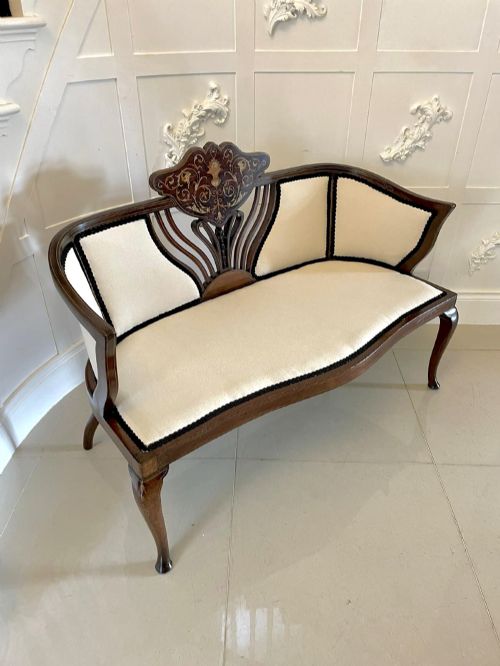
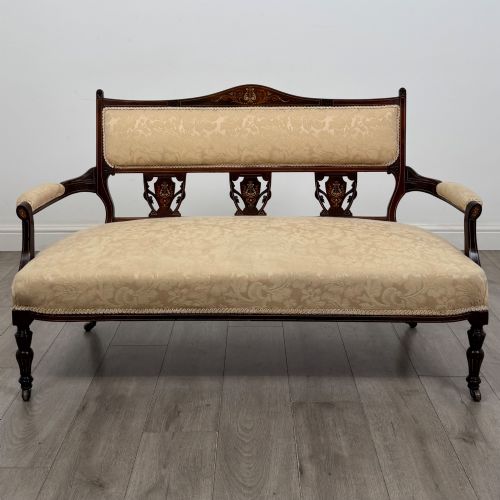
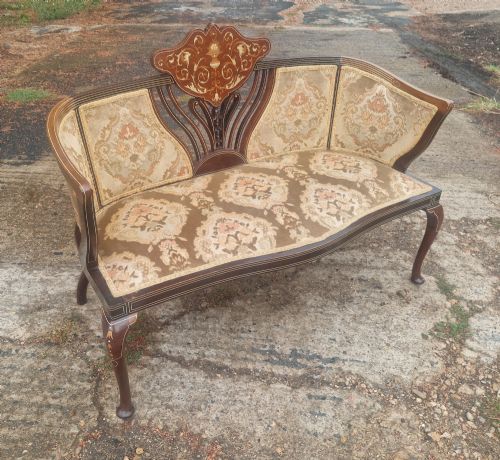
A marquetry salon settee is a formal two-seat upholstered seat decorated with intricate wood inlay, made to anchor a reception room.
Marquetry Salon Settee
A marquetry salon settee is a formal upholstered seat designed for reception rooms, combining decorative wood inlay with structural timbers. These pieces appear primarily across the Victorian and Edwardian eras, spanning the late nineteenth and early twentieth centuries.
Most examples found here utilise mahogany, rosewood or satinwood as the primary timber, enhanced by contrasting veneers. They range from compact two-seat parlour sofas to components of larger salon suites that include matching armchairs.
The style vocabulary draws on diverse historical precedents, incorporating Sheraton Revival, French Empire and Egyptian Revival motifs. Aesthetic Movement and Art Nouveau influences also surface in specific late nineteenth-century pieces.
How they were made
Cabinetmakers constructed the frames from dense hardwoods such as mahogany and rosewood, which provided the stability needed for intricate surface decoration. Surface embellishment relied on marquetry, applying contrasting veneers of satinwood and boxwood into shaped recesses.
Detailing often incorporated bone inlay alongside linear stringing to accentuate the contours of the backrest and cabriole legs. Upholstery techniques varied from traditional horsehair stuffing to sprung bases, covered in damask, velvet or patterned fabric.
Marquetry Salon Settee Retail Price Guide 2026
Typical asking prices for marquetry salon settee among the pieces listed under this phrase on Sellingantiques today, from the lower quarter to the upper quarter. They describe what is for sale here now, not the wider market.
Certain Edwardian sofas served specifically as end-of-bed seating, bridging the gap between bedroom utility and formal drawing-room style.
What varies in quality
Quality rests principally in the crispness of the marquetry cutting and the choice of cabinet timbers. Superior examples display tightly fitted wood veneers without gaps, utilising figured mahogany or rich rosewood rather than plain secondary woods.
The sophistication of the stylistic design and the integrity of the frame construction further separate standard production from exceptional pieces. Comprehensive inlay work extending across both the back and legs indicates a higher tier of manufacture.
Jas / James Shoolbred
The Marquetry Salon Settee Glossary
- Marquetry
- The art of applying pieces of veneer to a structure to form decorative patterns. This technique defines the surface ornamentation of these salon seats.
- Satinwood
- A durable tropical timber with a lustrous yellowish grain. Makers utilised this material extensively for contrasting inlays.
- Salon Suite
- A matched set of seating furniture comprising a settee and accompanying armchairs or parlour chairs. These suites furnished formal entertaining spaces.
- Aesthetic Movement
- A late nineteenth-century design current emphasising visual beauty over narrative content. Pieces from this period often display ebonised finishes.
- Sheraton Revival
- A late Victorian style inspired by eighteenth-century neoclassical furniture designs. It typically employs symmetrical satinwood inlay on mahogany frames.
Marquetry Salon Settee: Frequently Asked Questions
Where did these settees sit?
These pieces sat in formal reception rooms, drawing rooms and parlours where hosts entertained visitors. They functioned as principal seats of display rather than casual lounging furniture.
Their compact proportions allowed them to fit against perimeter walls or beneath tall windows while maintaining a decorative presence in the room.
How do I identify the period?
Dating relies on combining the timber choice, inlay style and structural silhouette. Victorian pieces often use heavy mahogany frames with dense floral marquetry, while Edwardian versions frequently employ lighter satinwood and neoclassical motifs.
Cabinet construction methods and upholstery webbing also offer clues to the exact manufacturing decade.
Are they comfortable to sit on?
These settees were built for upright posture during formal social calls rather than deep relaxation. The sprung or stuffed bases provide firm support beneath historical fabric or modern upholstery.
Many surviving examples require re-webbing or new padding to restore their original seat tension before daily use.
Can I mix them with modern furniture?
The rich wood tones and detailed marquetry allow these settees to anchor contemporary rooms as focal pieces. Placing one against a neutral wall highlights the craftsmanship of the inlay.
They pair effectively with mid-century or minimalist furniture by introducing textural contrast and historical depth.