

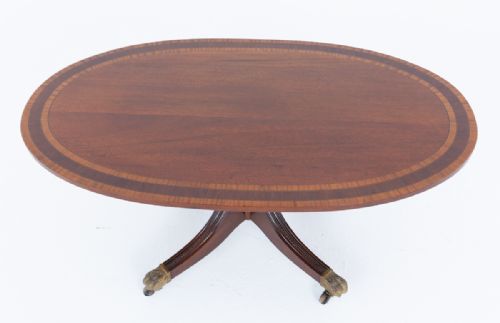
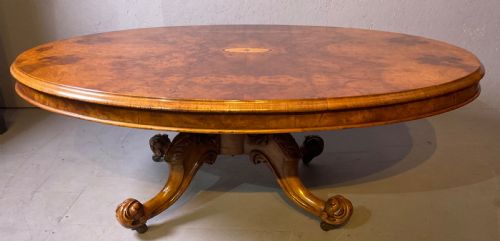
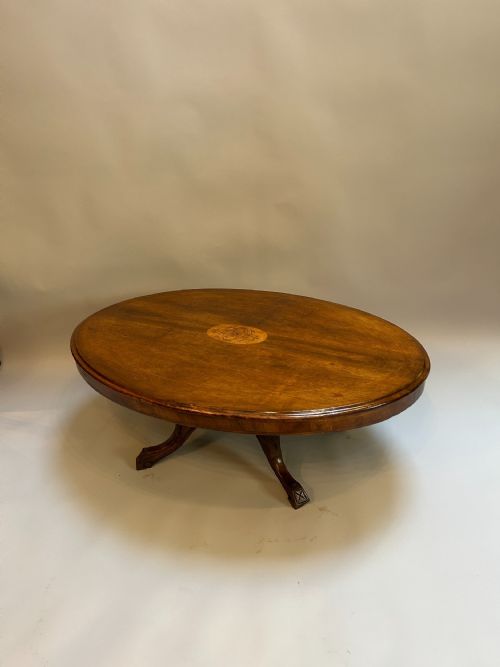


Inlaid Oval Centre Table
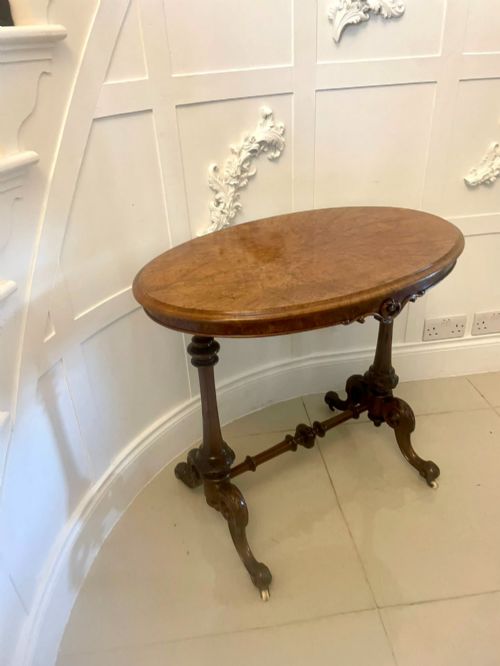
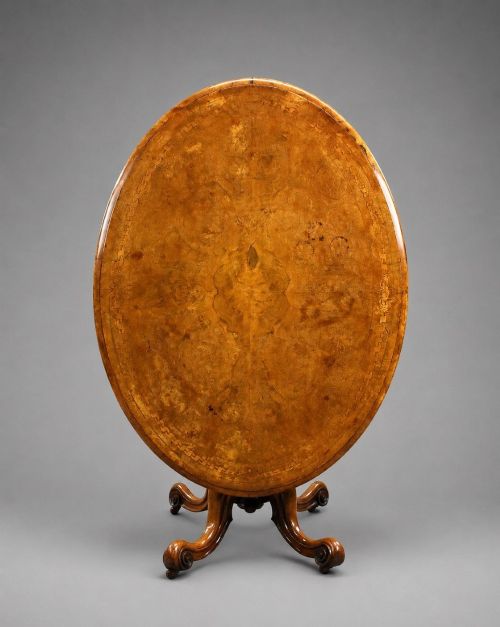
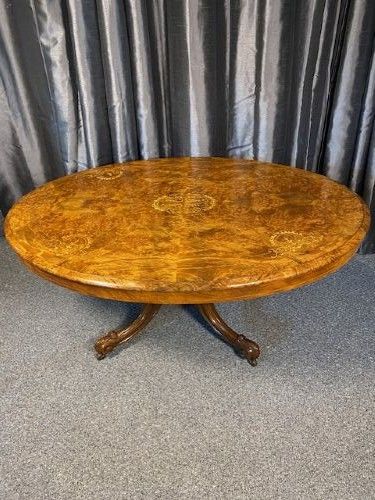
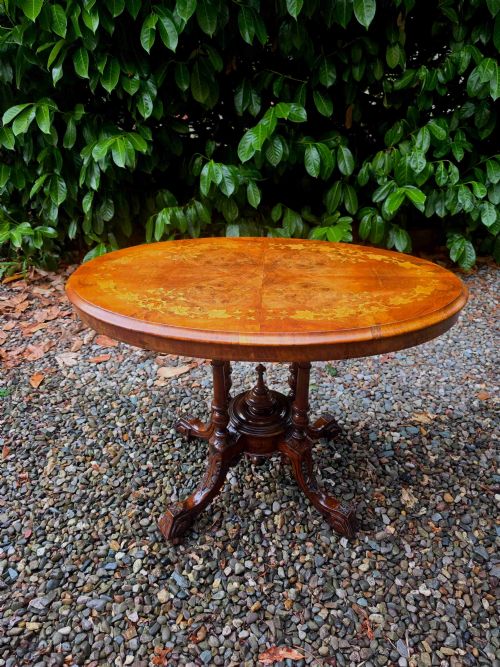
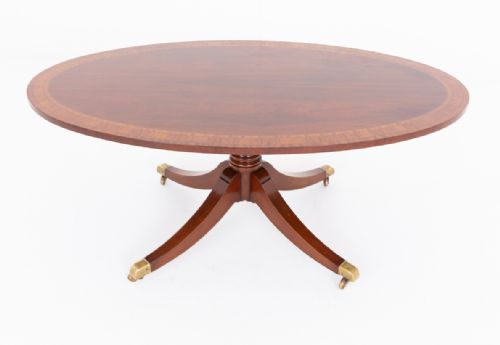
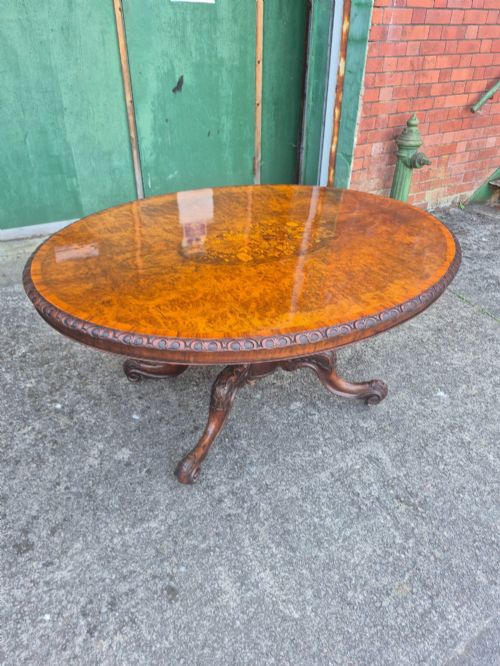
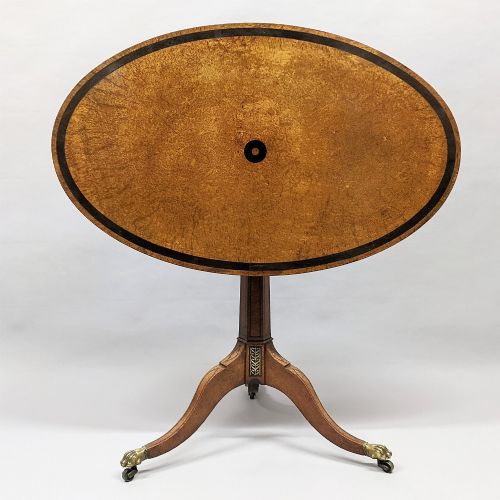
These pieces are an inlaid oval centre table, bringing rich burr walnut and delicate marquetry into the middle of a room.
Inlaid Oval Centre Table
An inlaid oval centre table appears most frequently in Victorian and Edwardian iterations, spanning the nineteenth century up to the early twentieth century. Walnut and burr walnut dominate the forms, shaped into lamp tables, loo tables, breakfast tables, and occasional pieces.
The silhouettes range from pedestal bases and tripod supports to basket bases and stretcher tables, designed to stand freely in a room rather than against a wall. Makers also produced mahogany, satinwood, and sycamore variants influenced by Sheraton Revival and Louis XVI styles.
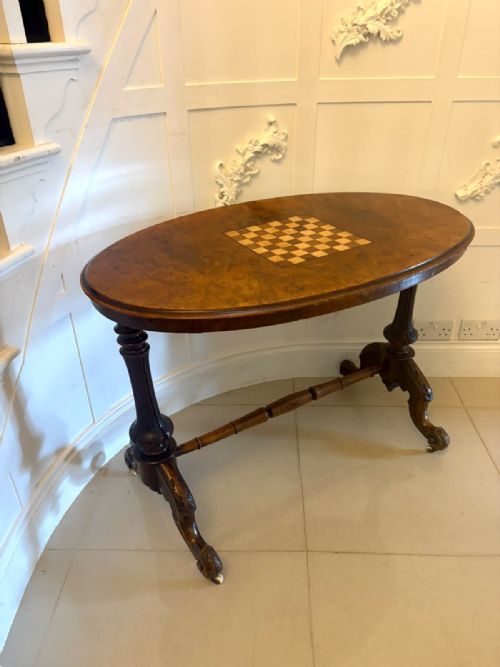
Buyers seeking an inlaid oval centre table encounter everything from small occasional tea tables to large six-seater dining and breakfast pieces. The integration of chess boards and tilt-top mechanisms reflects the versatile domestic function these tables served across the nineteenth century.
Materials and Techniques
Cabinet makers built the carcases of these tables using solid timbers such as mahogany and beech, then applied decorative veneers of burr walnut, amboyna, satinwood, and sycamore to the top surfaces. The distinctive grain patterns arise from selecting burr growths, which yield intricate swirling figures when sliced.
Inlay work relied on contrasting woods like boxwood and ebony, alongside hand-cut marquetry panels depicting floral motifs and classical swags. Craftsmen embedded these delicate veneers into recesses channelled directly into the primary timber, securing them with animal glue before scraping and polishing the surface.
Structural joints typically involved traditional tenons and dowels, whilst heavier pedestal designs incorporated carved wooden pillars supported by three or four splayed legs. Brass fittings, including castors and mounts, facilitated movement across heavy carpets in Victorian drawing rooms.
Some tables hid chess boards inside their polite walnut tops, proving the Victorians took their parlour games very seriously indeed.
Judging Quality
The distinction between standard production and exhibition quality rests on the selection of the veneers and the precision of the marquetry. Superior examples utilise heavily figured burr walnut with symmetrical grain matching across the entire oval top, paired with crisp, multi-wood boxwood stringing.
Hand-carving on the pedestals and bases separates fine workshop output from plain commercial manufacture, showing deep, clean undercut detailing rather than shallow, machine-pressed moulding. The complexity and tightness of the inlaid botanical or geometric motifs also indicate the maker's skill and time invested in the piece.
Structural integrity and timber stability govern longevity; better workshops ensured seasoned hardwoods were used to prevent warping across wide oval expanses. Original surfaces finished with traditional french polish retain a warm, mellow glow that chemical stripping and modern varnishes obscure.
Gillows·A. Beurdeley·Jackson & Graham
The Inlaid Oval Centre Table Glossary
- Burr Walnut
- A timber derived from the wart-like growths on walnut trees, prized for its swirling, highly figured grain pattern. Cabinet makers used veneers of this wood to create decorative table tops.
- Marquetry
- The art of applying pieces of veneer to a structure to form decorative patterns and pictures. It differs from inlay by assembling the design on a backing before gluing it down.
- Loo Table
- A large Victorian round or oval table designed for the card game loo. These tables often featured tilt-top mechanisms to save space when not in use.
- Boxwood Inlay
- Narrow strips of pale boxwood inserted into contrasting dark woods to create geometric borders and stringing lines. It provides sharp visual contrast on table edges and friezes.
- Tilt-Top Mechanism
- A pivoting table top mounted on a catch and pillar, allowing the surface to fold vertical. This clever engineering enabled large centre tables to be stored against walls when rooms required clear floor space.
- Sheraton Revival
- A late nineteenth and early twentieth century design movement that reinterpreted the light, neoclassical furniture styles of Thomas Sheraton. Pieces from this era often feature satinwood, delicate floral inlay, and tapering legs.
Inlaid Oval Centre Table: Frequently Asked Questions
What is an inlaid oval centre table used for?
These tables served primarily as decorative and functional hubs in Victorian and Edwardian reception rooms, holding lamps, silver, or books. Many models also functioned as occasional tea tables or featured tilt-top mechanisms for games and dining.
Because they were engineered to stand freely in the middle of a room rather than against a wall, their polished marquetry tops could be admired from every angle.
How do I tell Victorian from Edwardian pieces?
Victorian tables typically feature darker timbers like heavy burr walnut and mahogany, accompanied by dense marquetry and substantial carved pedestals. Edwardian examples often lean towards lighter satinwood and mahogany bodies with more restrained, delicate stringing influenced by Sheraton Revival designs.
Examining the underlying construction timber and the style of the carving usually clarifies the transition from nineteenth-century weight to twentieth-century lightness.
Can I use an antique centre table daily?
These tables were built from seasoned hardwoods and strong veneers, making them durable enough for everyday living. Using coasters and mats helps protect the French polished surface from heat and moisture rings.
Placing the table away from direct sunlight and extreme radiator heat prevents the burr walnut veneers from drying out or shrinking over time.
What is a chess top centre table?
A chess top table incorporates an inlaid playing board directly into the centre of the wooden surface, often framed by decorative walnut or satinwood borders. This dual-purpose design allowed the furniture to serve as a standard lamp or occasional table when not in use for games.
They represent the Victorian appetite for multifunctional drawing room pieces that combined entertainment with high-status interior decoration.