




Carved Quadruped Centre Table
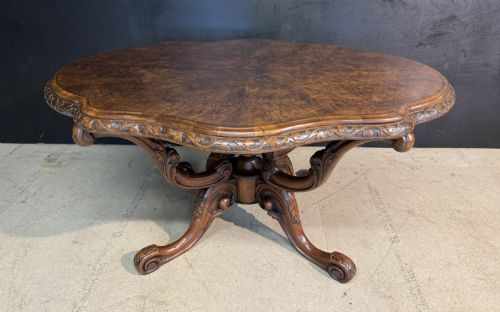
A carved quadruped centre table anchors a room with four-legged balance, offering a freestanding surface designed to sit in the middle of a space.
Carved Quadruped Centre Table
A carved quadruped centre table stands away from the wall, designed to be viewed from all sides within a room. When searching for a carved quadruped centre table, a buyer encounters pieces primarily from the Victorian and nineteenth-century periods, alongside Regency and William IV examples.
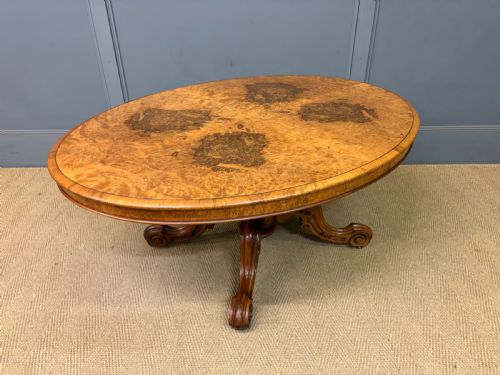
The forms span diverse tables including oval lamp tables, breakfast tables, loo tables, and occasional tables. Walnut, burr walnut, and mahogany dominate the selection, accompanied by rosewood, amboyna, and brass details.
Victorian pieces frequently display marquetry inlay and hand-carved bases, while pedestal dining tables and snap top tables appear alongside dedicated window and coffee tables.
Materials and construction methods
Cabinetmakers utilised dense hardwoods such as mahogany, rosewood, and figured walnut to build these substantial tables. Burr walnut and amboyna veneers provided rich grain patterns across tabletops, frequently enhanced by wood inlay and marquetry.
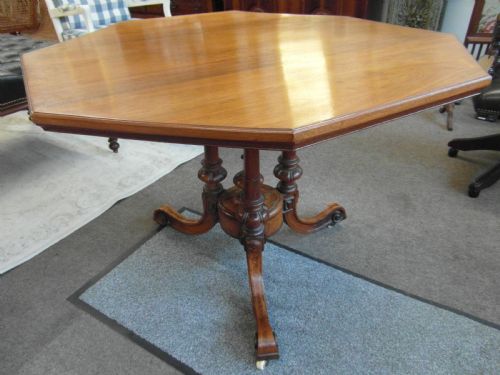
Structural bases relied on solid timber pedestals or four-legged supports, incorporating hand-carved details and brass fittings. Snap-top mechanisms and pedestal configurations allowed functional movement in dining and breakfast tables.
Some tables tilt their tops vertically, proving that nineteenth-century furniture makers understood the eternal struggle of making space for a vacuum cleaner.
Assessing craftsmanship and finish
Quality rests upon the selection of timber figures, where richly figured burr walnut or figured mahogany distinguishes finer examples from plain stock. The precision of marquetry inlay and the depth of hand-carved ornamentation reveal the hand of skilled makers.
Structural integrity shows in the smoothness of mechanisms like snap tops and the stability of the four-legged base. Finer execution is evident in the seamless integration of amboyna mounts and brass components.
Gillows
The Carved Quadruped Centre Table Glossary
- Burr walnut
- A highly figured timber taken from the growth excrescences of walnut trees, prized for swirling grain patterns. It forms decorative tabletops across many Victorian examples.
- Marquetry
- The art of applying decorative veneer pieces to a structure to form intricate pictorial designs. This technique decorates the surfaces of inlaid centre tables.
- Loo table
- A large round or oval table popular in the nineteenth century, designed for card games like loo. They often feature tilt-top mechanisms for storage against walls.
Carved Quadruped Centre Table: Frequently Asked Questions
What is a carved quadruped centre table used for?
These tables provide a freestanding surface designed to sit in the middle of a room rather than against a wall. They function as lamp tables, breakfast tables, or decorative centrepieces.
Their substantial four-legged bases and finished sides allow them to be viewed from every angle in a principal room.
How do I identify a Victorian centre table?
Victorian examples typically feature rich timbers like burr walnut, mahogany, or rosewood, often decorated with marquetry inlay. Look for hand-carved wooden bases and characteristic oval or round top shapes.
Many pieces from this period incorporate tilt mechanisms or pedestal supports characteristic of mid-nineteenth-century cabinetmaking.
What is the difference between a loo table and a breakfast table?
A loo table is typically round or oval and was traditionally used for nineteenth-century card games, often featuring a tilt-top mechanism. Breakfast tables serve a similar dining function but originate across the Regency and Victorian eras.
Both types utilise robust pedestal or quadruped bases to support large hardwood tops.
Where should I place a centre table?
A centre table requires open floor space to allow movement around all four sides. They suit large hallways, living rooms, or drawing rooms as functional focal points.
Placement should consider the freestanding nature of the piece so the carved base and inlaid top remain visible.