

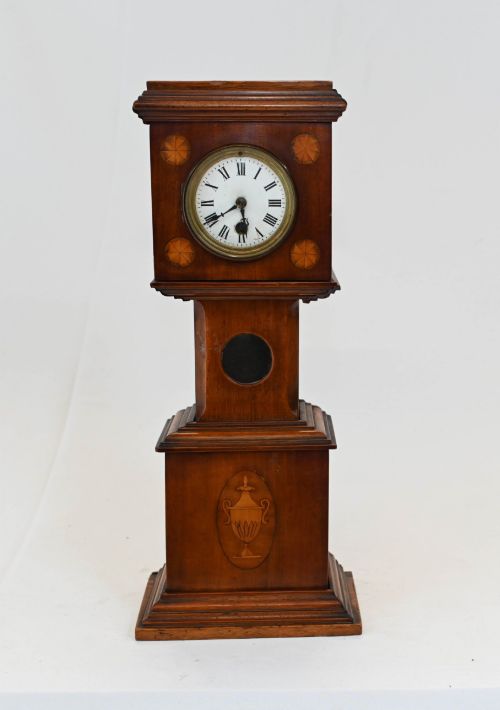
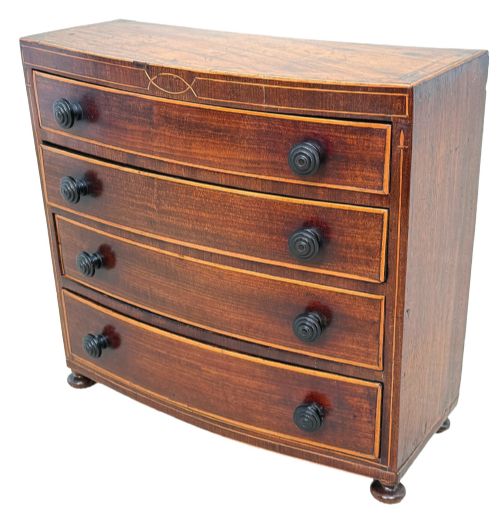
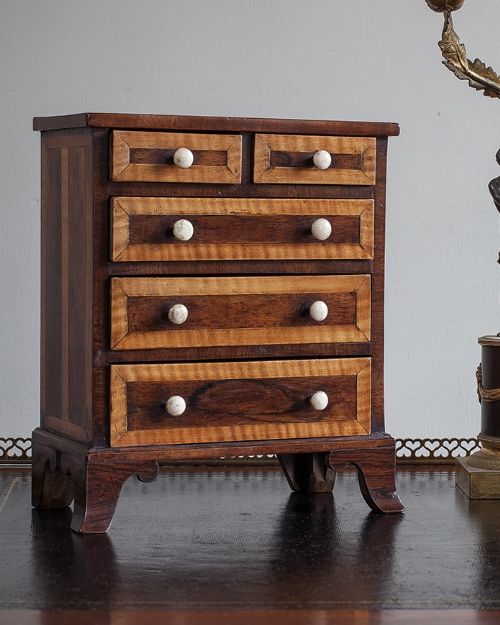
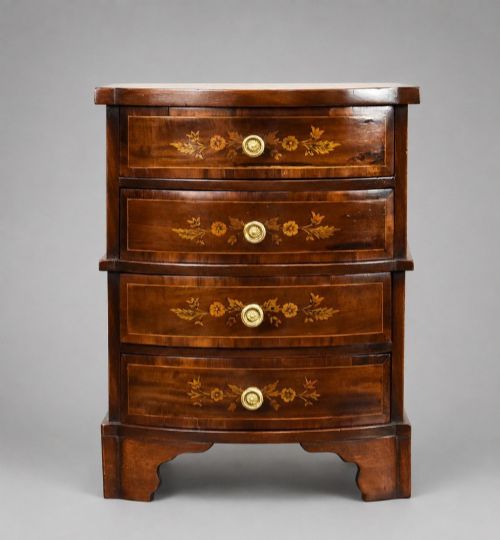


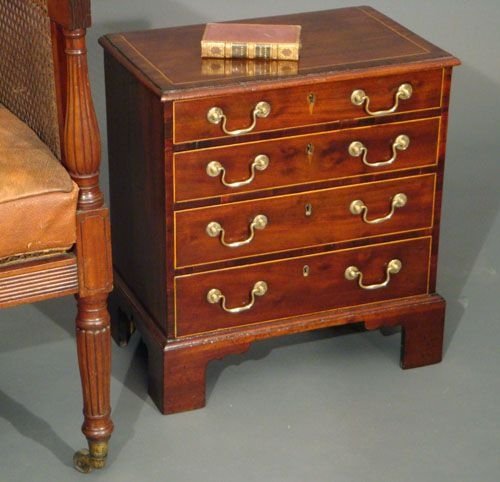


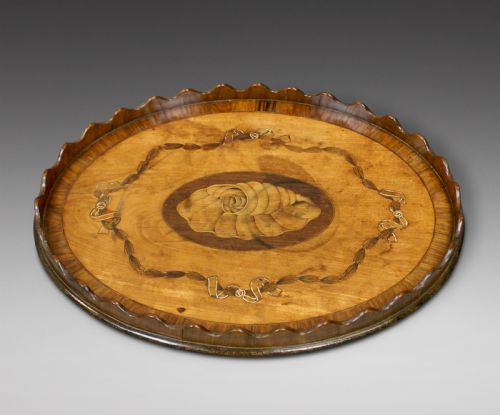
Inlaid Mahogany Miniature
These inlaid mahogany miniature pieces are small-scale masterworks of cabinet-making that deliver all the presence of full-sized furniture in miniature.
How they were made
Maker's workshops relied primarily on solid and veneered mahogany, enhanced with contrasting stringing and banding in satinwood and boxwood. Inlays often incorporate geometric lines or delicate floral motifs set flush into the primary timber.
Secondary materials such as brass for handles or key escutcheons, glass for cabinet doors, and mother-of-pearl accents appear across nineteenth-century items. Construction techniques mirrored full-sized furniture production, requiring precise miniature dovetails and turned components.
What varies in quality
Quality rests on the precision of the miniature joinery and the crispness of the boxwood or satinwood inlay work. Finer examples maintain accurate proportions relative to full-sized furniture rather than appearing clumsy or thick in their members.
The choice of timber grain and the subtlety of the contrasting stringing distinguish superior workshop output from simpler utilitarian pieces. Original brass hardware, clean glass panes, and well-fitted drawer linings also elevate the standing of a piece.
Inlaid Mahogany Miniature Retail Price Guide 2026
Typical asking prices for inlaid mahogany miniature among the pieces listed under this phrase on Sellingantiques today, from the lower quarter to the upper quarter. They describe what is for sale here now, not the wider market.
Among the small desks and chests, a nineteenth-century miniature golf game table proves that Victorian leisure took every possible hobby down to pocket size.
The Inlaid Mahogany Miniature Glossary
- Stringing
- A thin inlay of contrasting wood, usually boxwood or satinwood, set into channels in the mahogany surface to form delicate borders.
- Bow front
- A convex curved front facade seen on several miniature chests of drawers, requiring skilled woodworking to shape both timber and drawers.
- Serpentine
- A wave-like curved front featuring a central convex curve flanked by concave sections, typical of finer Georgian and Edwardian cabinet-making.
- Apprentice piece
- An item made by a trainee craftsman to demonstrate mastery of joinery techniques before gaining full guild admission.
Inlaid Mahogany Miniature: Frequently Asked Questions
What were miniature chests used for?
These small chests served diverse purposes, including salesman samples shown to prospective clients, trial pieces by craftsmen, or luxury playthings for wealthy households.
Their compact scale allowed makers to showcase intricate dovetailing and inlay techniques without consuming large amounts of prime timber.
How do I date an inlaid mahogany miniature?
Dating relies on stylistic clues such as cabinet proportions, handle hardware, and the specific patterns of satinwood or boxwood inlay.
Georgian pieces often display simpler architectural lines, while Edwardian and later nineteenth-century examples frequently feature richer marquetry and varied secondary woods.
Are miniature longcase clocks functional?
Most miniature longcase clocks house working clockwork movements suited for table-top display rather than floor standing.
Their tall, narrow proportions mirror full-sized grandfather clocks down to the tiny brass dials and weighted or spring-driven mechanisms.
How should I care for mahogany miniature furniture?
Keep pieces away from direct sunlight and steady heat sources to prevent the mahogany timber and delicate boxwood stringing from drying out.
Dust gently with a dry, soft cloth and avoid chemical polishes that can degrade nineteenth-century wax finishes.