



Inlaid Mahogany Escritoire
These inlaid mahogany escritoire pieces are finely constructed writing cabinets designed for private correspondence, offering concealed compartments and a polished writing surface.
Inlaid Mahogany Escritoire
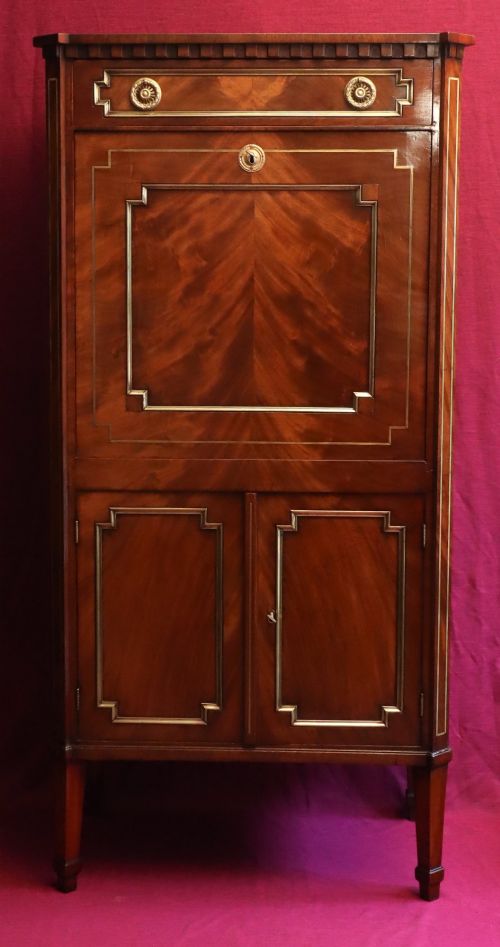
An inlaid mahogany escritoire combines cabinetwork with a dedicated writing surface, often featuring a drop-front or cylinder mechanism that conceals internal pigeonholes and small drawers. When you search for an inlaid mahogany escritoire, you encounter pieces spanning the Georgian, Victorian, and Edwardian eras, alongside French and Sheraton styles.
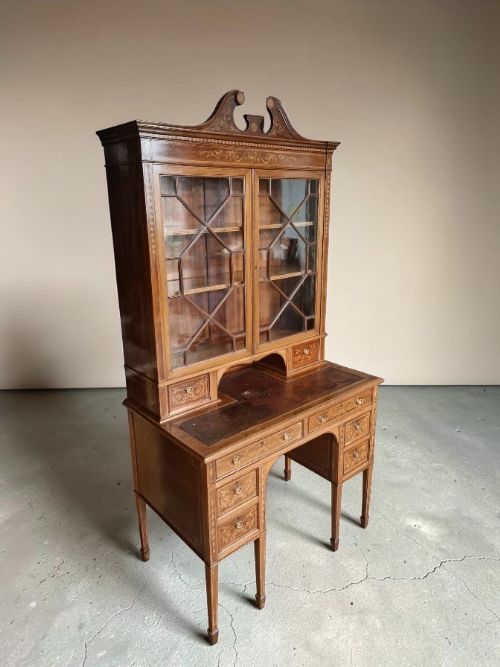
The versions most frequently met on this page range from Edwardian writing tables and barrel-front desks to nineteenth-century cylinder desks and fall-front cabinets. These forms reflect both English cabinetmaking traditions and continental influences such as French Neoclassical and Dutch marquetry.
Originating as portable or stationary receptacles for letters and documents, these desks evolved through the nineteenth and early twentieth centuries into refined pieces of parlour and study furniture. They balance structural utility with decorative marquetry, typically executed in contrasting light woods against a darker mahogany ground.
How they were made
Makers constructed these pieces using solid mahogany and mahogany veneers applied to secondary framing timbers, providing a stable canvas for decorative work. Cabinetmakers then incorporated contrasting elements such as satinwood and boxwood inlay to define borders, panels, and geometric motifs.
Metal components played a structural and decorative role, with brass fittings, gilt bronze, and ormolu mounts securing hinges, locks, and handles. Writing surfaces were frequently inset with tooled leather to provide a durable and smooth plane for handwriting.
Listings feature mahogany, satinwood, boxwood, brass, leather, and ormolu across Georgian, Victorian, and Edwardian periods.
What varies in quality
The refinement of the inlay work largely distinguishes the tier of a piece, with finely detailed boxwood and satinwood marquetry showing sharp precision and tight joints. Pieces benefiting from superior craftsmanship display seamless integration between the primary mahogany carcass and the delicate stringing or pictorial motifs.
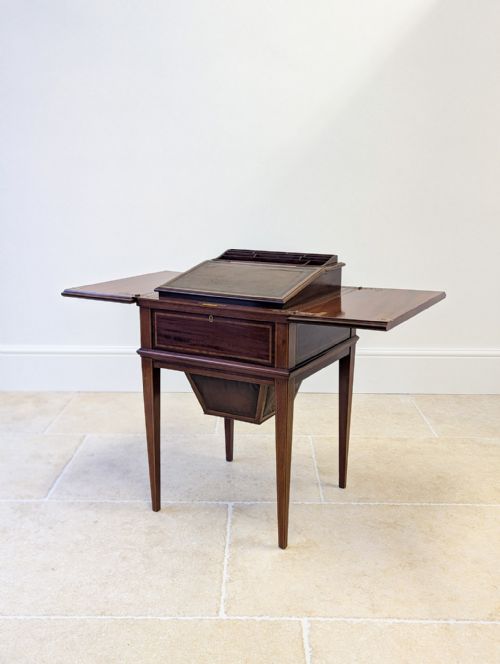
Internal engineering also separates standard production from exceptional examples, particularly in the smooth operation of cylinder lids, fall-front panels, and metamorphic writing mechanisms. The quality of cast ormolu mounts and brass hardware further indicates the original workshop's commitment to finished detail.
The Inlaid Mahogany Escritoire Glossary
- Escritoire
- A writing cabinet featuring a fall-front or slanted lid that opens to reveal compartments for stationery and letters. It functions as both a storage unit and a compact desk.
- Cylinder desk
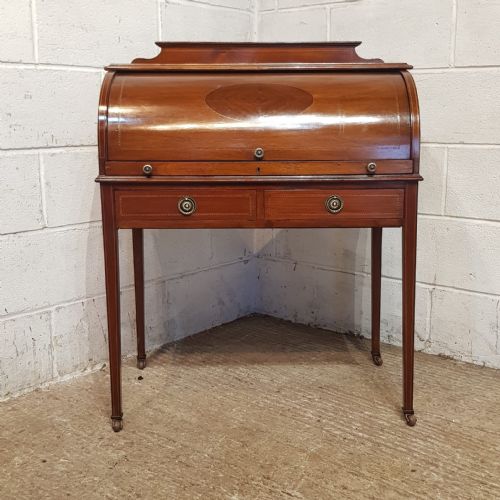
- A form of writing desk featuring a quarter-circle rotating wooden cylinder that covers the writing surface and internal pigeonholes. When rolled open, it retracts into the body of the desk.
- Marquetry
- The art of applying pieces of veneer to a structure to form decorative patterns and pictures. It utilises contrasting timbers such as satinwood and boxwood.
- Ormolu
- Gilded bronze used for decorative mounts and furniture hardware. It provides a bright metallic contrast against dark mahogany surfaces.
- Stringing
- A narrow inlay of contrasting wood used to create delicate linear borders on furniture panels and drawers. It outlines geometric shapes and structural edges.
Inlaid Mahogany Escritoire: Frequently Asked Questions
What is an escritoire?
An escritoire is a specialised writing cabinet designed for correspondence and the storage of writing materials. It typically incorporates a drop-front or roll-top mechanism concealing small drawers and pigeonholes.
These pieces were developed to keep private papers secure and organised while serving as elegant furniture in parlours, studies, and bedrooms.
How do I use an escritoire today?
You can use an escritoire as a functional laptop desk, a writing station for correspondence, or a striking display cabinet in a home study. The internal compartments remain useful for sorting post, stationery, and small personal items.
The fold-down or pull-out writing surfaces provide adequate space for contemporary writing tasks while maintaining a compact footprint.
How do I tell Edwardian from Victorian pieces?
Edwardian pieces often display lighter proportions and delicate Sheraton Revival influence, frequently utilising fine boxwood inlay and satinwood banding on mahogany. They date from the early twentieth century and tend to look airier.
Victorian examples generally present heavier proportions, deeper mahogany tones, and more robust construction. They reflect the stylistic revivals popular during the nineteenth century.
What is a cylinder desk?
A cylinder desk is a form of writing desk where a curved wooden roll encloses the desk surface and interior compartments. Rotating the cylinder upward clears the workspace.
This mechanism offers a neat way to conceal unfinished writing work without needing to clear away papers and books.