


Inlaid Executive Desk
An inlaid executive desk brings grand presence to a study through figured timbers and fine marquetry.
Inlaid Executive Desk
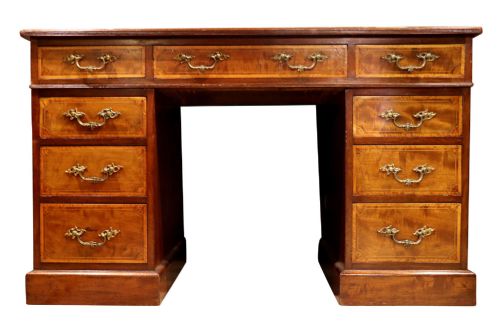
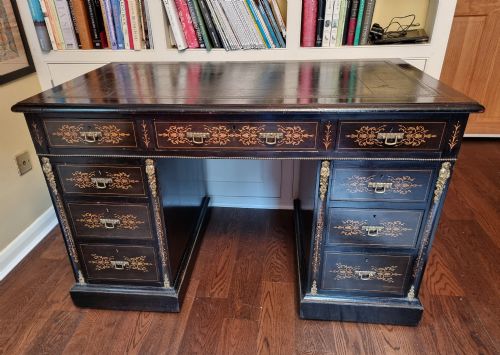
An inlaid executive desk is a substantial writing table or pedestal piece designed for professional use, combining practical workspace with decorative ornamentation. These desks frequently appear in Victorian, Edwardian, and nineteenth-century forms, alongside Georgian and Regency examples.
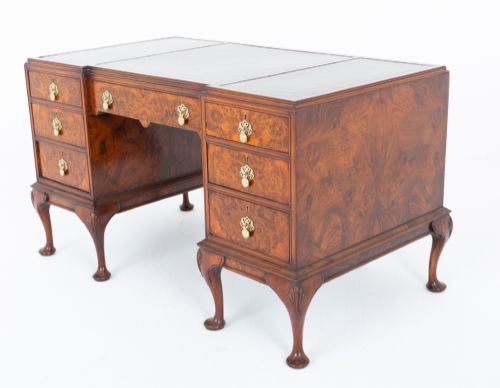
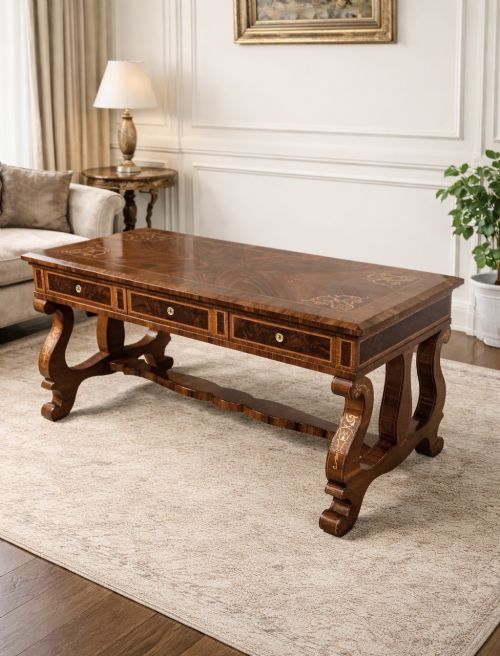
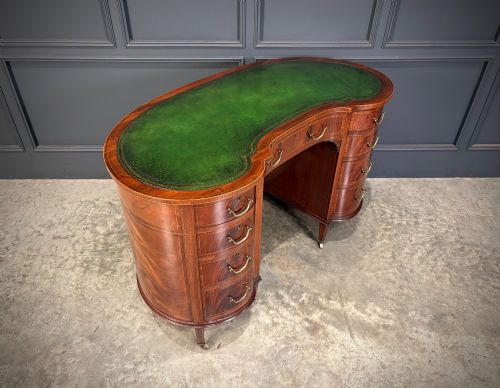
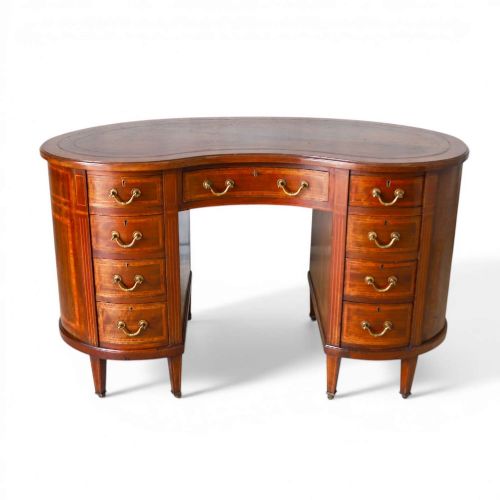
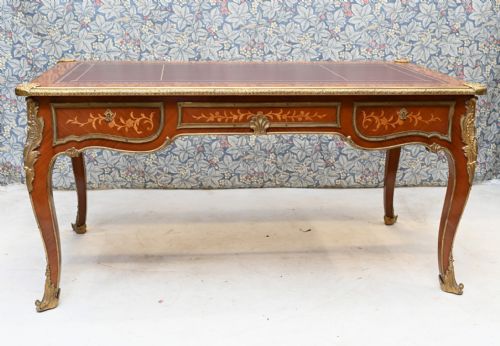
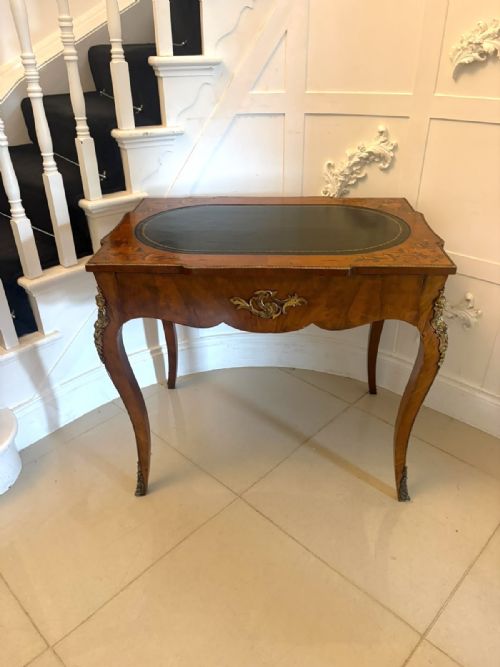
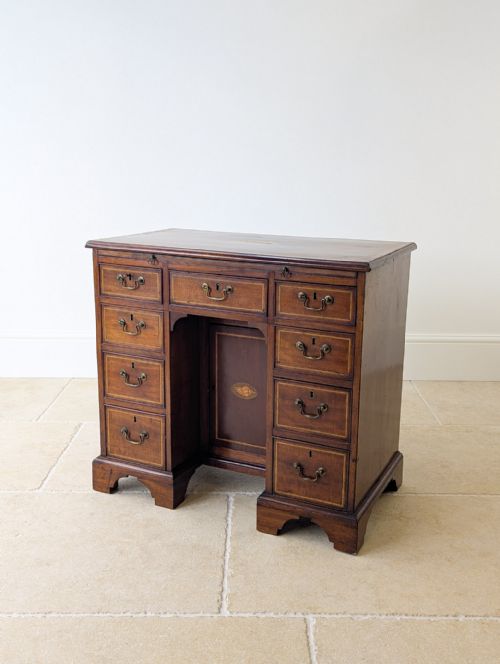
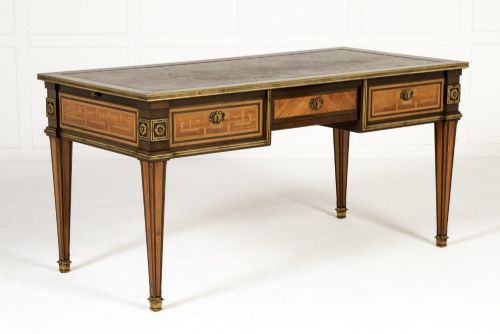
The varieties on this page span pedestal desks, kidney-shaped writing tables, and freestanding bureau plat models. Makers constructed them in mahogany, walnut, rosewood, and satinwood, often incorporating contrasting stringing or elaborate floral marquetry.
Buyers will encounter pedestal formats featuring banks of drawers alongside smaller library tables and specialised Carlton House desks. The decorative vocabulary draws heavily on Sheraton Revival and French Louis styles, utilising brass mounts and leather writing surfaces.
How they were made
Cabinetmakers constructed the carcases using solid timbers like mahogany and walnut, applying quarter-sawn veneers and burr walnut to large flat surfaces. Crossbanding and geometric stringing in satinwood or boxwood provided sharp linear borders around drawers and tops.
Marquetry and parquetry panels required meticulous hand-cutting of diverse wood species to form floral motifs or intricate geometric patterns. Ormolu mounts, brass banding, and leather inserts tooled in gold leaf completed the construction of high-status pieces.
Listings feature nineteen-century and Edwardian pieces, incorporating materials such as amboyna, ormolu, and burr walnut alongside standard mahogany.
What varies in quality
The distinction between standard commercial production and exceptional workshop output rests on the depth of the timbers and the precision of the inlay. Workshops like Edwards & Roberts or Gillows employed thicker veneers and crisper hand-cut stringing that resisted shrinkage.
Hardware selection marks another boundary of quality, separating original brass handles and finely chased ormolu from later replacements. The secondary woods inside drawer linings and the quality of the hand-tooled leather inserts further separate ordinary furniture from masterworks.
Edwards & Roberts·Gill & Reigate·James Shoolbred·Maple & Co·Gillows of Lancaster·Wolfe & Hollander·Donald Ross
The Inlaid Executive Desk Glossary
- Bureau plat
- A freestanding French writing table featuring multiple drawers beneath the top, designed to sit away from a wall. These tables typically display elaborate ormolu mounts and marquetry.
- Crossbanding
- A border of veneer laid around the edge of a tabletop or drawer front so that the grain runs at right angles to the central panel. This technique frames the primary wood and adds visual depth.
- Marquetry
- The art of forming decorative patterns using thin slices of wood, shell, and ivory fitted into a veneer ground. It differs from inlay by assembling the entire design before gluing it to the carcase.
- Pedestal desk
- A heavy office or library desk comprising a central writing surface supported by two independent banks of small drawers. They often feature inset leather tops and plinth bases.
- Satinwood
- A lustrous yellow-gold timber imported from the tropics, widely utilised for stringing, banding, and entire desk surfaces during the Sheraton Revival period. It accepts fine engraving and darkens gracefully with age.
Inlaid Executive Desk: Frequently Asked Questions
What is a Carlton House desk?
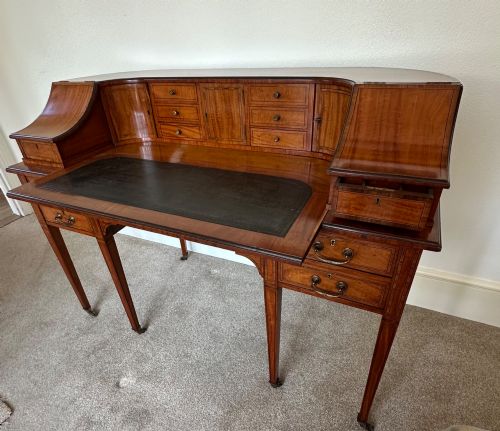
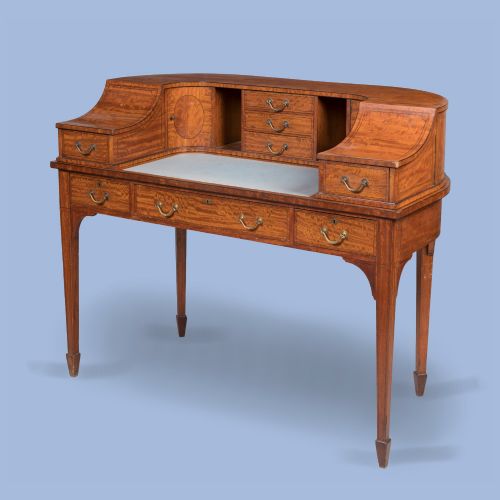
A Carlton House desk is a distinctive writing table featuring a curved superstructure of small drawers and pigeonholes fitted around the back and sides of the writing surface. This layout provides extensive compartmentalised storage while maintaining a compact footprint.
Cabinetmakers during the Edwardian era and late nineteenth century produced refined versions of this form in satinwood and mahogany, often accented with brass handles and inlaid stringing.
How do I distinguish a pedestal desk from a library table?
A pedestal desk incorporates two structural columns of drawers that rest directly on the floor, supporting a top with a central kneehole space. Library tables stand on legs at each corner and generally lack banks of built-in pedestal drawers.
While both forms serve executive workspaces, pedestal desks offer substantial enclosed storage beneath the writing surface, whereas library tables present an open, freestanding architectural profile.
What is the difference between marquetry and inlay?
Inlay involves carving a recess into a solid wood surface and gluing a contrasting piece of material into that channel to create a pattern. Marquetry assembles an entire pictorial or geometric mosaic of veneer sheets on a backing paper before applying the whole assembly to the furniture carcase.
Victorian and Edwardian workshops utilised both techniques, though complex floral displays on tabletops usually represent assembled marquetry.
Are leather writing surfaces original?
Many desks retain their original or early leather inserts, which show authentic signs of age, wear, and patination around the gilt-tooled borders. However, because heavy writing wear damages leather over time, replacement inserts appear frequently on restored pieces.
Inspect the surrounding mahogany or walnut rebate to determine whether a replacement leather sits cleanly within the original wooden borders.